


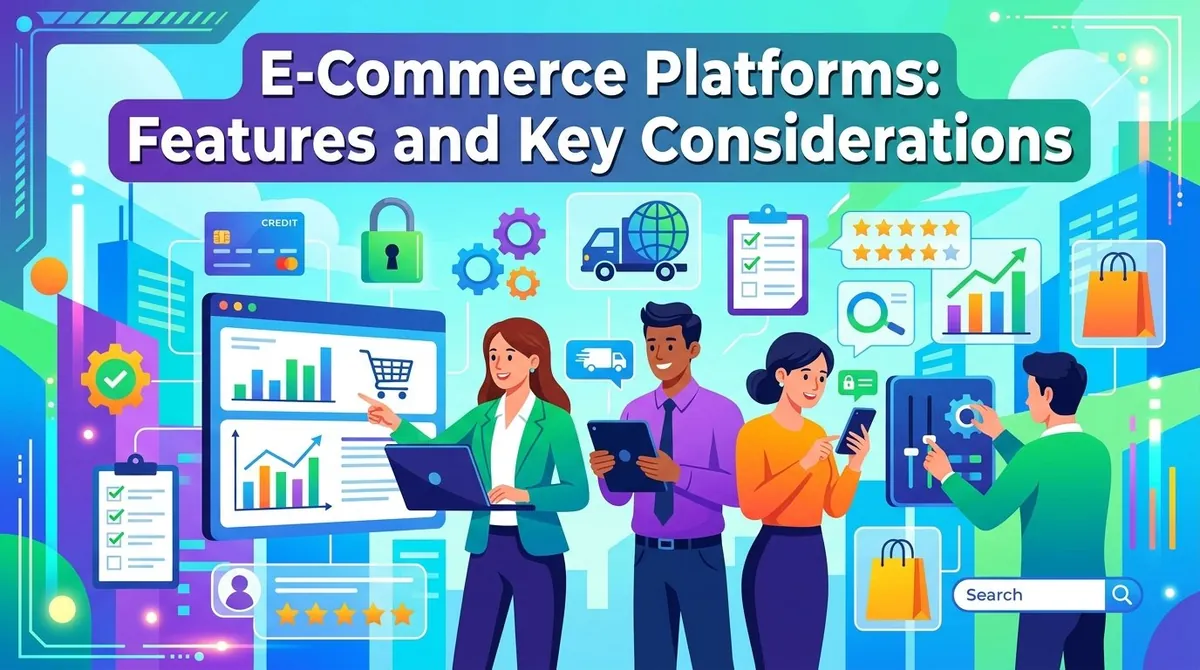
Selling products online requires more than simply creating a website. E-commerce businesses need systems for managing products, processing payments, handling orders, tracking inventory, supporting customers, and protecting transactions.
E-commerce platforms provide the software infrastructure businesses use to build and operate online stores. Depending on the platform, businesses can manage product catalogs, shopping carts, checkout, payments, shipping, customer accounts, marketing, and analytics from one system.
The right platform depends on the business model, product range, sales channels, technical requirements, budget, and plans for growth. Businesses should evaluate both the platform's current capabilities and how well it can support future changes.
What Is an E-Commerce Platform?
An e-commerce platform is software that provides the tools needed to sell products or services online. It can provide the storefront customers see as well as administrative functions for managing products, orders, customers, payments, and other aspects of an online business.
Platforms can support different business models, including business-to-consumer (B2C), business-to-business (B2B), direct-to-consumer (DTC), subscriptions, marketplaces, and digital products.
Some platforms are hosted services where the provider manages much of the technical infrastructure. Others provide more control over hosting, customization, and software configuration.
Shopify describes an e-commerce platform as software that helps businesses build online stores, manage products, process payments, and handle other elements of online selling. (shopify.com)
Key Features of E-Commerce Platforms
Product Catalog Management
Product-management tools allow businesses to create product listings with names, descriptions, prices, images, variants, specifications, and inventory information.
Businesses with large catalogs may also need bulk editing, product import and export, category management, filters, and search functionality.
Shopping Cart and Checkout
The shopping cart allows customers to select products before completing a purchase. Checkout functionality collects information such as shipping details and payment information.
A straightforward checkout process can reduce unnecessary steps between product selection and purchase. Businesses should also consider whether the platform supports guest checkout, multiple payment methods, discounts, taxes, and different shipping options.
Payment Processing
E-commerce platforms generally integrate with payment gateways or processors so businesses can accept online payments.
Available payment methods can include credit and debit cards, digital wallets, bank-based payments, and other region-specific options. Shopify, for example, provides integrations and payment capabilities through Shopify Payments as well as third-party payment providers. (shopify.com)
Businesses should review transaction fees, supported currencies, payment methods, fraud controls, and geographic availability.
Inventory Management
Inventory-management features help businesses monitor product availability across online stores and other sales channels.
More advanced platforms can support inventory locations, stock transfers, low-stock notifications, purchase orders, and synchronization between physical and online stores.
Accurate inventory information can help reduce overselling and improve fulfillment planning.
Order Management
Order-management functionality allows businesses to view, process, fulfill, cancel, refund, and track customer orders.
Businesses selling through multiple channels may also need centralized order management so orders from websites, marketplaces, social commerce channels, and physical locations can be handled consistently.
Shipping and Fulfillment
E-commerce platforms can connect businesses with shipping carriers and fulfillment services. Features may include shipping-rate calculations, labels, tracking, delivery options, and fulfillment status.
The available functionality varies by platform and geographic market, so businesses with complex logistics should evaluate these capabilities carefully.
Customer Management
Customer-management tools can maintain information such as contact details, order history, preferences, and account information.
This information can support customer service, personalized marketing, loyalty programs, and repeat-purchase strategies.
Analytics and Reporting
E-commerce analytics can provide information about sales, orders, customers, products, traffic, conversion rates, and other business metrics.
Google Analytics can also be integrated with many e-commerce websites to provide additional information about website traffic and customer behavior. (support.google.com)
Marketing and SEO
Many platforms include tools for creating discounts, promotions, email campaigns, product feeds, and other marketing activities.
Search-engine optimization features can help businesses manage product titles, descriptions, URLs, metadata, structured information, and other elements that affect how online stores are discovered.
Types of E-Commerce Platforms
Hosted E-Commerce Platforms
Hosted platforms provide the software and infrastructure through a managed service. Businesses typically pay a subscription and use the provider's administrative interface to operate the store.
This model can reduce the technical work involved in hosting, maintaining, and updating an e-commerce system.
Open-Source Platforms
Open-source e-commerce software provides greater control over the underlying application and can allow extensive customization.
However, businesses may need to manage hosting, security, updates, integrations, and technical maintenance themselves or through a development partner.
Headless E-Commerce
Headless commerce separates the customer-facing presentation layer from the underlying commerce system.
This architecture can provide greater flexibility for businesses that want to create customized shopping experiences across websites, mobile applications, kiosks, or other digital channels.
It can also require more technical resources than a conventional hosted storefront.
Benefits of E-Commerce Platforms
An e-commerce platform can centralize many of the systems required to operate an online store.
Potential benefits include:
- Centralized store management: Products, orders, customers, and inventory can be managed from one environment.
- Automated transactions: Payments, order confirmations, and other processes can be automated.
- Multi-channel selling: Some platforms allow businesses to sell through websites, marketplaces, social channels, and physical stores.
- Scalability: Platforms can support businesses as product catalogs, orders, and customer numbers grow.
- Analytics: Businesses can monitor sales and customer activity through reporting tools.
- Integration: E-commerce systems can connect with accounting, CRM, marketing, inventory, and fulfillment applications.
The actual benefits depend on the platform's capabilities and how effectively the business configures and manages its store.
Key Considerations When Choosing an E-Commerce Platform
Business Model
The platform should match the organization's selling model. A company selling a small number of consumer products may have different requirements from a B2B business with negotiated pricing, wholesale accounts, and complex ordering processes.
Product and Catalog Complexity
Consider the number of products, variants, categories, attributes, and inventory locations the business needs to manage.
Large catalogs may require advanced search, bulk management, product import tools, and sophisticated inventory functionality.
Payment and Geographic Support
Businesses operating internationally should examine supported currencies, payment methods, countries, languages, and tax requirements.
Payment processing fees and third-party transaction fees should also be included when calculating the total cost.
Integrations
E-commerce stores often need to connect with accounting software, ERP systems, CRM platforms, marketing tools, shipping providers, marketplaces, and inventory systems.
Strong integration capabilities can reduce manual data entry and help keep information synchronized.
Security
Online stores process customer and payment information, making security an important consideration. Businesses should evaluate authentication, access controls, encryption, platform security practices, payment security, and available fraud-prevention tools.
The Payment Card Industry Security Standards Council provides the PCI DSS framework for organizations that store, process, or transmit payment card information. (pcisecuritystandards.org)
Mobile Experience
A significant portion of online shopping takes place through mobile devices. Businesses should evaluate how the platform handles responsive storefronts, mobile checkout, page performance, and mobile administration.
Total Cost
Platform costs can include subscriptions, payment processing, transaction fees, premium themes, applications, hosting, development, integrations, and maintenance.
Businesses should calculate the expected total cost rather than comparing subscription prices alone.
Examples of E-Commerce Platforms
The e-commerce market includes platforms designed for different business sizes and technical requirements. Examples include Shopify, BigCommerce, Adobe Commerce, WooCommerce, and Wix eCommerce.
Shopify provides hosted commerce capabilities, while Adobe Commerce offers a more customizable platform for organizations with complex commerce requirements. WooCommerce operates as an e-commerce solution integrated with WordPress. BigCommerce provides tools for online stores and B2B commerce.
Businesses should compare platforms according to their product catalog, business model, technical resources, integrations, geographic requirements, and expected growth rather than selecting a platform solely based on popularity.
Final Thoughts
E-commerce platforms provide the infrastructure businesses need to sell products and services online, manage orders, process payments, track inventory, and support customers. Their capabilities can range from straightforward storefront tools to highly customizable commerce systems supporting complex operations.
Before selecting a platform, businesses should define their selling model, product requirements, payment needs, integrations, security expectations, and budget. Evaluating the total cost and technical requirements can help ensure that the chosen platform supports both current operations and future expansion.