


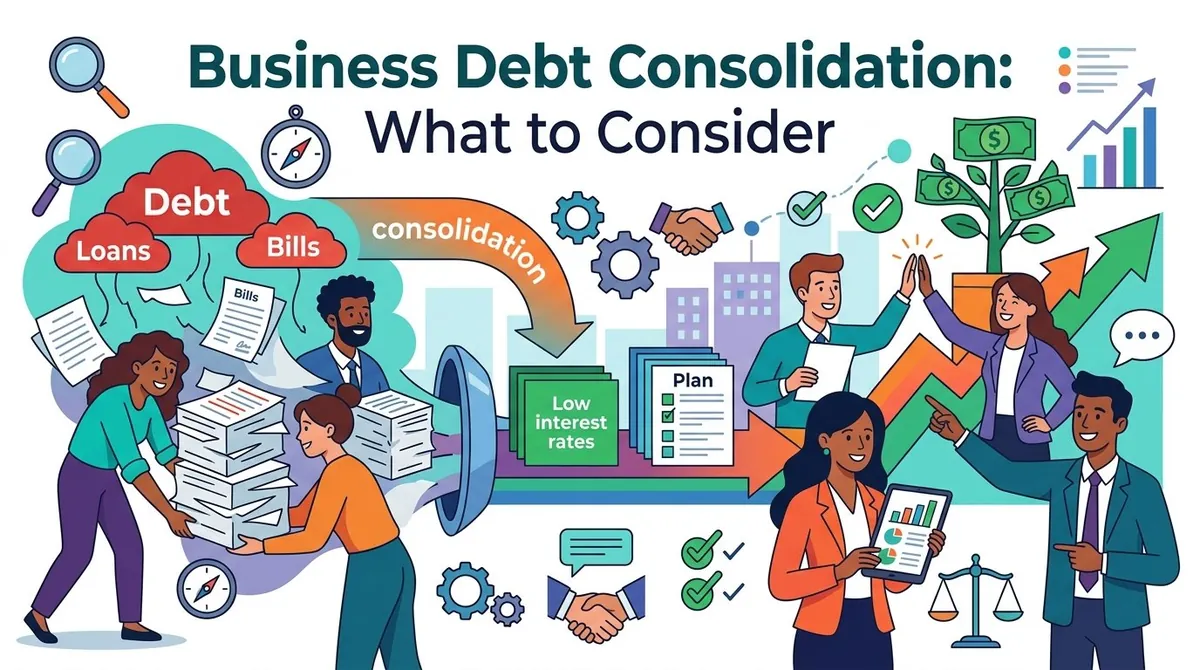
Businesses often use multiple forms of financing to manage operating expenses, purchase equipment, fund expansion, or cover temporary cash-flow gaps. Over time, these obligations can become difficult to manage when they have different interest rates, payment schedules, fees, and lenders.
Business debt consolidation is one approach that may allow a company to replace multiple debt obligations with a single financing arrangement. The goal is generally to simplify repayment, potentially reduce financing costs, or create a payment structure that better matches the company's cash flow.
However, consolidation does not automatically make debt less expensive. Businesses need to compare the full cost of the new financing, understand its terms, and determine whether their financial position can support the new payment.
What Is Business Debt Consolidation?
Business debt consolidation involves using new financing to pay off multiple existing business debts. Instead of making several payments to different creditors, the business makes payments on one consolidated loan or financing facility.
For example, a company might have a business credit card balance, equipment loan, short-term loan, and business line of credit. If eligible, the company could obtain a consolidation loan and use the proceeds to pay some or all of those obligations.
The potential advantages include:
- Simplified repayment: Multiple payments can become one scheduled payment.
- Potentially lower interest costs: A new loan may have a lower rate than some existing debts.
- Improved cash-flow management: A longer repayment period may reduce monthly payments.
- More predictable financing: Fixed-rate financing can make future payments easier to forecast.
The actual benefit depends on the terms available and the business's existing debt.
When Might Consolidation Make Sense?
Debt consolidation may be worth evaluating when a business has several high-cost obligations and can qualify for financing with more manageable terms.
One important consideration is whether the new financing actually improves the overall financial position. A lower monthly payment alone does not necessarily mean the debt is cheaper. A longer repayment period can reduce monthly payments while increasing the total interest paid over the life of the loan.
Businesses should first create a complete list of existing obligations, including:
- Outstanding balance
- Interest rate or factor rate
- Monthly payment
- Remaining repayment period
- Prepayment penalties
- Origination or other fees
- Collateral or personal guarantees
This provides a baseline for comparing a consolidation offer.
Key Factors to Consider
Interest Rate and Total Cost
The interest rate is one of the most important factors, but it should not be considered in isolation. Businesses should calculate the total repayment cost of the new financing, including interest and fees.
A consolidation loan with a lower advertised rate may still be expensive if it includes substantial origination fees or a significantly longer repayment period.
Monthly Cash Flow
The new payment should fit realistically within the company's cash flow. "A business's ability to repay is an important consideration" in securing financing, according to the U.S. Small Business Administration.
Review several months of revenue, operating expenses, existing debt payments, and cash reserves before taking on the new obligation. Businesses with seasonal revenue should also consider whether payments remain manageable during slower periods.
Loan Term
A longer term can make monthly payments more manageable, but it can also increase the amount of interest paid over time.
For example, refinancing several short-term obligations into a longer-term loan could provide immediate cash-flow relief. The business should then compare that relief against the total cost and the additional period during which it will remain in debt.
Fees and Penalties
Businesses should review the complete fee structure before accepting an offer. Potential costs can include:
- Origination fees
- Application fees
- Closing costs
- Late-payment charges
- Prepayment penalties
- Annual or maintenance fees
The SBA recommends asking lenders about "rates, fees, credit requirements, cash-flow requirements, prepayment penalties, and other repayment conditions."
Collateral and Personal Guarantees
Some business financing may require collateral, while other arrangements may require the business owner to provide a personal guarantee.
These requirements can materially change the risk associated with consolidation. Before signing, understand exactly which business assets are securing the loan and whether personal assets could be exposed if the business cannot repay.
What Financing Options Can Be Used?
Businesses may have several potential financing routes, depending on their credit profile, revenue, time in operation, and financing needs.
Traditional bank loans can provide structured repayment terms and may be appropriate for established businesses with strong financial records.
SBA-backed financing is another possibility for eligible U.S. small businesses. The SBA's 7(a) program, for example, can be used for refinancing current business debt, subject to program requirements.
Certain SBA 504 financing can also be used for qualifying debt consolidation or refinancing under specific conditions.
Business lines of credit may provide more flexibility than a conventional consolidation loan, although they may not be suitable for replacing every type of debt.
Alternative lenders may offer faster application processes, but businesses should carefully examine pricing, repayment frequency, collateral requirements, and contractual terms before proceeding.
How Credit and Financial Records Affect Eligibility
Lenders commonly evaluate factors such as business revenue, cash flow, credit history, existing debt, time in business, and the purpose of the financing.
For SBA lending, lenders may consider credit history, financial projections, collateral, and the business's ability to repay.
Business owners should therefore organize financial statements, tax records, bank statements, debt information, and other documentation before applying. Reviewing business and personal credit reports where applicable can also help identify inaccuracies or potential issues before a lender evaluates the application.
Potential Risks of Business Debt Consolidation
Consolidation can simplify repayment, but it does not eliminate the underlying debt.
A business could also face higher total interest costs if the new loan extends repayment substantially. If collateral or a personal guarantee is involved, the consequences of default may also be more significant.
Another risk is accumulating new debt after consolidation. If the original credit cards or lines of credit remain available and the business begins borrowing again, it could end up with both the consolidation loan and new balances.
For this reason, consolidation works best as part of a broader debt-management plan rather than simply moving balances from one lender to another.
How to Compare Consolidation Offers
Before selecting a financing arrangement, compare offers using the same criteria:
- 1Amount available — Is it enough to pay the debts being consolidated?
- 2Interest rate or financing cost — What is the actual cost of borrowing?
- 3Loan term — How long will repayment take?
- 4Monthly payment — Does it fit projected cash flow?
- 5Total repayment — How much will the business pay overall?
- 6Fees — Are there origination, maintenance, or closing costs?
- 7Collateral — What assets secure the financing?
- 8Guarantees — Is a personal guarantee required?
- 9Prepayment terms — Can the business repay early without additional charges?
Comparing these factors can provide a clearer picture than focusing only on the monthly payment or advertised interest rate.
Final Thoughts
Business debt consolidation can simplify debt management and potentially improve cash flow, but the financial benefit depends on the terms of the new financing. A lower payment is not necessarily a lower total cost, and extending repayment can create additional interest expense.
Before consolidating, businesses should inventory their existing obligations, calculate their current financing costs, review cash flow, and compare the complete terms of available options. Understanding fees, collateral, guarantees, repayment periods, and total repayment costs can help a business determine whether consolidation fits its financial objectives.