


Business growth rarely happens through a single customer interaction. People typically move through several stages before becoming customers, from first discovering a company to evaluating its offering, making a purchase, and potentially returning in the future.
The growth funnel provides a framework for understanding this journey. By examining how potential customers move from awareness to revenue, businesses can identify opportunities to improve marketing, sales, customer experience, and overall growth strategy.
What Is a Growth Funnel?
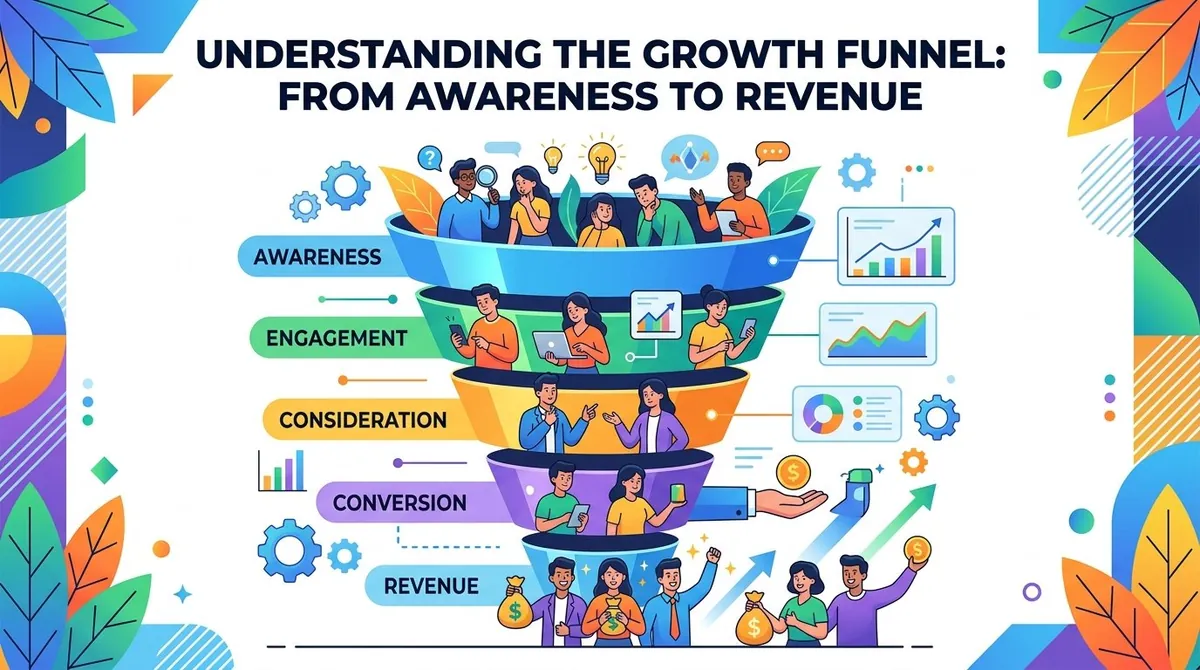
A growth funnel represents the stages a potential customer can move through before and after making a purchase.
While businesses may use different models, a typical funnel includes awareness, consideration, conversion, retention, and advocacy.
At the top of the funnel, a company reaches people who may have little or no previous knowledge of its brand. Further down, potential customers become more engaged, evaluate available options, and eventually make a purchasing decision.
The funnel can therefore help organizations connect marketing and sales activity with measurable business outcomes.
From Awareness to Consideration
The first stage is awareness. Businesses can generate awareness through advertising, search, social media, content, referrals, partnerships, and other channels.
At this stage, the objective is generally to reach relevant audiences and introduce them to the company's products or services.
The next stage is consideration. Potential customers who become interested may visit a website, compare alternatives, read reviews, request additional information, or interact with sales teams.
Understanding how people move between these stages can help businesses determine which channels and messages are generating meaningful interest rather than simply generating traffic.
Turning Interest Into Revenue
The middle and lower stages of the funnel focus increasingly on conversion.
A potential customer may compare pricing, evaluate features, speak with a representative, or complete a trial before deciding whether to purchase.
Businesses can analyze metrics such as conversion rates, customer acquisition costs, average order value, and sales cycle length to understand how effectively prospects are moving toward revenue.
For example, a company may generate substantial website traffic but have a relatively low conversion rate. This could indicate that the business needs to investigate factors such as the offer, pricing, user experience, or audience targeting.
The specific cause needs to be determined through further analysis rather than assumed from a single metric.
Retention and Customer Growth
The growth funnel does not necessarily end when a customer makes a purchase.
Customer retention can influence long-term revenue because returning customers may purchase additional products or services and can reduce the need to continually acquire new customers.
Businesses can monitor metrics such as repeat purchase rates, churn, customer lifetime value, and engagement to understand what happens after conversion.
Customer feedback can also reveal opportunities to improve products, services, onboarding, and support.
This creates a broader view of growth in which revenue comes not only from acquiring new customers but also from maintaining valuable customer relationships.
Measuring the Growth Funnel
Different stages of the funnel require different metrics.
Awareness metrics may include reach, impressions, website traffic, and brand-related searches.
Consideration metrics can include engagement, product-page visits, inquiries, downloads, or trial registrations.
Conversion metrics may include purchases, qualified leads, conversion rates, and revenue.
Retention metrics can include repeat purchases, churn, customer lifetime value, and renewal rates.
Looking at these metrics together can help businesses identify where potential customers are being lost and where improvements may have the greatest practical relevance.
Implementation Roadmap and Best Practices
Organizations can develop a more useful growth funnel strategy by following a structured approach:
- Define each stage: Establish clear criteria for awareness, consideration, conversion, and retention.
- Identify relevant metrics: Choose measurements that reflect meaningful customer actions.
- Connect data sources: Bring marketing, sales, and customer information together where appropriate.
- Analyze conversion points: Determine where significant numbers of potential customers stop progressing.
- Test improvements: Experiment with messaging, offers, channels, or customer experiences.
- Measure revenue impact: Evaluate whether changes improve meaningful business outcomes rather than only intermediate metrics.
A consistent measurement framework can help teams understand how individual activities contribute to broader growth objectives.
Common Challenges
One challenge is focusing too heavily on top-of-funnel metrics. High traffic or engagement does not necessarily translate into customers or revenue.
Another issue is fragmented data. If marketing and sales teams use different systems or definitions, it can become difficult to understand the complete customer journey.
Attribution can also be complicated. Customers may interact with multiple channels before making a purchase, making it difficult to assign the outcome to a single activity.
Finally, funnels are not always linear. Customers can move backward, skip stages, return after periods of inactivity, or interact with several channels at the same time.
The Future of Growth Strategy
Digital platforms and analytics tools are making it easier for businesses to track customer interactions across multiple stages of the growth process.
Organizations can increasingly combine marketing, sales, customer, and financial information to evaluate how activities influence revenue.
Artificial intelligence and automation may also help businesses identify patterns in customer behavior and personalize parts of the customer journey.
However, the fundamental principle remains the same: businesses need to understand how potential customers discover their offerings, evaluate them, become customers, and continue engaging afterward.
Ultimately, the growth funnel connects customer behavior with business outcomes. By measuring the journey from awareness to revenue and continuously evaluating where improvements can be made, organizations can develop a more structured approach to sustainable business growth.
References
- HubSpot. "The Marketing Funnel: What It Is & How It Works."
- Google. "Think with Google."
- McKinsey & Company. "The Consumer Decision Journey."
- Harvard Business Review. "The New Science of Customer Emotions."
- Salesforce. "What Is Customer Journey Mapping?"