


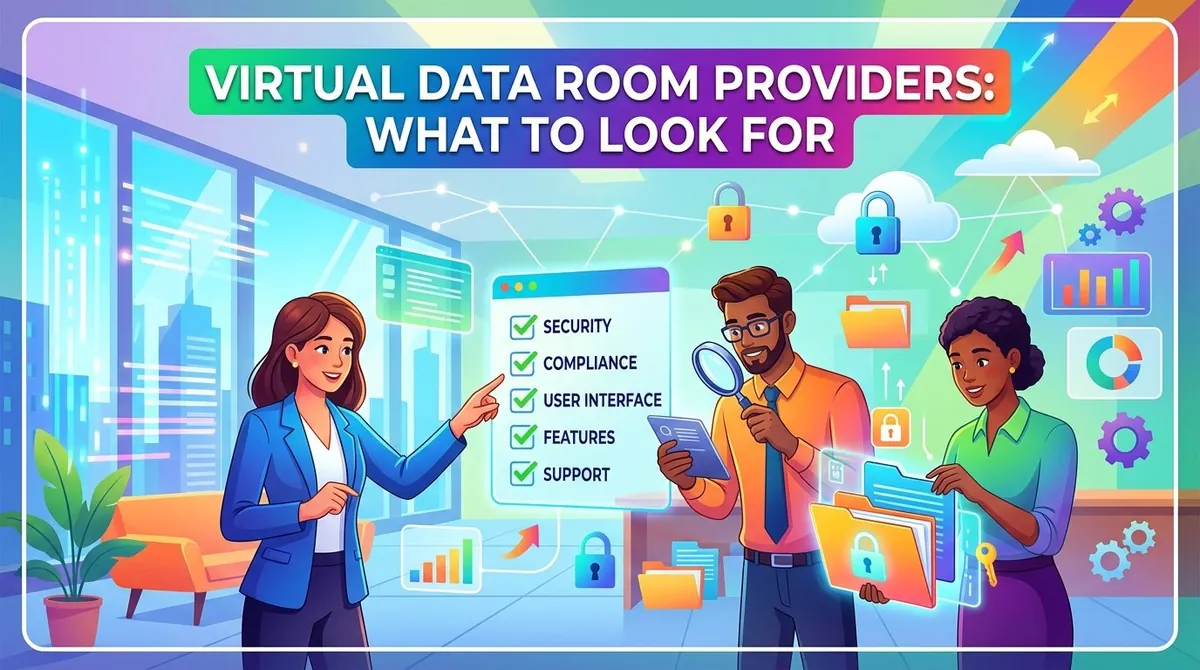
Businesses involved in mergers and acquisitions, fundraising, audits, legal proceedings, and other sensitive transactions often need to share large volumes of confidential documents with external parties. Traditional file-sharing tools may not provide the level of access control, tracking, and transaction-specific organization required for these activities.
Virtual data rooms (VDRs) are secure online environments designed for storing and sharing sensitive documents while controlling who can access them. They are commonly used for due diligence, M&A transactions, capital raising, real estate deals, legal reviews, and other situations where confidential information must be exchanged between multiple parties.
Choosing among virtual data room providers requires more than comparing storage capacity. Organizations should examine security controls, user permissions, document management, audit trails, collaboration features, support, pricing, and the specific requirements of the transaction.
What Is a Virtual Data Room?
A virtual data room is a secure digital workspace used to store, organize, and share confidential business documents. Unlike general-purpose cloud storage, VDRs are designed around controlled information sharing and transaction workflows.
During due diligence, for example, a company may need to provide financial statements, contracts, intellectual property records, employee information, and other documents to potential buyers or investors. A VDR can allow authorized users to review these materials while giving administrators control over access and activity.
VDRs can also provide records showing when documents were viewed, downloaded, or otherwise accessed, creating an audit trail throughout the transaction.
Common Uses for Virtual Data Rooms
VDRs can support several types of business activities.
**Mergers and acquisitions:** Companies can organize documents for buyers, sellers, advisers, and other participants during due diligence.
**Fundraising:** Startups and other organizations can share financial information, business plans, legal documents, and other materials with prospective investors.
**IPO preparation:** Companies preparing for public offerings may use secure document environments to coordinate large collections of financial, legal, and corporate information.
**Legal proceedings:** Law firms and businesses can use VDRs to organize and control access to confidential case documents.
**Real estate transactions:** Property records, financial documents, contracts, inspections, and other materials can be shared with authorized parties.
**Audits and compliance:** Organizations can provide auditors or other reviewers with controlled access to relevant documentation.
The appropriate VDR depends on the type, size, and complexity of the project.
Key Features to Look For
Security and Encryption
Security is one of the most important considerations when evaluating a VDR. Providers may offer encryption for data in transit and at rest, multi-factor authentication, access controls, and other security measures.
For example, Datasite identifies "encryption, granular document permissions, certifications, and detailed audit trails" as key VDR security controls.
Organizations should verify the provider's current security certifications and understand which security features are included in the specific plan being considered.
Granular User Permissions
A VDR should allow administrators to control access at an appropriate level.
Different participants may need access to different folders or documents. A buyer may need to review financial records, while a legal adviser may need access to contracts and intellectual property documentation.
Granular permissions can help organizations limit information according to user roles and transaction requirements.
Audit Trails
Detailed audit logs can record user activity within the data room. Depending on the platform, administrators may be able to see document views, downloads, searches, and other actions.
Audit trails can provide visibility into how confidential information is being accessed and can support transaction management, compliance, and internal review.
Watermarking and Document Controls
Dynamic watermarking can add information such as a user's identity, date, or other identifiers to documents viewed or downloaded from the data room.
Some VDRs also provide controls that restrict downloading, printing, copying, or other actions. Information rights management can provide additional control over documents after they have been distributed. Intralinks, for example, describes information rights management as "a feature that can help organizations revoke access to protected files after distribution."
Document Organization
Large transactions can involve thousands of files. VDRs should therefore make it easy to upload, organize, search, index, and retrieve documents.
Bulk upload, automatic indexing, folder structures, search functions, and document versioning can reduce administrative work and make due diligence easier to manage.
Q&A Management
Many transactions involve questions from buyers, investors, auditors, or legal advisers.
A structured Q&A system allows participants to submit questions and enables administrators or authorized team members to assign, answer, and track them within the data room. This can keep transaction-related communication organized rather than scattering questions across email threads.
Reporting and Analytics
VDR reporting tools can provide information about user activity and document engagement.
For example, transaction teams may be able to see which documents have been reviewed, which users have accessed the room, and which areas of the data room receive the most attention.
These insights can help administrators understand the progress of a review without relying entirely on manual updates.
AI Features in Virtual Data Rooms
Some VDR providers now incorporate artificial intelligence into document workflows. Depending on the platform, AI may assist with document summaries, sensitive-information detection, redaction, document categorization, translation, or question answering.
Intralinks, for example, describes AI capabilities for "summarization, document insights, Q&A, and sensitive-information detection."
AI features can potentially reduce manual review work, but organizations should examine how the provider handles confidential information, permissions, data retention, and AI-generated results before using these tools in sensitive transactions.
How to Evaluate Virtual Data Room Providers
Organizations should start by defining the transaction rather than comparing providers based only on feature lists.
Important considerations include:
- Transaction type: Is the VDR intended for M&A, fundraising, real estate, legal work, or another use?
- Document volume: How many files and how much storage will be required?
- Users: How many internal and external participants need access?
- Permissions: How detailed do access controls need to be?
- Security: Which certifications, encryption standards, and authentication controls are required?
- Q&A: Does the transaction require structured question management?
- Reporting: What activity and document-use information needs to be tracked?
- Support: Is live or dedicated support available during critical transaction periods?
- Pricing: Is pricing based on storage, users, projects, duration, or another model?
A provider that works well for a small fundraising process may not have the same workflow requirements as a large cross-border acquisition.
Pricing and Contract Considerations
VDR pricing models vary significantly. Some providers use project-based pricing, while others offer subscriptions, storage-based pricing, or custom enterprise agreements.
Organizations should look beyond the initial price and ask about additional storage, extra users, extended project periods, implementation services, and other potential charges.
It can also be useful to determine whether a provider offers a trial, demonstration environment, or sample project before signing a contract.
Examples of Virtual Data Room Providers
The VDR market includes providers with different approaches to transaction management and security.
**Datasite** provides VDR and transaction-management solutions designed for activities such as M&A and due diligence. Its platform includes document security, access controls, audit trails, and AI-related capabilities.
**Intralinks** offers VDR solutions for M&A, capital markets, and other complex transactions, with features including access controls, audit reporting, watermarking, and AI-assisted document workflows.
**Firmex** provides VDR software for transactions, due diligence, compliance, and legal document review. Its documented features include permissions, watermarking, activity reporting, and Q&A functionality.
**iDeals** provides VDR software for M&A, due diligence, fundraising, and other transactions, with features including granular permissions, Q&A, watermarking, and audit capabilities.
These examples illustrate the range of solutions available. Organizations should evaluate providers according to their own transaction requirements rather than selecting a platform solely because of its size or feature count.
Final Thoughts
Virtual data room providers offer secure environments for sharing confidential information during transactions and other sensitive business activities. Features such as encryption, granular permissions, audit trails, watermarking, document organization, Q&A workflows, and reporting can help organizations manage controlled information sharing.
When evaluating a VDR, businesses should consider the specific transaction, number of users, document volume, security requirements, workflow needs, support options, and pricing structure.
A practical evaluation should also include a review of the provider's current security documentation and a test of the platform's usability. Choosing a VDR that fits the actual transaction can help teams organize information effectively while maintaining appropriate control over sensitive documents.