


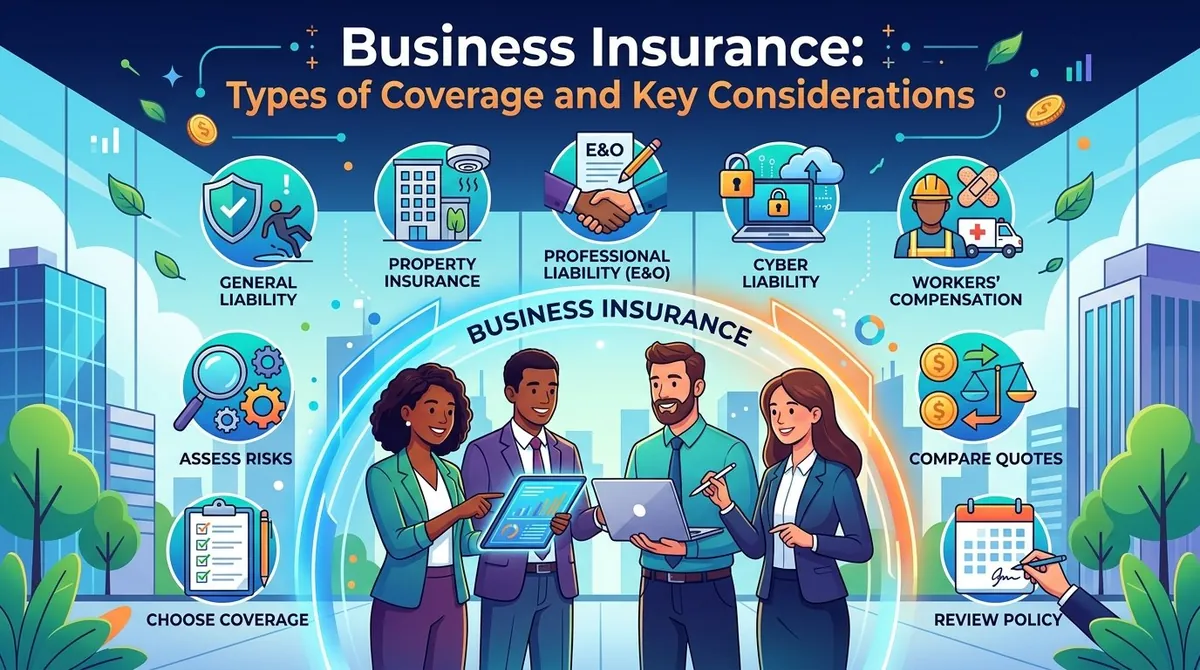
Businesses face a range of risks, from property damage and customer injuries to employee-related claims, vehicle accidents, professional mistakes, and interruptions to normal operations. Without appropriate insurance, a major unexpected event can create significant financial pressure.
Business insurance provides financial protection against specific risks covered by a policy. The appropriate coverage depends on factors such as the company's industry, location, employees, property, vehicles, customers, and contractual obligations.
Insurance requirements also vary by jurisdiction. Some types of coverage may be legally required, while others are optional but potentially important based on the business's risk profile. The U.S. Small Business Administration recommends that businesses assess their risks and compare coverage, terms, and prices when purchasing insurance.
What Is Business Insurance?
Business insurance refers to a range of insurance policies designed to protect companies from financial losses associated with covered risks. A business may purchase individual policies or combine several types of coverage into a package.
Commercial insurance generally includes two broad areas: property coverage, which protects business assets against covered losses, and liability coverage, which addresses certain claims that a business is legally responsible for causing harm to other people or their property.
The policies a business needs depend on its activities. A retailer, construction company, consultant, restaurant, and technology company can have very different exposures.
Common Types of Business Insurance
General Liability Insurance
Commercial general liability insurance can protect a business against certain claims involving bodily injury, property damage, and personal or advertising injury arising from business operations.
For example, a customer could be injured on business premises, or an employee could accidentally damage a customer's property while performing a service. General liability coverage can help with covered legal defense costs and damages, subject to policy terms and limits.
General liability does not cover every type of business risk. Professional errors, employee injuries, and certain cyber, pollution, and other exposures may require separate coverage.
Commercial Property Insurance
Commercial property insurance protects covered business property against specified risks. Depending on the policy, this can include buildings, equipment, inventory, furniture, computers, machinery, and other physical assets.
Businesses should review which causes of loss are covered and which are excluded. Certain risks, such as floods, may require separate policies.
Workers' Compensation Insurance
Workers' compensation insurance is designed to cover employees who suffer qualifying work-related injuries or illnesses. Coverage can include medical expenses and a portion of lost wages, subject to applicable laws and policy provisions.
Requirements vary by state and can depend on factors such as the number of employees and business structure. Businesses should check the requirements applicable to their location rather than assuming the same rules apply everywhere.
Professional Liability Insurance
Professional liability insurance, sometimes called errors and omissions (E&O) insurance, can protect businesses that provide professional services or advice against certain claims involving errors, negligence, or failure to perform professional services as expected.
It can be particularly relevant for consultants, accountants, technology professionals, architects, and other service providers. Professional liability is generally separate from standard general liability coverage.
Business Auto Insurance
Businesses that own or use vehicles for commercial purposes may need business auto insurance. Coverage can address certain liabilities and physical damage involving covered business vehicles.
Companies should also consider how employees use personal vehicles for business purposes, because a personal auto policy may not provide the same coverage for commercial activities.
Business Interruption Insurance
A covered event can sometimes prevent a business from operating normally even when the company's physical property is insured. Business interruption insurance can provide coverage for certain income losses and additional expenses resulting from a covered disruption, depending on the policy.
The Insurance Information Institute notes that business interruption coverage may help replace lost income after events such as fires or other catastrophes that interrupt operations.
Cyber Insurance
Businesses increasingly depend on digital systems and store sensitive customer, employee, or financial information. Cyber insurance can provide coverage for certain losses associated with cyber incidents, depending on the policy.
Potential exposures can include data breaches, ransomware, business interruption, notification expenses, and third-party claims. Cyber coverage should be evaluated separately because standard general liability policies may not cover many cyber-related risks.
Product Liability Insurance
Businesses that manufacture, distribute, wholesale, or sell products may face claims if a product causes injury or property damage.
Product liability insurance can provide protection against certain covered claims. The SBA identifies product liability as a common type of coverage for businesses involved in manufacturing, wholesale, distribution, or retail.
Business Owners' Policies
A business owners' policy (BOP) combines several types of coverage into one package, commonly including commercial property, general liability, and business interruption coverage.
BOPs are often designed for small and midsize businesses with relatively straightforward risks. They do not automatically replace every type of insurance a business may need. For example, professional liability, workers' compensation, and commercial auto coverage generally require separate policies.
A BOP can simplify insurance administration, but businesses should still examine its exclusions, limits, deductibles, and available endorsements.
Key Considerations When Choosing Business Insurance
Assess Business Risks
Start by identifying the risks associated with the company's activities. Consider the physical location, equipment, inventory, employees, vehicles, customers, professional services, digital systems, and contractual responsibilities.
The SBA recommends assessing potential accidents, natural disasters, lawsuits, and other events that could cause significant financial losses.
Review Coverage Limits
A policy's coverage limit determines the maximum amount the insurer will pay for covered losses under specified circumstances. Businesses should consider whether their limits are appropriate for the potential size of a claim.
Choosing limits solely based on price can leave a company with substantial exposure if a major claim exceeds available coverage.
Understand Deductibles
A deductible is the amount the insured generally pays before the insurer contributes toward a covered loss. Higher deductibles can sometimes reduce premiums, but they also increase the amount the business must be prepared to pay after a claim.
Check Exclusions
Insurance policies do not cover every possible event. Exclusions can significantly affect the protection a policy provides.
Businesses should review exclusions, endorsements, waiting periods, and conditions rather than relying only on the policy's name or general description.
Consider Contracts and Legal Requirements
Some customers, landlords, lenders, licensing authorities, or business partners may require specific insurance coverage or minimum limits.
Businesses should also verify legally required coverage with the relevant government authorities. Insurance requirements can vary by state and business circumstances.
Review Coverage Regularly
Insurance needs can change as a company grows. New employees, vehicles, equipment, locations, products, services, or contracts can create different risks.
The SBA recommends reassessing insurance coverage as business circumstances change rather than simply renewing the same policies indefinitely.
Comparing Business Insurance Options
Businesses can obtain insurance through agents, brokers, or directly from insurers, depending on the market and available products. When comparing options, consider coverage, limits, exclusions, deductibles, premiums, endorsements, claims service, and insurer financial strength.
It can also be useful to obtain multiple quotes with comparable coverage. A lower premium does not necessarily represent equivalent protection if another policy has broader coverage or higher limits.
For businesses with complex risks, an insurance professional can help identify potential gaps and determine which specialized policies may be appropriate.
Final Thoughts
Business insurance can help protect companies against financial losses arising from covered property, liability, employee, vehicle, professional, and operational risks. There is no single insurance package that fits every business, because coverage requirements depend heavily on the company's activities and risk profile.
Businesses should identify their major exposures, determine which coverage is legally required, review policy limits and exclusions, and compare the total cost of available options. Insurance should also be reassessed as the business changes so that coverage continues to reflect its current operations and risks.
References
- U.S. Small Business Administration — Business Insurance
- U.S. Small Business Administration — Rethinking Insurance Coverage
- Insurance Information Institute — Commercial General Liability Insurance
- Insurance Information Institute — Types of Commercial Insurance Policies
- Insurance Information Institute — Small Business Insurance Basics