


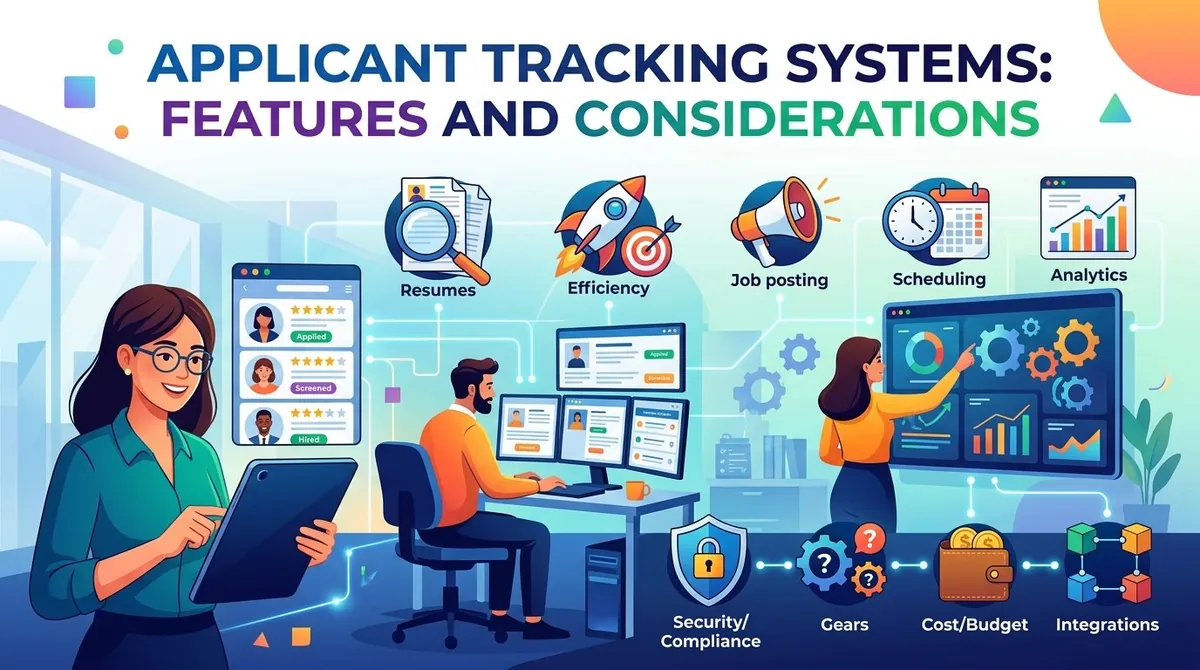
Recruiting can involve job postings, applications, resume reviews, interviews, candidate communication, approvals, and hiring decisions. As the number of open positions and applicants increases, managing these activities through spreadsheets, email, and separate tools can become difficult.
Applicant tracking systems (ATS) are designed to organize and manage the recruitment process in one centralized platform. They can store candidate information, track applicants through different hiring stages, support collaboration, and provide reporting on recruitment activity.
The features available vary between platforms, from basic application tracking to automated workflows, interview management, analytics, integrations, and AI-assisted recruiting tools. Businesses should evaluate these capabilities based on their hiring volume, workflow, team structure, and data requirements.
What Is an Applicant Tracking System?
An applicant tracking system is software used to manage candidates throughout the hiring process. An ATS can collect applications, store candidate information, track application status, and organize recruiting activities in a centralized database.
A typical ATS can support the process from creating a job requisition and publishing a job to screening candidates, conducting interviews, managing offers, and reporting on hiring activity.
Instead of maintaining candidate information across multiple spreadsheets and email conversations, recruiting teams can use the ATS as a central record of the recruitment process.
Key Features of Applicant Tracking Systems
Job Posting and Distribution
Many ATS platforms allow recruiters to create job postings and distribute them through company career pages and external job boards. This can reduce the need to manually publish the same position across multiple channels.
Some platforms also provide tools for creating branded career pages and application forms.
Candidate Database
An ATS typically stores candidate profiles containing information such as resumes, contact details, application history, interview notes, and hiring-stage information.
Search and filtering capabilities allow recruiters to find candidates based on criteria such as skills, experience, education, tags, or previous interactions.
Resume Parsing and Screening
Resume parsing can extract information from candidate resumes and organize it into structured profiles. This can reduce manual data entry when recruiters process large numbers of applications.
Some modern systems also offer AI-assisted candidate screening or profile summaries. These tools vary significantly between vendors, so businesses should understand how automated recommendations are generated and what human review remains necessary.
Candidate Pipeline Management
ATS platforms generally organize candidates according to stages in the recruitment process. Typical stages may include application review, phone screening, interviews, assessment, offer, and hired.
Recruiters and hiring managers can use the pipeline to see where candidates are in the process and identify applications that require action.
Interview Scheduling
Interview scheduling features can help coordinate interviews between candidates, recruiters, and hiring managers. Depending on the platform, this may include calendar synchronization, self-scheduling, automated reminders, and integrations with video-conferencing tools.
Interview Kits and Scorecards
Structured interview tools allow organizations to establish consistent evaluation criteria. Interview kits can provide interviewers with predefined questions, while scorecards allow interviewers to record feedback against specific criteria.
This can make feedback easier to organize and compare across candidates.
Candidate Communication
Many ATS platforms include email or messaging functionality for communicating with applicants. Recruiters may be able to use templates for common communications such as interview invitations, status updates, follow-ups, and rejection messages.
Centralizing communication can also make it easier for recruiting teams to see previous interactions with a candidate.
Reporting and Analytics
Recruiting analytics can provide information about the hiring pipeline and recruitment performance. Depending on the system, reports may cover:
- Number of applicants
- Candidates by hiring stage
- Time spent in each stage
- Source performance
- Interview activity
- Offer acceptance
- Time-to-fill
- Hiring funnel conversion
These reports can help organizations identify bottlenecks and understand how candidates move through the recruitment process.
Integrations
An ATS may integrate with calendars, job boards, HR systems, background-check providers, assessment platforms, video-interviewing tools, and other recruiting applications.
Integration capabilities are particularly important when a business already has an established HR technology stack.
Benefits of an Applicant Tracking System
Centralized Recruiting Information
An ATS provides a central location for candidate information, hiring stages, interview feedback, and related recruiting activities. This can reduce the need to search through multiple systems.
Reduced Administrative Work
Automation can reduce repetitive tasks such as sending reminders, scheduling interviews, moving candidates through predefined workflows, and creating standardized communications.
Improved Team Collaboration
Recruiters, hiring managers, interviewers, and HR teams can access relevant candidate information within the same system. This can reduce back-and-forth communication and make responsibilities clearer.
Better Recruitment Visibility
Reporting provides organizations with a view of hiring activity and pipeline performance. Managers can use this information to identify delays and monitor recruitment progress.
More Consistent Hiring Processes
Standardized workflows, interview kits, and scorecards can help organizations establish consistent processes across roles and recruiting teams.
Applicant Tracking Systems and Recruiting CRMs
An ATS and a recruiting CRM can serve different purposes.
An ATS generally focuses on managing candidates through the hiring process after they enter the recruitment pipeline. A recruiting CRM is more focused on proactive sourcing, talent pools, candidate relationships, and engaging potential applicants before they formally apply.
Some recruiting platforms combine both functions, while others integrate an ATS with a separate CRM.
Key Considerations When Choosing an ATS
Hiring Volume
A small business hiring occasionally may have different requirements from an organization managing hundreds or thousands of applications. Consider the number of open positions, applicants, recruiters, and hiring managers who will use the system.
Workflow Customization
Recruiting processes differ between organizations. Look for an ATS that can accommodate the company's approval stages, interview structures, hiring workflows, and reporting requirements.
Ease of Use
An ATS may be used by recruiters as well as hiring managers and interviewers. A complicated interface can make adoption more difficult, so usability should be evaluated for everyone who will interact with the system.
Integrations
Review whether the platform connects with the tools already used by the organization, including calendars, HR software, job boards, assessment systems, communication tools, and onboarding platforms.
Security and Data Management
Candidate records contain sensitive personal information. Businesses should examine access controls, data retention, audit trails, security practices, and data-export capabilities before selecting a platform.
AI and Automation
AI features can assist with tasks such as resume summarization, candidate matching, screening, and workflow automation. Businesses should evaluate these features carefully, including transparency, human oversight, governance, and how candidate data is handled.
Total Cost
Pricing may include more than the basic subscription. Businesses should consider implementation, data migration, additional users, integrations, support, API access, and optional features when estimating the total cost of an ATS.
Examples of Applicant Tracking Systems
Several established HR and recruiting platforms offer ATS functionality.
Greenhouse provides applicant tracking, structured hiring tools, interview kits, scorecards, recruiting analytics, integrations, and workflow management.
Workable offers applicant tracking alongside candidate sourcing, talent CRM capabilities, interview tools, reporting, automated actions, integrations, and HR features.
The appropriate platform depends on an organization's hiring process, technology environment, budget, and data requirements.
Final Thoughts
Applicant tracking systems can help organizations centralize candidate information, manage recruiting workflows, coordinate interviews, automate repetitive activities, and analyze hiring performance.
The most important considerations extend beyond the number of available features. Businesses should examine usability, workflow flexibility, integrations, security, reporting, AI governance, implementation requirements, and total cost.
A carefully selected ATS can provide a structured foundation for recruiting while giving hiring teams greater visibility into the candidate pipeline and the overall hiring process.