


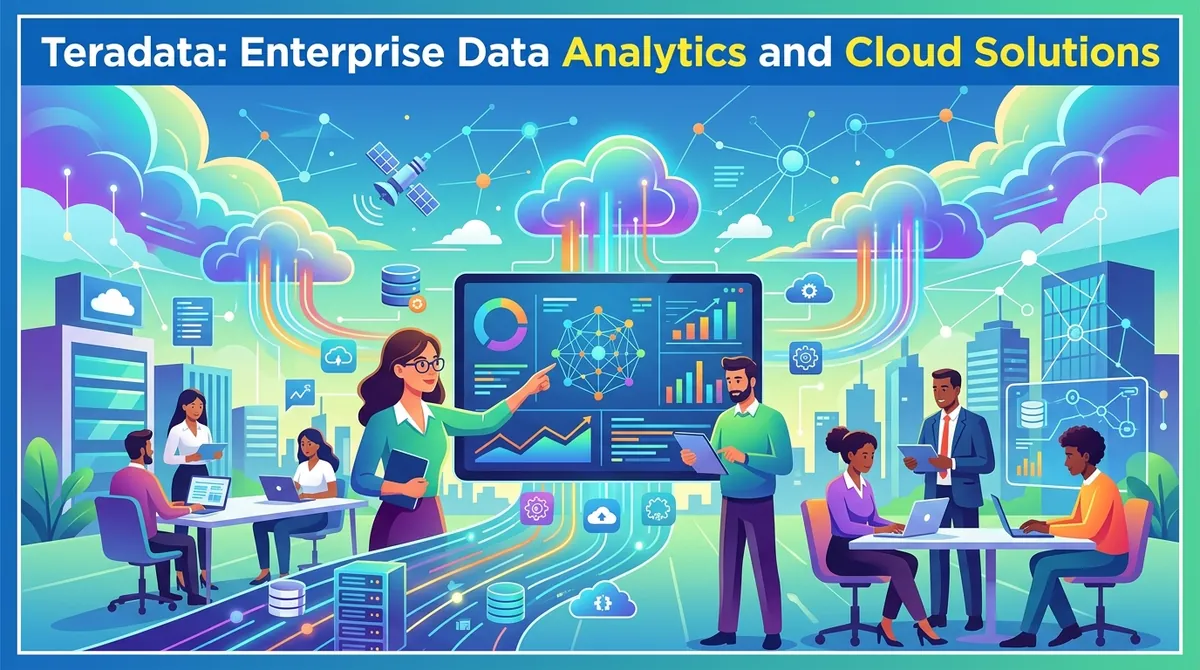
Large organizations often need to analyze information across finance, customer operations, supply chains, marketing, and other business functions. Teradata provides an enterprise data and analytics platform designed to help organizations consolidate information, run large-scale analytical workloads, and use data for artificial intelligence and machine learning.
Teradata's current portfolio centers on VantageCloud, its cloud analytics and data platform. The company describes VantageCloud as a flexible environment for enterprise analytics that can operate across public clouds and support complex workloads at scale.
Teradata has also expanded its focus on AI. Its platform provides capabilities for preparing data, developing analytical models, operationalizing AI, and connecting enterprise information with generative AI and large language model technologies.
What Is Teradata?
Teradata is an enterprise data analytics company that provides cloud and data-platform technologies for large-scale analytical workloads.
Its VantageCloud platform is designed to bring data together from different sources and provide a common environment for SQL analytics, data engineering, machine learning, and AI. Teradata supports deployment through public cloud environments while also providing capabilities for hybrid and multi-cloud architectures.
The platform is particularly focused on organizations with large datasets, complex analytical workloads, and requirements for governed enterprise data.
Teradata VantageCloud
VantageCloud is Teradata's cloud analytics platform.
The platform provides analytical processing, data management, workload management, and integration capabilities in a managed cloud environment. Teradata supports deployment on major cloud providers, including AWS, Microsoft Azure, and Google Cloud.
VantageCloud is designed to allow organizations to run multiple workloads against shared enterprise data while managing resources according to analytical requirements.
The platform supports both modern cloud architectures and organizations transitioning from established Teradata environments.
Key Teradata Analytics Features
Enterprise Data Warehousing
Enterprise data warehousing remains an important part of Teradata's architecture.
Organizations can consolidate structured business information and make it available for SQL queries, reporting, dashboards, and advanced analytics. Teradata's architecture is designed to support large volumes of data and concurrent analytical workloads.
A centralized analytical environment can provide a common foundation for departments that would otherwise maintain separate datasets.
SQL Analytics
Teradata supports SQL as a primary interface for analytical workloads.
Analysts and data engineers can use SQL to query information, create transformations, aggregate data, and build analytical processes. Teradata also supports advanced analytical functions through its broader analytics environment.
SQL compatibility can be particularly important for organizations with existing analytical applications, BI tools, and data-engineering teams.
Data Integration
Teradata can integrate data from enterprise applications, cloud services, databases, files, and other environments.
The platform supports data ingestion and movement through integration technologies and partnerships with major cloud and data-management providers. Teradata also provides connectivity to cloud storage and external data environments.
This allows organizations to build analytical environments that incorporate information from multiple operational systems.
Teradata and Artificial Intelligence
AI has become a central part of Teradata's current strategy.
The platform provides capabilities for preparing enterprise data for AI, developing machine-learning models, and deploying analytical applications. Teradata emphasizes the importance of trusted enterprise data as a foundation for AI initiatives.
Its AI capabilities support both traditional machine learning and newer generative AI use cases.
Teradata also provides ClearScape Analytics, a collection of analytical functions and tools designed to help data scientists and analysts perform advanced analytics directly within the data environment.
ClearScape Analytics
ClearScape Analytics provides analytical functions for data scientists and developers working with Teradata.
The environment includes statistical analysis, machine learning, time-series analysis, and other analytical functions. By performing analysis close to the data, organizations can reduce the need to move large datasets into separate analytical environments.
This approach can be useful for organizations working with large datasets where repeatedly extracting information for external processing would create additional complexity.
Teradata and Generative AI
Teradata has expanded its platform to support generative AI and large language model applications.
Organizations can use enterprise data with generative AI applications while maintaining governance and security controls. Teradata's approach includes capabilities for connecting enterprise data with external and proprietary AI models.
The company has also developed partnerships and integrations with major cloud and AI providers to support enterprise AI architectures.
The objective is to allow organizations to combine proprietary business information with AI capabilities without treating the underlying enterprise data as a separate system.
Multi-Cloud and Hybrid Analytics
Many enterprises operate across multiple cloud providers or maintain a combination of cloud and on-premises infrastructure.
Teradata supports multi-cloud architectures through VantageCloud deployments across AWS, Azure, and Google Cloud.
This can allow organizations to select cloud environments based on existing infrastructure, regional requirements, application dependencies, or other enterprise considerations.
Hybrid architectures can also help organizations transition gradually from traditional data environments to cloud analytics.
Data Governance and Security
Enterprise analytics platforms need controls that determine who can access information and how data is managed.
Teradata provides governance and security capabilities within its VantageCloud environment, including access controls, authentication, auditing, encryption, and policy-based management.
Teradata also emphasizes governance as part of its AI strategy. Organizations can apply controls to enterprise data while making information available to approved analytical and AI workloads.
These capabilities can be important when analytics involve financial information, customer records, employee data, or other sensitive business information.
Teradata for Different Business Functions
- Finance: Finance organizations can use Teradata for financial reporting, profitability analysis, forecasting, risk analysis, and other large-scale analytical workloads.
- Marketing: Marketing teams can combine customer, campaign, and behavioral information to analyze customer segments and marketing performance.
- Sales: Sales organizations can analyze revenue, customers, product performance, and regional trends through centralized enterprise data.
- Supply Chain: Supply-chain teams can use analytics to investigate demand, inventory, suppliers, logistics, and operational performance.
- Customer Analytics: Organizations can consolidate customer information to support segmentation, personalization, retention analysis, and customer-value modeling.
Teradata Pricing
Teradata does not publish one universal price for its enterprise analytics platform. Pricing depends on factors such as deployment model, cloud provider, compute requirements, storage, workloads, and contract arrangements.
VantageCloud is offered through consumption and subscription structures, allowing customers to select configurations according to their analytical requirements. Teradata also provides pricing information through its sales organization rather than presenting a single standardized public rate.
Organizations evaluating costs should consider compute consumption, storage, data movement, users, implementation, migration, administration, and AI workloads.
How Businesses Evaluate Teradata
Organizations considering Teradata can examine several areas:
- Data scale: Determine whether workloads involve large datasets or high analytical concurrency.
- Cloud architecture: Review requirements across AWS, Azure, Google Cloud, or hybrid environments.
- Analytics: Evaluate SQL, advanced analytics, machine learning, and BI requirements.
- AI: Consider generative AI, machine learning, and enterprise AI use cases.
- Data integration: Identify the databases, applications, cloud services, and other sources that need to connect.
- Governance: Review security, access controls, auditing, data policies, and AI governance.
- Migration: Consider the effort required to move existing Teradata or other data warehouse workloads into the target environment.
- Cost: Model compute, storage, cloud infrastructure, data movement, implementation, and ongoing administration.
Final Thoughts
Teradata combines enterprise data warehousing, cloud analytics, advanced analytics, machine learning, and AI capabilities within its VantageCloud platform. Its architecture is designed for organizations managing large and complex analytical environments across cloud and hybrid infrastructure.
The platform's AI strategy also places greater emphasis on preparing enterprise information for machine learning and generative AI applications. For organizations evaluating Teradata, important considerations include data scale, cloud architecture, analytical workloads, AI requirements, governance, migration complexity, and total cost.