


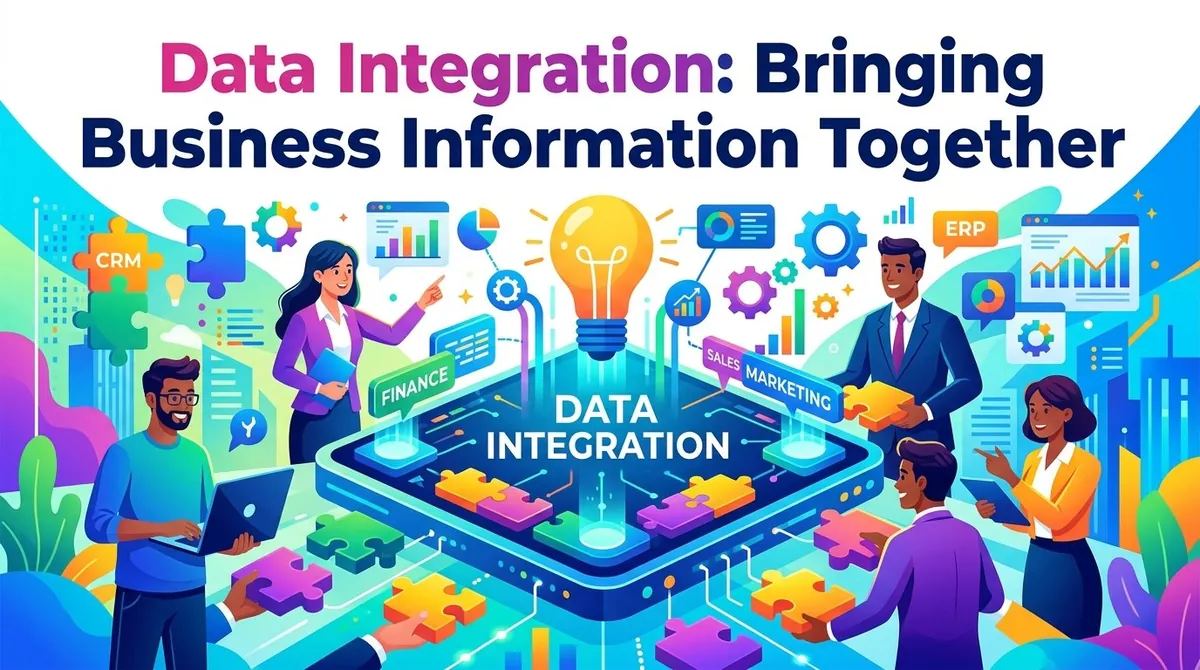
Modern businesses generate information across many systems. Sales platforms, customer databases, financial software, marketing tools, websites, and operational systems can all contain valuable information, but keeping these sources separate can make it difficult to develop a complete view of business performance.
Data integration provides a way to bring information from different sources together so that organizations can analyze it more efficiently. By connecting business data across systems, companies can reduce information silos, improve reporting, and create a stronger foundation for data-driven decision-making.
What Is Data Integration?
Data integration is the process of combining information from different sources so it can be accessed, analyzed, and used together.
For example, a company might maintain customer information in a CRM system, transaction records in an accounting platform, and website activity in an analytics tool. Data integration can connect these sources so teams can examine customer activity alongside purchasing and financial information.
The goal is not necessarily to place every piece of information into one system. Instead, effective integration allows relevant data to move between systems or become accessible through a shared analytical environment.
Why Businesses Need Integrated Data
When important information is distributed across disconnected systems, employees may have to manually combine reports or switch between different platforms to understand business performance.
This can create duplicated work and make it harder to maintain consistent definitions for important metrics.
Integrated information can provide a more complete view of customers, operations, and financial performance. For example, combining sales and customer data can help businesses understand which customer groups generate the most revenue and how purchasing behavior changes over time.
This broader perspective can support more informed analysis and reduce reliance on isolated datasets.
Common Approaches to Data Integration
Organizations can use different approaches depending on their systems and analytical requirements.
ETL (Extract, Transform, Load) involves extracting information from source systems, transforming it into a suitable format, and loading it into a target environment such as a data warehouse.
ELT (Extract, Load, Transform) loads information into the target environment first and performs transformations afterward. This approach is increasingly common with modern cloud data platforms.
APIs can allow different applications to exchange information directly. Businesses may use APIs to connect software applications and transfer relevant data between them.
Data warehouses and data lakes can provide centralized environments for storing information from multiple sources and supporting analytics at scale.
The appropriate approach depends on factors such as data volume, system architecture, business requirements, and technical resources.
Data Integration for Business Analytics
Integrated data can strengthen business analytics by giving analysts access to information from multiple parts of an organization.
Consider a company analyzing customer profitability. Sales data alone may show how much a customer purchased, while financial information can provide details about margins and costs. Customer service records might provide additional information about support activity.
Combining these sources can create a more complete picture than analyzing each dataset independently.
Integration can also support dashboards and reporting by allowing different business metrics to be analyzed from consistent and connected sources.
Implementation Roadmap and Best Practices
Organizations planning a data integration strategy can begin with a focused approach:
- Identify important data sources: Determine which systems contain information needed for key business decisions.
- Define common standards: Establish consistent definitions, formats, and rules for important data.
- Improve data quality: Address duplicate, missing, outdated, or inconsistent information.
- Choose the right architecture: Select integration methods that fit the organization's systems and analytical requirements.
- Establish governance: Define responsibilities for data access, security, quality, and maintenance.
- Monitor integration processes: Check that information continues to move accurately between connected systems.
Starting with high-value use cases can help organizations demonstrate the benefits of integration before expanding across the wider business.
Common Challenges
One of the main challenges is data quality. Information collected by different systems may use different formats, naming conventions, or definitions, making it difficult to combine without additional preparation.
Legacy systems can create another challenge. Older applications may not have modern integration capabilities and may require additional technical solutions.
Security and access controls also need to be considered. Bringing more information together can increase its usefulness, but organizations need appropriate controls to protect sensitive business and customer information.
Finally, integration is not simply a technical project. Business teams need to agree on how information should be defined and used. Without consistent processes and ownership, technical connections alone may not produce reliable business data.
The Future of Data Integration
Cloud computing, automation, APIs, and modern data platforms are changing how businesses connect information.
Organizations can increasingly integrate information from cloud applications, internal systems, websites, and other sources without relying entirely on manual processes. Automated pipelines can also help keep analytical environments updated as new information becomes available.
As businesses adopt more artificial intelligence and advanced analytics, reliable integration becomes increasingly important. Analytical systems need access to relevant and well-structured information to produce useful results.
Ultimately, data integration helps businesses bring fragmented information together so it can be analyzed as a more complete resource. By reducing data silos, improving consistency, and connecting information across departments, organizations can build a stronger foundation for business analytics and more informed decision-making.
References
- IBM. "What Is Data Integration?"
- Microsoft. "What Is Data Integration?"
- Oracle. "What Is Data Integration?"
- AWS. "What Is Data Integration?"
- IBM. "What Is a Data Warehouse?"
- Microsoft. "What Is Business Intelligence?"