


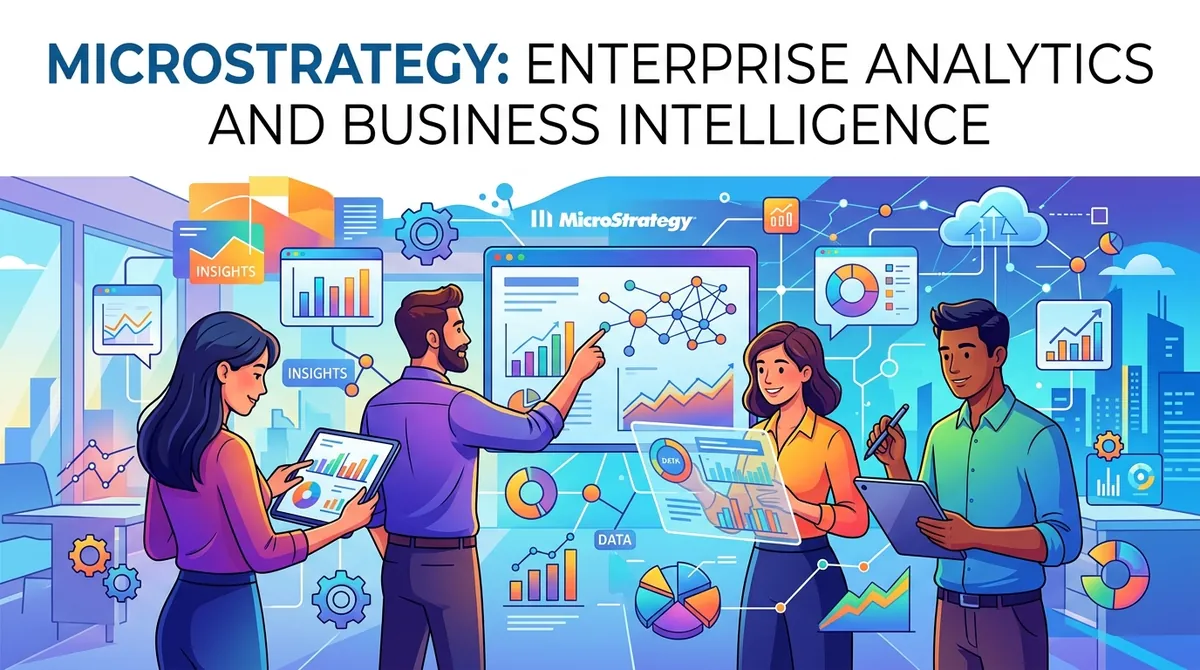
Enterprise organizations often need analytics platforms that can support thousands of users, standardized reporting, interactive dashboards, and governed access to business data. MicroStrategy has historically been positioned around these requirements, providing enterprise business intelligence, reporting, analytics, and data visualization capabilities.
The company now operates under the Strategy name, and its current platform is presented as the Strategy Intelligent Enterprise platform. However, MicroStrategy remains a widely used name for the company's business intelligence technology and is still relevant when researching its enterprise analytics products.
The platform combines governed analytics with self-service capabilities, allowing organizations to create standardized metrics and dashboards while giving business users tools for exploring information and generating insights.
What Is MicroStrategy?
MicroStrategy is an enterprise analytics and business intelligence platform designed to help organizations turn data into reports, dashboards, visualizations, and analytical applications.
Its architecture has traditionally emphasized centralized governance, reusable business definitions, scalable analytics, and support for large enterprise deployments. The platform includes capabilities for reporting, dashboard development, data analysis, mobile access, and embedded analytics.
The current Strategy platform continues this focus while adding AI-enabled business intelligence capabilities.
Key MicroStrategy Business Intelligence Features
Enterprise Reporting
Enterprise reporting is a core capability of the platform. Organizations can create highly formatted reports, scorecards, dashboards, and operational documents for different departments and audiences.
The reporting environment supports detailed layouts and pixel-perfect documents, making it suitable for organizations that require standardized reports rather than only interactive visualizations.
Reports can be distributed to users through the platform's web and mobile experiences.
Interactive Dashboards
MicroStrategy provides interactive dashboards for monitoring KPIs and exploring business information.
Dashboard authors can combine visualizations, filters, metrics, and other analytical components into applications designed around specific business processes. Users can then interact with the information to investigate trends or drill into underlying details.
The current Strategy environment includes Workstation for administrators and dashboard authors, while Library provides a web-based environment where business users can view dashboards and documents, filter data, and collaborate.
Data Modeling and Governed Metrics
A major feature of enterprise BI platforms is the ability to create reusable definitions for business information.
MicroStrategy's architecture has traditionally emphasized centralized metadata and governed metrics so that different reports and dashboards can use consistent definitions. This can help organizations avoid situations where separate departments calculate the same KPI differently.
Governed metrics can be particularly important for financial reporting, executive dashboards, sales performance, and other areas where consistency matters.
Advanced Data Analysis
MicroStrategy supports analytical workflows that go beyond static reporting.
Its analytical architecture includes capabilities for filtering, drilling, calculations, derived metrics, and multidimensional analysis. Historical MicroStrategy documentation describes Intelligent Cubes as shared in-memory datasets that allow users to manipulate analytical views while retaining the ability to drill through to the underlying warehouse.
These capabilities allow business users to investigate information interactively instead of requesting a separate report for every analytical question.
Data Visualization
Visualization capabilities allow organizations to turn business data into charts, graphs, tables, scorecards, and dashboards.
Users can customize visualizations and apply filters to focus on specific regions, products, customers, departments, or time periods. Analysts can also combine multiple visual elements into applications intended for recurring business analysis.
The current Strategy platform continues to emphasize dashboards as a central interface for business users and analysts.
HyperIntelligence and Zero-Click Analytics
One distinctive capability associated with MicroStrategy is HyperIntelligence.
The technology is designed to provide contextual information through cards that "surface relevant business information without requiring users to navigate to a separate dashboard first."
This approach can be useful when employees need quick access to customer, product, account, or other business information during their normal workflows.
MicroStrategy's training materials continue to describe HyperIntelligence as part of its zero-click analysis capabilities.
AI-Powered Business Intelligence
The current Strategy platform incorporates AI into business intelligence workflows.
Its AI-enabled capabilities include conversational interactions with business data, automated answers, dashboard creation assistance, and customized AI applications. Strategy's training materials describe Auto Answers, Auto Dashboard, and Auto Bot as components of its AI-enabled BI environment.
Natural-language interaction can make analytics more accessible to business users who may not have experience writing queries or constructing complex reports.
AI functionality can also assist analysts by reducing some of the manual work involved in creating analytical content.
Mobile Analytics
Enterprise analytics increasingly needs to be accessible outside traditional desktop environments.
MicroStrategy has supported mobile access as part of its broader BI architecture, allowing users to view dashboards, documents, and analytical applications from mobile devices. The current Strategy ecosystem continues to provide dedicated application experiences for business users.
Mobile access can be particularly useful for executives, sales teams, field employees, and managers who need current information while away from their desks.
Embedded Analytics
MicroStrategy can also be used to incorporate analytics into other applications.
Embedded analytics allows organizations to deliver dashboards, reports, and analytical functionality within existing business applications or customer-facing software.
This approach can help companies provide analytics as part of an operational workflow rather than requiring users to open a separate BI application.
MicroStrategy's enterprise architecture has historically included SDK and embedding capabilities for organizations developing customized analytical applications.
Enterprise Scalability and Administration
Large organizations often require more than visualization functionality. They also need centralized administration, performance management, authentication, and system availability.
MicroStrategy's enterprise architecture has included Intelligence Server as a central component responsible for analytical processing, communication with data warehouses, workload management, and scalability. Its platform also provides administrative and monitoring capabilities for enterprise deployments.
Current Strategy documentation continues to emphasize enterprise administration, APIs, and cloud-environment management.
Security and Governance
Security and governance are important when business intelligence is deployed across departments and large user populations.
MicroStrategy supports controlled access to analytical content and data through enterprise administration, authentication, permissions, and governance mechanisms.
Its ability to establish reusable metrics and centralized analytical objects can also help organizations maintain consistent definitions across reports and departments.
These capabilities are particularly relevant when BI environments contain financial, customer, operational, or employee information.
MicroStrategy for Different Business Functions
- Finance: Finance teams can use enterprise reporting and dashboards to monitor revenue, expenses, profitability, budgets, and financial KPIs.
- Sales: Sales departments can analyze pipeline activity, revenue, customer performance, and regional results.
- Marketing: Marketing teams can combine campaign and customer information to evaluate performance and identify trends.
- Operations: Operations groups can monitor KPIs, productivity, inventory, and other operational measures.
- Executive Management: Executives can use centralized dashboards and scorecards to monitor organizational performance and investigate important changes.
MicroStrategy Pricing
Pricing for enterprise Strategy and MicroStrategy deployments is generally dependent on the organization's requirements rather than a single universal public subscription price.
Factors can include users, deployment model, analytical workloads, support requirements, embedded analytics, and enterprise functionality. Strategy also offers separate passes and training products, with its public store currently listing an Analyst Pass at $350 and an Architect Pass at $3,500.
Organizations evaluating the platform should therefore distinguish training costs from the licensing and infrastructure costs associated with a production analytics deployment.
How Businesses Evaluate MicroStrategy
Organizations considering MicroStrategy or the current Strategy platform can examine several areas:
- Enterprise reporting: Determine whether the organization needs highly formatted and standardized reporting.
- Data governance: Review requirements for shared metrics, centralized definitions, and controlled access.
- Scalability: Consider the expected number of users, data volumes, and analytical workloads.
- Self-service analytics: Evaluate how much analysis should be performed directly by business users.
- AI capabilities: Examine natural-language analytics and AI-assisted content creation.
- Embedded analytics: Determine whether analytical functionality needs to be integrated into other applications.
- Deployment: Consider cloud, hybrid, and existing infrastructure requirements.
- Total cost: Include licensing, implementation, administration, training, and ongoing support.
Final Thoughts
MicroStrategy has developed from a traditional enterprise business intelligence platform into the broader Strategy Intelligent Enterprise platform. Its core capabilities remain centered on governed analytics, reporting, dashboards, data visualization, and enterprise-scale deployment, while newer functionality adds AI-assisted analysis and content creation.
For organizations evaluating the platform, the main considerations include reporting complexity, data governance, scalability, user requirements, AI use cases, embedded analytics, deployment architecture, and total cost.
References
- MicroStrategy — Introduction to MicroStrategy and Business Intelligence
- Strategy — Intelligent Enterprise Platform
- Strategy — Workstation and Library
- MicroStrategy — MicroStrategy AI and BI Training
- Strategy — MicroStrategy Cloud Console APIs
- MicroStrategy — Current Product Documentation
- Strategy — Analyst and Architect Passes