


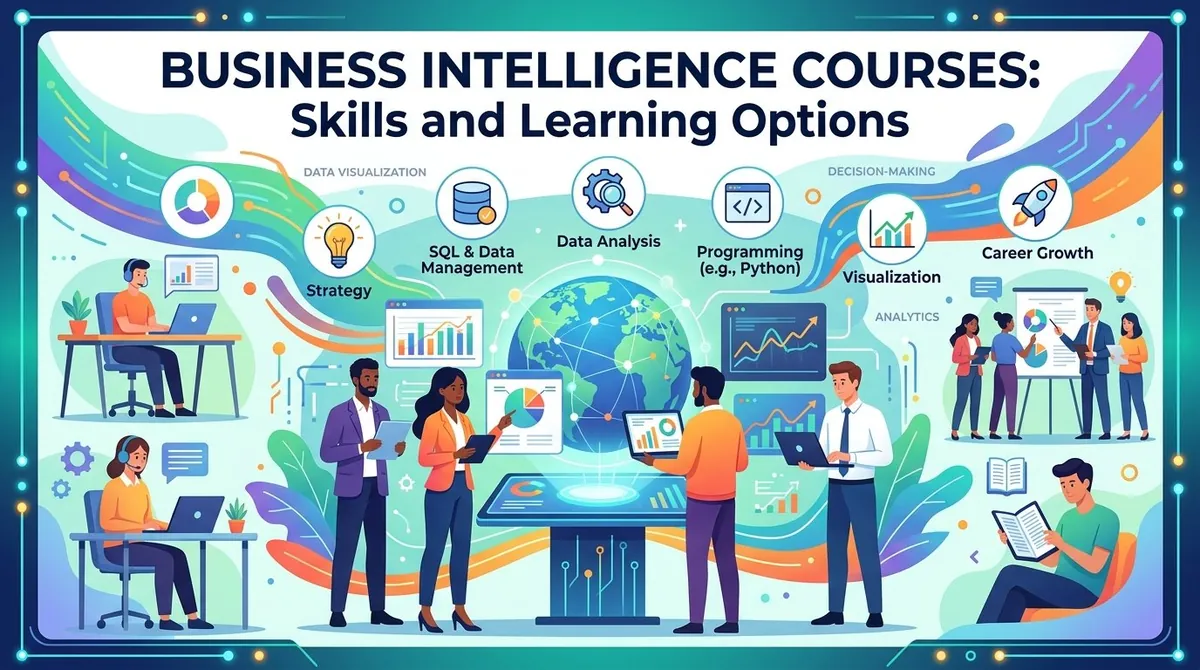
Organizations rely on data to monitor performance, understand customers, evaluate operations, and support business decisions. As companies collect information from more systems, professionals need the ability to turn that information into understandable reports, dashboards, and insights.
Business intelligence (BI) courses provide structured learning in areas such as data analysis, visualization, reporting, databases, SQL, data modeling, and dashboard development. Some courses introduce BI concepts to beginners, while others focus on specific platforms or more advanced analytical techniques.
Learning options range from short online courses and professional certificates to vendor-specific training and university programs. Understanding the skills covered, available formats, and different types of courses can help students and professionals select an option that fits their background and career objectives.
What Are Business Intelligence Courses?
Business intelligence courses teach students how organizations can collect, analyze, visualize, and use data to support business activities. IBM describes BI as a combination of technologies and processes used to collect, manage, and analyze organizational data to generate insights for business strategies and operations. (IBM)
A typical BI course may cover data preparation, querying, reporting, dashboards, data visualization, and analytical methods. More advanced programs can introduce data modeling, data warehouses, ETL processes, and business intelligence architecture.
The level of technical training varies considerably, so students should review course descriptions and learning objectives before enrolling.
Common Skills Taught in BI Courses
Data Analysis
Students learn how to examine datasets, identify patterns, calculate metrics, and interpret business information. Analytical exercises may use sales, financial, marketing, customer, or operational data.
SQL and Databases
SQL is an important skill for professionals who need to retrieve and analyze information from relational databases. Courses may cover queries, joins, filtering, aggregation, and other techniques for working with structured data.
Data Visualization
BI professionals often communicate information through charts, graphs, maps, and dashboards. Courses can teach students how to select appropriate visualizations and present information in a way that makes trends and relationships easier to understand.
Dashboard Development
Dashboards combine multiple metrics and visualizations into an interactive interface. Students may learn how to design dashboards, add filters, organize key performance indicators, and create reports for different audiences.
Data Modeling
Data modeling involves organizing data and establishing relationships between different tables and datasets. More advanced BI courses may teach dimensional modeling, data warehouses, data marts, and other approaches to structuring information for analysis.
ETL and Data Preparation
ETL stands for extract, transform, and load. These processes involve collecting data from sources, transforming it into a usable format, and loading it into a destination system.
Modern BI training may also introduce broader data pipeline concepts and cloud-based data environments.
Types of Business Intelligence Courses
Students can choose from several learning formats depending on their experience and goals.
Beginner BI Courses
Beginner courses generally introduce concepts such as data analysis, spreadsheets, dashboards, reporting, and basic visualization.
These programs can be useful for students, business professionals, or career changers who have limited experience with analytics.
Platform-Specific Courses
Some courses focus on particular BI technologies. Common examples include Microsoft Power BI, Tableau, IBM Cognos Analytics, and Google Looker.
Platform-specific training can be useful for professionals whose employers already use a particular technology.
Professional Certificates
Professional certificate programs typically combine several courses into a structured curriculum. For example, Google's Business Intelligence Professional Certificate covers data modeling, ETL processes, data visualization, dashboard development, SQL, data warehousing, and stakeholder communication. (Coursera)
University and Academic Courses
Universities may offer BI courses within business analytics, information systems, data analytics, or computer science programs. These courses can provide broader theoretical and technical foundations and may form part of a larger degree.
Popular Business Intelligence Learning Options
Several established providers offer BI-related training.
Google: The Google Business Intelligence Professional Certificate includes courses covering data modeling, visualization, dashboards, reporting, ETL, SQL, and data warehousing. Google describes the program as a four-course series that can be completed at an accelerated pace. (Coursera)
Microsoft: Microsoft Learn provides training for Power BI, including learning paths related to data preparation, modeling, visualization, analysis, and reporting. Microsoft's Power BI ecosystem also includes professional certification for data analysts.
Tableau: Tableau provides self-paced learning, instructor-led training, role-based learning paths, and skill assessments. Its analyst learning materials cover areas such as data preparation, calculations, visualization, and dashboards. (Tableau)
IBM: IBM offers BI-related professional learning that can cover SQL, Excel, data management, visualization, reporting, and tools such as Tableau, Cognos Analytics, and Looker. Its BI Analyst Professional Certificate also includes hands-on projects. (IBM)
How to Choose a Business Intelligence Course
The right course depends on the learner's existing knowledge and intended use of BI skills.
Important factors include:
- Experience level: Is the course designed for beginners, intermediate learners, or experienced analysts?
- Curriculum: Does it cover the technical and analytical skills you need?
- Platform: Does it teach Power BI, Tableau, Cognos, Looker, or another tool?
- Projects: Are there practical exercises using real or realistic datasets?
- SQL: Does the course provide database and querying experience?
- Certification: Does the program provide a certificate or prepare learners for an external certification?
- Format: Is it self-paced, instructor-led, online, or classroom-based?
- Cost: Are course materials, exams, software, or subscriptions included?
Students should also consider whether they need general BI knowledge or a specific technology that appears frequently in their target job postings.
Building Practical BI Skills
Completing a course is only one part of developing business intelligence skills. Practical projects can help learners apply concepts and demonstrate their abilities.
A portfolio project might involve importing a dataset, cleaning the information, creating a data model, building a dashboard, and presenting several findings.
For example, a learner could create a sales performance dashboard showing revenue, product categories, regional performance, customer segments, and monthly trends. The project can demonstrate technical skills while also showing whether the learner can connect data to business questions.
Communication is another important skill. A technically accurate dashboard may still be difficult to use if the metrics are unclear or the information is poorly organized.
Career Paths Related to Business Intelligence
BI training can support several career directions.
Business intelligence analyst: Analyzes organizational data and creates reports and dashboards.
Data analyst: Examines datasets, identifies trends, and communicates analytical findings.
BI developer: Builds dashboards, reports, data models, and other BI solutions.
Reporting analyst: Focuses on recurring reports, performance metrics, and business reporting requirements.
Business analyst: Uses data and business information to evaluate processes, requirements, and organizational problems.
More advanced roles may involve data architecture, data engineering, analytics management, or BI administration and require additional technical experience.
BI Courses vs. Data Analytics Courses
Business intelligence and data analytics courses overlap in areas such as SQL, visualization, statistics, and data preparation.
BI courses tend to emphasize reporting, dashboards, business performance, and decision support, while broader data analytics programs may place greater emphasis on statistical analysis, programming, predictive methods, and exploratory analysis.
The distinction is not universal, however. Course content can vary significantly between providers, so reviewing the actual curriculum is more useful than relying only on the course title.
Final Thoughts
Business intelligence courses can provide practical training in data analysis, SQL, visualization, reporting, dashboards, and data modeling. They are available in formats ranging from short introductory classes to professional certificate programs and university coursework.
Students and professionals should choose learning options based on their current skill level, career objectives, preferred technologies, and desired depth of training. A course that includes practical projects can also help learners develop a portfolio that demonstrates how they apply BI tools to real business questions.
As organizations continue to use data across departments, developing both technical and communication skills can help professionals work more effectively with business intelligence systems.