


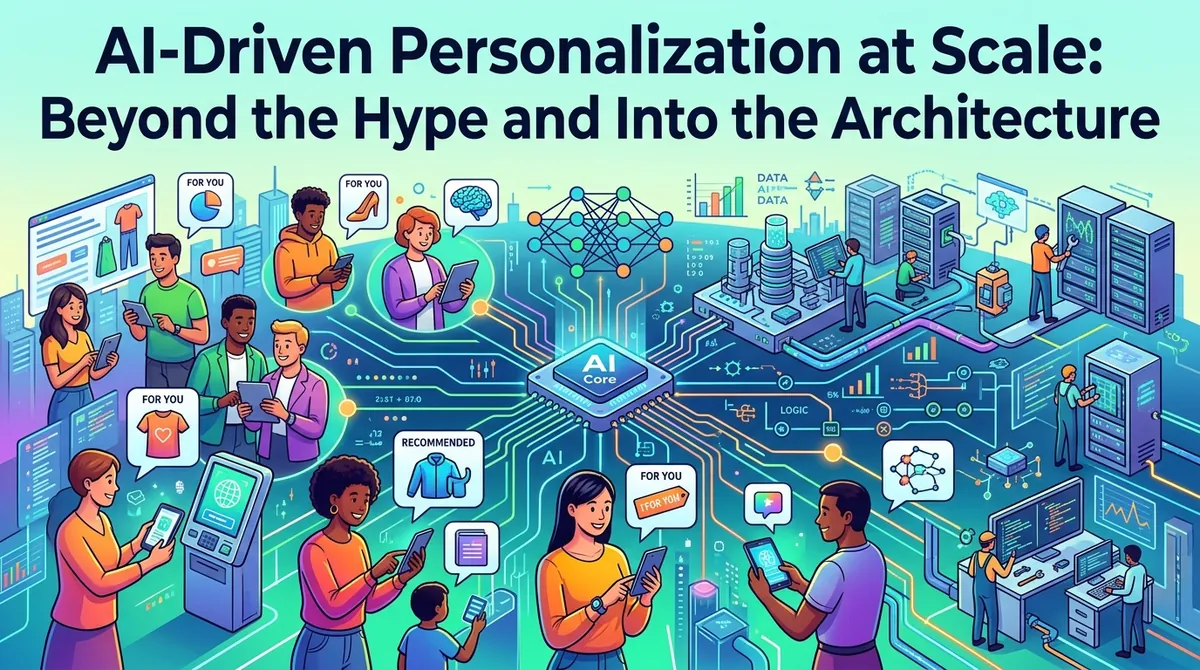
Few concepts in modern tech marketing generate as much enthusiastic hand-waving as "AI-driven personalization at scale."
Open any software vendor's landing page, and you'll see glowing promises of hyper-individualized web experiences, real-time product recommendations tailored to a user's exact psychological state, and dynamic messaging that adapts second-by-second. It sounds like magic. But talk to the engineering and data teams tasked with building these systems, and you hear a very different story: a grueling reality of brittle models, exploding cloud bills, and latency spikes that frustrate users rather than convert them.
The gap between marketing hype and production reality isn't a failure of machine learning algorithms. It is an architectural failure. True personalization at scale cannot be solved by dropping a generic chat widget or an off-the-shelf recommendation plugin onto a front-end website. It requires a robust, low-latency data architecture capable of turning raw behavioral telemetry into immediate, model-driven decisions.
1. The Fallacy of Static Personalization
To understand why traditional personalization engines break down under enterprise scale, we first need to identify what went wrong with legacy approaches.
For years, "personalization" meant static segmentation: rule-based branching logic built on coarse demographic buckets or rigid historical tags (e.g., If user visits from a mobile device and clicked a fitness ad, show them the workout banner). While better than a generic homepage, these systems suffer from severe structural limitations:
- The Latency of Batch Processing: Traditional systems rely on nightly batch ETL jobs to update user profiles. If a customer spends thirty minutes exploring luxury apparel on your site, a batch-based engine won't reflect that intent until the following morning—long after the user has bounced.
- Combinatorial Explosion: As you add more variables—browsing history, cart value, geographical region, time of day, inventory levels—hardcoded rule engines grow exponentially. Maintaining thousands of overlapping "if/then" rules quickly becomes an unmanageable engineering nightmare.
- Lack of Contextual Fluidity: Static segments treat users as monolithic personas. They fail to capture micro-moments—the sudden shift from casual research to urgent purchase intent—because they lack a real-time behavioral feedback loop.
2. The Modern Personalization Pipeline Architecture
Moving from static rules to true AI-driven personalization requires treating user engagement as a continuous, streaming data flow. Rather than querying a bloated relational database on every page load, high-scale architectures rely on a decoupled, four-tier pipeline:
- 1User Browser & App Telemetry: Every click, scroll pause, hover, and cart addition is captured instantly as raw event data.
- 2The Event Stream: Enterprises use distributed event brokers—such as Apache Kafka or Apache Flink—to ingest millions of telemetry events per second without dropping frames or creating server bottlenecks.
- 3Real-Time Stream Processing & Feature Stores: Raw logs are normalized and transformed into model-ready features on the fly. Feature stores (like Feast) and vector databases store high-dimensional embeddings for semantic similarity, computing behavioral features in under 50 milliseconds.
- 4Model Inference Engine: When a user requests a page, the inference engine evaluates the real-time feature vector, scores recommendations through a machine learning model, and serves the personalized asset within a strict sub-100-millisecond window.
3. Designing for the Edge: Balancing Cost and Latency
One of the most common pitfalls in enterprise personalization is running expensive, centralized LLM or deep learning inferences for every minor UI adjustment. Scaling this approach will quickly bankrupt your cloud infrastructure.
Sustainable architecture requires a tiered computation strategy:
- Edge Caching & Heuristics: For anonymous users or low-intent pages, rely on edge workers (like Cloudflare Workers or AWS CloudFront functions) to serve cached variations instantly with zero origin server overhead.
- Asynchronous Deep Personalization: Reserve heavy model inference and generative AI personalization for high-intent moments—such as checkout flows, pricing pages, or logged-in dashboard experiences—where the ROI of precise individualization justifies the compute cost.
- Graceful Degradation: If the personalization model or feature store experiences a latency spike or timeout, the system must instantly fall back to a robust default experience rather than throwing a blank screen or a 500 error at the user.
4. Operationalizing AI Personalization: A Blueprint for Tech Teams
If your organization is planning to move past the marketing hype and build a production-grade personalization engine, follow this roadmap:
- 1Start with Use-Case Clarity: Do not build a generalized "AI personalization platform." Solve a specific, high-impact bottleneck first—such as dynamic product recommendations in cart recovery emails or real-time layout adjustments for high-traffic landing pages.
- 2Unify Your Data Silos: AI models are only as good as the data feeding them. If your CRM data, web telemetry, and transactional databases live in isolated silos, your personalization engine will output fragmented, contradictory experiences.
- 3Monitor Model Drift and Latency: Unlike traditional software code, machine learning models degrade over time as user behavior shifts. Implement rigorous MLOps observability to track prediction drift, feature freshness, and latency bottlenecks continuously.
Conclusion
AI-driven personalization at scale is not a plug-and-play software feature you can buy off the shelf; it is an engineering discipline.
Organizations that treat personalization as a front-end marketing exercise will continue to struggle with bloated cloud costs and disappointing conversion lifts. Conversely, those that invest in clean event-streaming pipelines, low-latency feature stores, and disciplined inference architectures will turn real-time data into a deeply responsive, individualized customer experience. In the modern digital landscape, true intelligence isn't about how much data you collect—it's how fast you can turn an event into an action.