


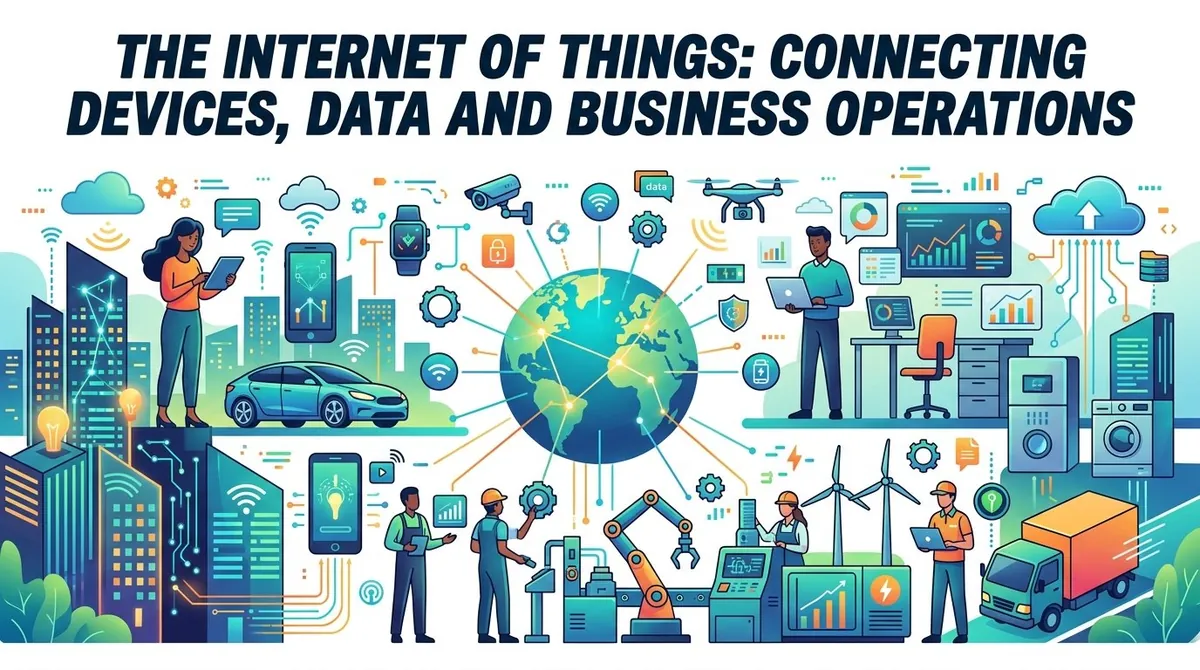
The Internet of Things (IoT) is changing how businesses collect information from the physical world and use it to improve everyday operations. Connected devices can capture information about equipment, products, locations, environmental conditions, and customer activity, creating new sources of data for organizations.
As more devices become connected, businesses can move beyond periodic manual checks toward continuous monitoring and data-driven processes. The value of IoT, however, does not come from connecting devices alone. Organizations need to determine how the resulting information can support practical business objectives.
Understanding the Internet of Things
The Internet of Things describes networks of physical devices equipped with sensors, software, and connectivity that allow them to collect and exchange information. These devices can include industrial equipment, vehicles, appliances, inventory systems, and specialized business hardware.
An IoT system typically involves several components working together. Sensors collect information, connectivity transfers it, software processes the data, and business applications use the resulting information to support monitoring or decision-making.
This creates a connection between physical activity and digital information. A machine, for example, can report operating conditions continuously rather than requiring an employee to inspect it manually at regular intervals.
Turning Connected Devices Into Business Data
The most important output of an IoT system is often the data generated by connected devices. Sensors can collect information such as temperature, movement, location, energy consumption, operating time, or equipment performance.
Businesses can use this information to understand what is happening across their operations in greater detail. Instead of relying only on historical reports, managers may be able to observe current conditions and identify unusual patterns more quickly.
However, large quantities of data do not automatically create useful insight. Organizations need appropriate systems for storing, processing, analyzing, and presenting IoT data so that employees can use it effectively.
Improving Operational Efficiency
IoT can support operational efficiency by giving businesses greater visibility into physical processes. Connected equipment can provide information about utilization, performance, and operating conditions, allowing organizations to identify potential inefficiencies.
For example, a manufacturer could monitor production equipment and compare operating data across different machines or production periods. A logistics company could use connected tracking devices to monitor vehicles and shipments.
These applications can help businesses identify where resources are being used inefficiently and where operational processes may need adjustment.
Predictive Maintenance and Asset Management
Equipment maintenance is another important application of IoT technology. Traditional maintenance schedules may be based on fixed intervals, while connected sensors can provide information about the actual condition of equipment.
By analyzing data such as vibration, temperature, or operating hours, organizations can identify patterns that may indicate developing equipment problems. Maintenance teams can then investigate potential issues before they result in unexpected downtime.
IoT can also improve broader asset management. Businesses can track the location, status, and usage of valuable equipment, helping them understand how physical assets are being utilized.
IoT and Customer Experiences
Connected devices can also influence how businesses interact with customers. Companies can use information from connected products to understand how products are being used and identify opportunities to improve services.
For example, connected products may provide usage information that helps businesses offer more relevant support or maintenance. Retail environments can also use connected systems to monitor inventory and improve product availability.
The use of customer-generated IoT data requires careful consideration of privacy and transparency. Businesses need to understand what information they collect, why it is collected, and how it is protected.
Building an IoT Strategy
Successful IoT adoption requires businesses to connect technology investments with clearly defined operational objectives. Simply installing sensors across an organization can create large amounts of information without necessarily improving performance.
A practical IoT implementation can include:
- Define the business problem: Identify a specific operational challenge that connected devices could help address.
- Select relevant data: Determine which measurements are actually needed to support the intended objective.
- Plan the technology architecture: Consider devices, connectivity, data storage, analytics, and business applications together.
- Establish security controls: Protect connected devices, networks, and the information they generate.
- Measure results: Track changes in efficiency, downtime, maintenance costs, resource utilization, or other relevant outcomes.
Starting with a focused use case can help organizations evaluate the technology before expanding it across larger parts of the business.
Managing IoT Security and Data Challenges
Connecting physical devices to business networks introduces additional security considerations. Each connected device can represent another point that needs to be protected, monitored, and maintained.
Organizations also need to consider data quality and system compatibility. Different devices may use different standards or produce information in different formats, making integration more complicated.
Strong access controls, software updates, network monitoring, and appropriate device management can help reduce these risks. Businesses should also determine how long IoT data needs to be retained and who should have access to it.
Measuring the Business Impact of IoT
IoT projects should be evaluated according to the business problems they are designed to solve. Relevant measures can include equipment downtime, maintenance expenses, energy consumption, production efficiency, inventory accuracy, delivery performance, or asset utilization.
Monitoring these indicators can help organizations determine whether connected technology is producing meaningful operational improvements. It can also reveal which IoT applications are worth expanding.
The financial impact should be considered alongside operational benefits. A connected system may generate substantial information, but its value depends on whether that information leads to better decisions, lower costs, improved service, or other measurable outcomes.
The Future of Connected Business Operations
The Internet of Things is becoming increasingly connected with other areas of digital transformation. IoT-generated information can feed into analytics platforms, cloud infrastructure, automation systems, and artificial intelligence applications.
This combination can create more responsive business operations. Connected devices can capture information, analytics can identify patterns, and automated systems can respond to predefined conditions.
As businesses adopt more connected technology, the focus will increasingly shift from the number of devices deployed to the quality of the systems built around them. Organizations that combine reliable data, secure infrastructure, effective analytics, and clear business objectives can use IoT to create greater visibility across physical operations.
The Internet of Things is therefore not simply about connecting devices. Its broader business value comes from creating a continuous link between physical activity, operational data, and informed decision-making.