


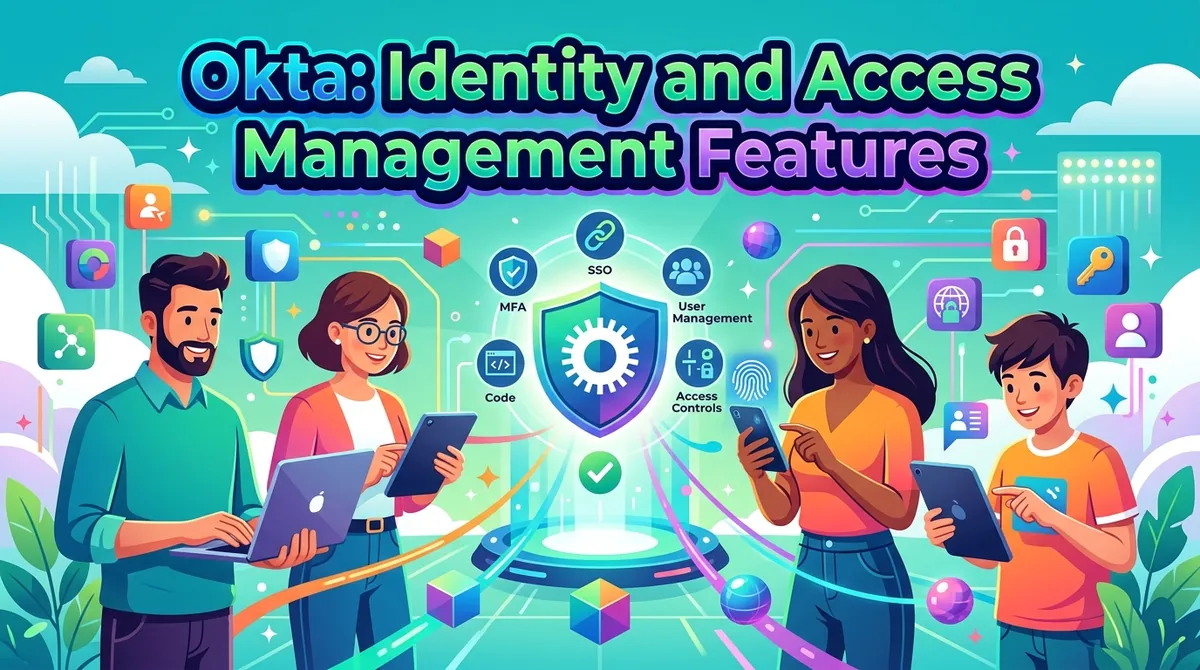
Okta is an identity and access management platform designed to help organizations control how employees, contractors, partners, customers, and other identities access applications and resources. Its products cover authentication, single sign-on, multi-factor authentication, identity lifecycle management, directories, governance, privileged access, and identity security.
The platform is particularly relevant to organizations that operate across many cloud applications and need a centralized way to manage user identities and access policies. Okta can connect with cloud and on-premises applications, identity stores, HR systems, and other infrastructure.
Okta's portfolio includes Workforce Identity for employees and business users and Customer Identity for applications serving external customers. Additional products address privileged access, APIs, device access, identity governance, and AI-agent identities.
What Is Okta?
Okta provides a centralized identity layer between users and the applications or resources they need to access. Instead of each application independently managing authentication, organizations can use Okta to establish identity policies and connect users with authorized services.
Its Workforce Identity portfolio includes Single Sign-On, Adaptive MFA, FastPass, Universal Directory, Lifecycle Management, Identity Governance, Privileged Access, Device Access, and Workflows.
Okta also maintains an integration ecosystem covering thousands of applications, allowing organizations to connect identity services with existing business and IT systems.
Single Sign-On
Single Sign-On (SSO) allows users to authenticate through a central identity provider and then access authorized applications without repeatedly entering separate credentials.
Okta supports SSO across cloud, on-premises, and mobile applications. Its current platform advertises more than 8,000 pre-built integrations, which can help organizations connect identity management with commonly used business applications.
For IT departments, centralized SSO can simplify application access while providing a common location for authentication policies and reporting.
Multi-Factor Authentication
Multi-Factor Authentication (MFA) adds verification requirements beyond a password. Okta supports multiple authentication factors, including Okta Verify, FIDO2/WebAuthn authenticators, smart cards, and other supported methods.
Okta's Adaptive MFA adds contextual evaluation to the authentication process. Policies can consider factors such as device condition, network, location, IP address, and user behavior when determining whether additional verification should be required.
This allows organizations to apply different authentication requirements according to the circumstances surrounding a login.
Passwordless Authentication and FastPass
Okta FastPass provides phishing-resistant, passwordless authentication for supported environments.
Instead of relying exclusively on traditional passwords, users can authenticate using device-based credentials and other supported factors. Okta positions FastPass as part of its broader approach to reducing reliance on passwords and strengthening authentication.
Organizations can combine passwordless authentication with adaptive policies to create different access requirements for different applications or risk conditions.
Universal Directory
Universal Directory provides a centralized location for managing users, groups, and devices.
Organizations can connect identity information from sources such as Active Directory, LDAP, HR systems, and other directories. This allows IT teams to establish a common identity layer rather than maintaining disconnected user records across individual applications.
Directory information can also be used in access policies and automated provisioning workflows.
Lifecycle Management
Employee access changes as people join an organization, change positions, or leave. Lifecycle Management automates parts of this process.
Okta can connect identity information with applications and HR systems to provision or deprovision accounts according to organizational rules. This can reduce manual administration and help remove access when it is no longer required.
Lifecycle management is also part of Okta's broader Identity Governance offering, which combines access governance, lifecycle management, and Workflows.
Identity Governance
Identity Governance provides tools for managing and reviewing access across an organization.
Okta's Identity Governance offering includes Access Governance, Lifecycle Management, and Workflows. These capabilities can support access requests, approvals, policy enforcement, and automated identity processes.
Governance features can be particularly relevant for organizations that need greater visibility into who has access to applications and whether that access remains appropriate.
Privileged Access
Privileged accounts can provide elevated access to important systems and infrastructure. Okta offers Privileged Access capabilities designed to apply stronger controls to administrative identities and sensitive resources.
The product is part of Okta's Workforce Identity portfolio and can be combined with other identity controls to support least-privilege approaches. Okta also provides Advanced Server Access for managing identity-based access to modern server infrastructure.
Workflows and Identity Automation
Okta Workflows provides no-code automation for identity-related processes.
Organizations can use workflows to automate tasks such as onboarding, account updates, access changes, notifications, and integrations between identity systems and other business applications.
The current Okta Workforce Identity Starter plan includes five Workflows, while Essentials includes 50 Workflows.
Automation can reduce repetitive administrative work and help standardize identity processes across departments.
Device and Access Security
Okta also provides Device Access, which connects device authentication with application and resource access.
Adaptive access policies can incorporate device-security information when determining whether a user should be granted access. Okta's Adaptive MFA documentation describes real-time device-posture checks that can be used to restrict access when devices fail configured security requirements.
This creates a connection between identity, authentication, and device security rather than treating each area as a separate control.
Customer Identity and Developer Tools
Okta also offers Customer Identity capabilities for organizations building applications used by customers or other external users.
Customer Identity products support authentication, user management, lifecycle capabilities, social authentication, and developer-focused APIs and SDKs. Okta also maintains a separate developer platform for integrating identity functionality into applications.
This allows businesses to use Okta not only for employee access but also for authentication experiences embedded into their own products.
AI and Non-Human Identities
Identity management is expanding beyond traditional human users. Organizations increasingly need to manage service accounts, API credentials, and AI agents.
Okta now includes AI agent identities and non-human identities among its identity-security offerings. Its platform is designed to provide visibility and governance for identities that interact with applications and resources without representing a traditional employee.
Okta has also introduced Agent SSO capabilities that treat supported AI agents as identities within enterprise access-management workflows.
Okta Pricing
Okta currently publishes several Workforce Identity pricing tiers.
- Starter: $6/user/month
- Essentials: $17/user/month
- Professional: Contact Okta for pricing
Starter includes Single Sign-On, MFA, Universal Directory, and five Workflows. Essentials adds Adaptive MFA, Privileged Access, Lifecycle Management, Access Governance, and 50 Workflows. Professional adds capabilities such as Device Access and additional advanced identity-security functionality.
Okta states that Workforce Identity suites are billed annually and have a $1,500 annual contract minimum. Pricing can also vary depending on additional products and organizational requirements.
How Businesses Evaluate Okta
Organizations generally consider:
- Number of employees and external users
- Applications requiring SSO
- MFA and passwordless requirements
- Existing identity providers
- HR and directory integrations
- User provisioning and deprovisioning
- Governance and compliance requirements
- Privileged-access needs
- Device-security policies
- Developer and customer identity requirements
- AI and non-human identity management
- Total licensing costs
The appropriate Okta configuration depends on the organization's identity architecture, application environment, security requirements, and level of automation.
Final Thoughts
Okta provides an identity-focused platform covering authentication, SSO, MFA, directories, lifecycle management, governance, privileged access, device access, and automation. Its Workforce Identity products are designed to centralize employee and partner access, while Customer Identity extends identity capabilities into customer-facing applications.
As organizations adopt more cloud applications and automated systems, identity management increasingly involves devices, APIs, service accounts, and AI agents as well as employees. Okta's broader platform addresses these areas through a combination of authentication, governance, security, and identity automation tools.
About the Author
Emily Carter, 34, is an investment consultant at a business advisory publication, specializing in emerging markets and risk management. She provides entrepreneurs with practical strategies to maximize returns, manage uncertainty, and protect long-term wealth.