


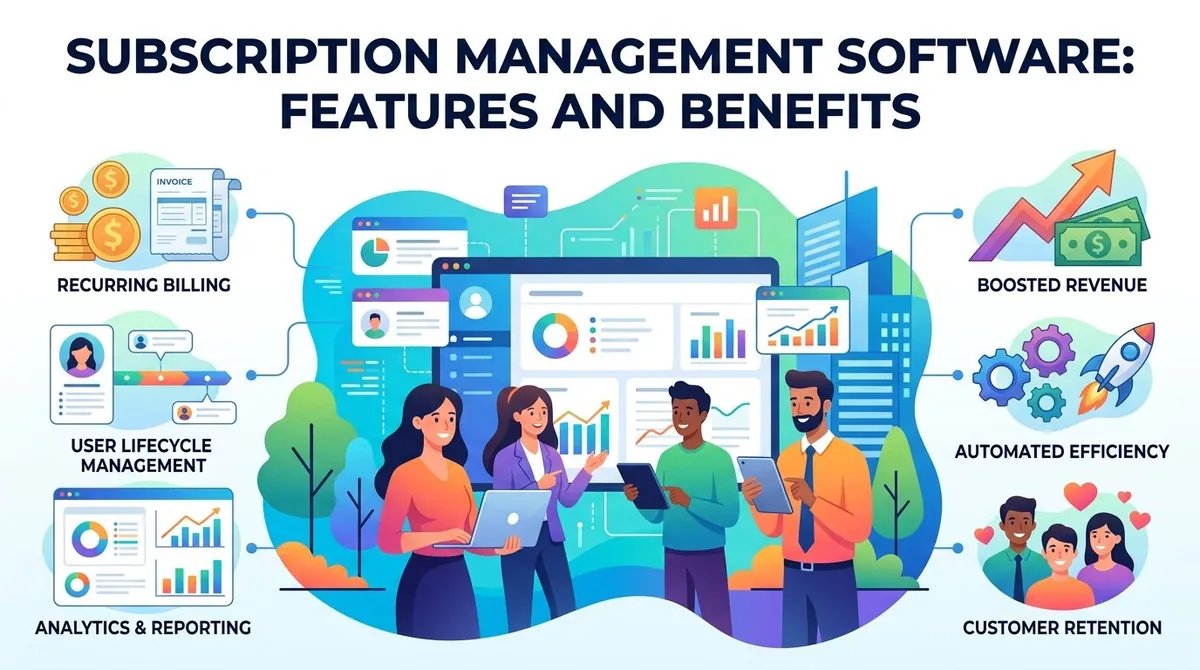
Subscription-based business models are used across software, media, memberships, online services, consumer products, and other industries. Managing recurring customers manually can become increasingly difficult as businesses add more plans, pricing options, payment methods, and subscribers.
Subscription management software helps businesses manage recurring customer relationships and the operational processes surrounding subscriptions. These systems can automate billing, handle plan changes, manage renewals and cancellations, track customer information, and provide reporting on subscription performance. (Stripe)
Subscription management is broader than simply collecting recurring payments. A complete solution may need to support the customer lifecycle from signup through renewal or cancellation while also connecting billing information with accounting, customer service, and other business systems.
What Is Subscription Management Software?
Subscription management software is designed to help businesses manage customers who pay for products or services on a recurring basis.
Recurring billing is one component of subscription management. A broader subscription management system can also handle pricing plans, free trials, upgrades, downgrades, prorated charges, cancellations, refunds, customer information, invoices, and reporting. (Stripe)
For example, a software company may offer monthly and annual plans with different features. When a customer upgrades from one plan to another, the system may calculate the applicable charge, update the subscription, adjust future billing, and record the change.
Key Features of Subscription Management Software
Recurring Billing
Automated recurring billing allows businesses to charge customers according to a predefined schedule. Billing may occur monthly, quarterly, annually, or according to another billing cycle.
Automation reduces the need for employees to manually create invoices or initiate payments for every subscription. Modern platforms can also support different pricing models, including flat-rate, tiered, per-seat, and usage-based billing. (Stripe)
Subscription Lifecycle Management
A subscription can change significantly after the initial purchase. Customers may upgrade, downgrade, pause, renew, or cancel their plans.
Subscription management software can centralize these changes and maintain a record of the customer's subscription history. This allows businesses to manage the relationship from signup through renewal or cancellation.
Plan and Pricing Management
Businesses may offer multiple subscription plans with different prices, features, billing intervals, or usage limits.
Software can help businesses configure these plans and apply pricing rules consistently. More advanced platforms can also support discounts, promotional offers, free trials, usage-based pricing, and prorated charges.
Invoicing and Payments
Subscription platforms can automatically generate invoices and process recurring payments. Depending on the system, businesses may support multiple payment methods and currencies.
Automated payment collection can also be combined with customer notifications, receipts, and payment-status tracking.
Failed Payment Recovery
Recurring payments can fail because of expired cards, insufficient funds, incorrect payment information, or other issues.
Subscription management software may use dunning tools to notify customers about failed payments and automatically retry transactions according to predefined rules. These processes can help businesses recover payments without requiring employees to manually contact every customer. (Stripe)
Customer Self-Service
Customer portals can allow subscribers to manage their own billing information and subscription preferences.
Depending on the platform, customers may be able to update payment details, change plans, view invoices, or cancel subscriptions without contacting customer support.
Self-service capabilities can reduce administrative work while giving customers greater control over their subscriptions.
Trial Management
Free trials and introductory offers are common in subscription businesses. Software can automate trial periods, track trial status, send reminders, and convert eligible customers into paid subscriptions.
Businesses can also use trial analytics to understand how many users move from trials to paid plans.
Reporting and Analytics
Subscription management platforms can provide information about recurring revenue and customer activity.
Common metrics include:
- Monthly recurring revenue (MRR)
- Annual recurring revenue (ARR)
- Customer churn
- Customer lifetime value
- New subscriptions
- Renewals
- Cancellations
- Trial conversions
- Failed and recovered payments
Centralized reporting can help businesses monitor subscription performance and identify changes in customer behavior. (Stripe)
Integrations
Subscription software often needs to connect with other business systems. Integrations may include accounting platforms, customer relationship management systems, payment providers, data warehouses, customer-support tools, and enterprise resource planning systems.
Connecting these systems can reduce duplicate data entry and allow subscription information to move into financial and operational workflows.
Benefits of Subscription Management Software
Reduces Manual Work
Automating recurring invoices, payment collection, renewals, reminders, and plan changes can reduce repetitive administrative tasks.
Instead of managing each subscription individually, businesses can establish rules that handle routine events automatically.
Supports Recurring Revenue
Subscription models can provide businesses with recurring revenue from ongoing customer relationships. Subscription management software helps maintain the billing processes required to support those relationships.
Helps Manage Churn
Cancellation and failed-payment data can provide information about customer retention. Automated payment recovery and customer lifecycle tools can also help businesses address certain causes of involuntary churn. (Stripe)
Improves Customer Experience
Self-service portals, accurate billing, automated notifications, and flexible plan management can make subscription administration more convenient for customers.
Improves Financial Visibility
Subscription analytics can give businesses a clearer view of recurring revenue, customer growth, cancellations, and other financial indicators.
Subscription Management vs. Recurring Billing
The terms subscription management and recurring billing are related but describe different scopes.
Recurring billing primarily refers to automatically charging customers on a repeating schedule. Subscription management encompasses a broader set of activities, including customer onboarding, plan changes, trials, renewals, cancellations, refunds, customer data, reporting, and billing operations. (Stripe)
A business with a simple recurring payment model may require only basic billing capabilities. A company with multiple subscription plans and a large customer base may need a more comprehensive management system.
Key Considerations When Choosing Subscription Management Software
Pricing Models
Businesses should determine whether the software supports the pricing structure they currently use and may introduce in the future. Consider flat-rate, tiered, per-user, usage-based, hybrid, and other models.
Billing Flexibility
Review whether the platform can handle upgrades, downgrades, prorations, discounts, free trials, renewals, and cancellations according to the company's billing rules.
Payment Methods and Currencies
Businesses serving international customers should examine supported currencies and payment methods. Availability can vary by provider and geographic market.
Integrations
Consider which systems need access to subscription information. Accounting, CRM, ERP, customer service, and analytics integrations can be important for businesses with more complex technology environments.
Security and Compliance
Subscription platforms handle customer and payment information, so security should be evaluated carefully. Businesses should review authentication, access controls, data handling, payment security, and applicable regulatory requirements.
Reporting
Evaluate whether the platform provides the subscription metrics needed by finance, sales, marketing, and management teams. Businesses may also need data exports or integrations with external analytics systems.
Scalability and Cost
The software should accommodate growth in subscribers, transactions, products, pricing plans, and geographic markets.
Businesses should also consider the full cost of the system, including subscription fees, transaction charges, implementation, integrations, additional users, and optional services.
Examples of Subscription Management Software
Stripe Billing provides subscription management, recurring billing, invoicing, customer portals, pricing models, trials, payment recovery, and analytics. (Stripe)
Zuora provides subscription and billing capabilities designed for businesses managing recurring revenue models, including subscription products, amendments, and changes to customer subscriptions. (Zuora)
The appropriate platform depends on the complexity of the subscription model, existing technology, payment requirements, reporting needs, and expected growth.
Final Thoughts
Subscription management software can help businesses automate recurring billing, manage customer subscriptions, recover failed payments, support self-service, and monitor recurring revenue.
The most suitable solution depends on how the business structures its subscriptions and how much complexity exists in its billing and customer lifecycle. Businesses should evaluate pricing flexibility, payment support, integrations, reporting, security, automation, and total cost before selecting a platform.
For businesses with recurring revenue models, a well-designed subscription management system can provide a centralized foundation for managing both the financial and operational aspects of ongoing customer relationships.