


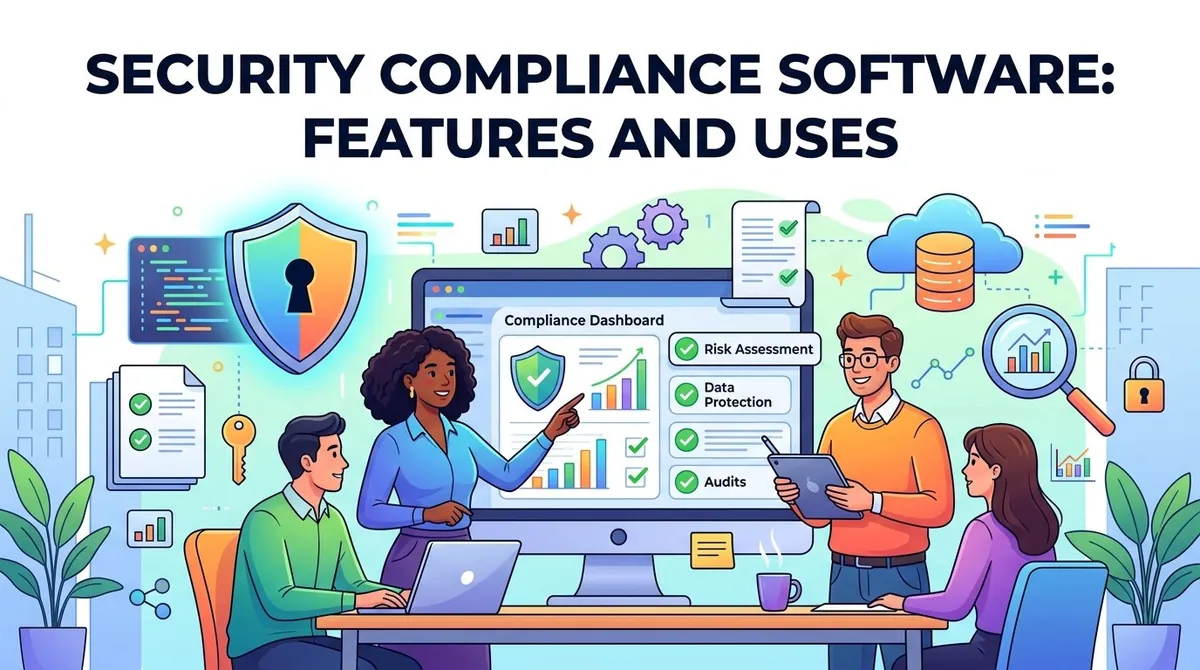
Organizations need to protect systems and information while also meeting security, privacy, and regulatory requirements. As businesses use more cloud services, applications, and connected systems, tracking security controls and preparing evidence for audits can become increasingly complex.
Security compliance software helps organizations manage activities related to cybersecurity compliance, risk, controls, assessments, and audit preparation. These platforms can help teams identify requirements, map controls to standards, monitor compliance activities, collect evidence, manage remediation, and produce reports.
Security compliance software does not automatically make an organization compliant with every regulation or standard. Instead, it provides tools for organizing and managing compliance activities. The appropriate solution depends on the organization's industry, regulatory requirements, technology environment, risk profile, and internal processes.
What Is Security Compliance Software?
Security compliance software is designed to help organizations manage cybersecurity controls and demonstrate that required policies and procedures are being followed.
These platforms are often associated with governance, risk, and compliance (GRC) activities. They can help organizations map internal controls to frameworks and regulations, assign responsibilities, monitor progress, collect documentation, and prepare for audits.
For example, AWS Audit Manager can continuously collect evidence related to AWS environments and organize that evidence against predefined or customized control frameworks. AWS notes that the service assists with evidence collection but does not itself determine an organization's overall compliance.
Key Features of Security Compliance Software
Compliance Assessments
Compliance software can provide assessments based on security standards, regulations, or organizational requirements. Prebuilt assessments can help teams evaluate controls against recognized frameworks, while custom assessments can address organization-specific requirements.
Microsoft Purview Compliance Manager, for example, provides prebuilt and custom assessments and allows organizations to track improvement actions associated with compliance requirements.
Control Management
Controls are safeguards or procedures designed to address specific security or compliance requirements. Compliance platforms can help organizations document controls, assign owners, track implementation, and monitor their status.
Some systems allow organizations to create custom controls in addition to using predefined ones. AWS Audit Manager, for example, supports both standard and custom control frameworks.
Evidence Collection
Audit evidence can include configuration information, activity records, policies, screenshots, reports, and other documentation demonstrating how controls operate.
Automated evidence collection can reduce the amount of manual work required to gather information for recurring assessments. AWS Audit Manager collects automated evidence from supported AWS services and can also accommodate manually uploaded evidence.
Risk Management
Security compliance platforms may include tools for identifying, assessing, assigning, and tracking risks.
Organizations can use these capabilities to document identified risks, assign responsible owners, establish remediation plans, and monitor progress.
Policy Management
Businesses can use compliance software to organize security policies, procedures, standards, and related documentation.
Centralized policy management can make it easier to track document ownership, approvals, review dates, and changes.
Remediation Tracking
Compliance assessments may identify gaps or control deficiencies. Software can help organizations assign remediation tasks, establish deadlines, monitor progress, and document completed actions.
This creates a connection between compliance assessments and the operational work required to address identified issues.
Reporting and Dashboards
Compliance dashboards can provide visibility into assessment status, open issues, control performance, risks, and remediation activities.
Reporting tools can also help organizations prepare information for internal stakeholders, auditors, customers, or regulators.
AWS Audit Manager can generate assessment reports that compile selected evidence associated with controls for audit preparation.
Framework Mapping
Organizations often need to address overlapping requirements from multiple standards or regulations. Compliance software can map controls to different frameworks to reduce duplicate work.
AWS Audit Manager, for example, provides predefined frameworks associated with standards and regulations including PCI DSS, HIPAA, GDPR, and SOC 2.
Common Uses of Security Compliance Software
Audit Preparation
Organizations can use compliance software to organize controls and evidence before an internal or external audit.
Maintaining evidence continuously can make recurring audit preparation more structured than gathering documentation only shortly before an audit.
Regulatory Compliance
Businesses operating in regulated industries may need to demonstrate that specific security and privacy controls are in place. Compliance platforms can help organize these requirements and track related activities.
Security Framework Management
Organizations can use software to manage controls aligned with frameworks such as NIST, CIS Controls, ISO/IEC 27001, SOC 2, or industry-specific requirements.
The specific framework required depends on the organization's industry, customers, contracts, and regulatory environment.
Vendor and Third-Party Risk
Some compliance platforms include capabilities for evaluating the security posture of suppliers, service providers, and other third parties.
Organizations can use questionnaires, documentation requests, assessments, and risk ratings to support third-party risk management.
Continuous Compliance Monitoring
Instead of conducting compliance checks only periodically, organizations can use automated monitoring and evidence collection to identify changes in security controls over time.
This can be particularly useful for cloud environments where configurations and resources can change frequently.
Benefits of Security Compliance Software
Security compliance software can provide several potential benefits:
- Centralized compliance information: Controls, policies, risks, and evidence can be managed in one environment.
- Reduced manual work: Automated evidence collection and workflows can reduce repetitive administrative tasks.
- Improved visibility: Dashboards can show assessment progress, control gaps, and remediation activities.
- Better audit preparation: Evidence and documentation can be organized throughout the year.
- Consistent processes: Standardized workflows can help teams manage recurring compliance activities.
- Framework management: Controls can be mapped across multiple standards and requirements.
The value of the software depends on how well the organization defines its controls, maintains accurate information, and incorporates compliance into ongoing security processes.
Security Compliance Software vs. Security Software
Security compliance software and cybersecurity software serve related but different purposes.
Cybersecurity software primarily focuses on protecting systems and detecting or responding to threats. Examples include endpoint security, vulnerability management, firewalls, identity security, and security monitoring tools.
Security compliance software focuses more heavily on managing requirements, controls, evidence, assessments, risks, policies, and audit processes.
The two categories can work together. Security tools may generate technical evidence that compliance platforms use when assessing whether specific controls are operating as expected.
Key Considerations When Choosing Security Compliance Software
Relevant Standards
Identify the regulations, standards, and contractual requirements that apply to the organization. Make sure the platform supports the relevant frameworks or allows appropriate custom controls.
Automation
Evaluate which evidence, assessments, notifications, and workflows can be automated. Automation can reduce manual effort, particularly for recurring compliance activities.
Integration
Check whether the platform integrates with cloud environments, identity systems, security tools, ticketing systems, document repositories, and other business applications.
Evidence Management
Consider how evidence is collected, stored, searched, reviewed, retained, and shared. Strong evidence management can be important when preparing for audits.
Reporting
Review the available dashboards and reporting capabilities. Determine whether the system can produce reports appropriate for security teams, executives, auditors, and other stakeholders.
Security and Access Controls
Because compliance platforms can contain sensitive security information, evaluate authentication, role-based access, encryption, audit logs, data retention, and administrative controls.
Scalability
Consider whether the software can support additional users, business units, frameworks, cloud environments, and compliance requirements as the organization grows.
Cost
Evaluate licensing, implementation, integrations, administration, support, and training when calculating total cost.
Examples of Security Compliance Software
Microsoft Purview Compliance Manager provides compliance assessments, improvement actions, workflows, and a risk-based compliance score to help organizations manage compliance activities.
AWS Audit Manager provides frameworks, assessments, evidence collection, evidence search, and assessment reporting for AWS environments. Its framework library includes predefined frameworks for several standards and regulations, as well as options for customized frameworks.
Other GRC and compliance platforms provide similar capabilities across broader IT environments, including risk management, policy management, third-party assessments, and audit workflows.
Final Thoughts
Security compliance software helps organizations organize and manage cybersecurity controls, assessments, risks, policies, evidence, and audit preparation. Automation can reduce manual compliance work, while dashboards and reporting can provide greater visibility into the organization's compliance activities.
When evaluating a solution, businesses should consider the frameworks they need to support, evidence collection, automation, integrations, reporting, security, scalability, and total cost. Compliance software is a management tool rather than a replacement for security controls, qualified personnel, legal advice, or an organization's broader cybersecurity program.