


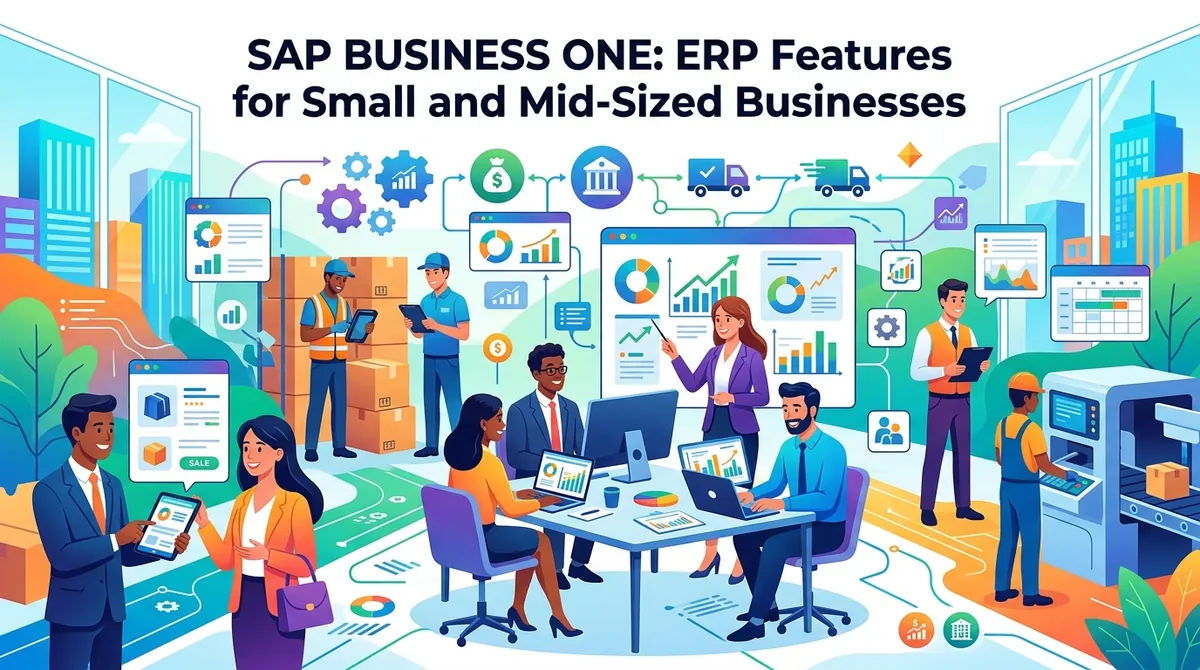
SAP Business One is an enterprise resource planning platform designed specifically for small and mid-sized businesses. The system brings financial management, sales, purchasing, inventory, customer relationship management, reporting, and other operational processes into a connected ERP environment.
Unlike large enterprise ERP platforms designed for organizations of many different sizes, SAP Business One focuses on the needs of smaller companies and subsidiaries. It is intended to provide integrated business information while allowing organizations to customize and extend the system as their requirements develop.
The platform can support businesses across industries such as manufacturing, retail, wholesale distribution, consumer products, and professional services. Its modular structure allows companies to use ERP capabilities across finance, operations, sales, and supply chain management.
What Is SAP Business One?
SAP Business One is an integrated ERP and business management solution from SAP. It provides a central system for managing core business processes and gives users access to information across multiple departments.
SAP describes Business One as a solution for small and midsize businesses, as well as subsidiaries of larger organizations. The platform can be deployed through different environments and supports extensibility through integrations and add-ons.
The system is organized around business functions rather than requiring separate applications for every department. This allows accounting, purchasing, sales, inventory, customer management, and operations to work with connected business data.
Financial Management
Financial management is one of the central components of SAP Business One. The platform includes accounting functions for managing transactions and monitoring financial performance.
Key capabilities include:
- General accounting and journal entries
- Accounts payable and accounts receivable
- Banking and payment management
- Budgeting and financial controls
- Fixed asset management
- Cash-flow monitoring
- Financial reporting
- Bank reconciliation
SAP Business One can also create standard and customized financial reports using business data available within the system.
For smaller businesses, having accounting connected directly with purchasing, sales, inventory, and other operational processes can reduce the need to reconcile information across disconnected systems.
Sales and Customer Management
SAP Business One includes CRM and sales management capabilities for managing prospects, customers, opportunities, and sales activities.
Sales teams can "track opportunities throughout the sales cycle, manage customer information, and monitor activities related to potential and existing customers."
The platform also includes service management capabilities. Businesses can manage service calls, warranties, service agreements, and after-sales activities within the same business environment.
Mobile capabilities allow sales employees to access customer and sales information while working away from the office.
Purchasing and Procurement
SAP Business One supports procurement processes from purchasing requests through purchase orders, goods receipts, invoices, and returns.
Purchasing information can be connected with inventory and financial records. For example, receiving goods can update inventory information while the corresponding transaction can feed into accounts payable.
The platform also supports supplier information, purchasing prices, tax information, and multiple currencies. This gives purchasing teams a structured environment for managing supplier-related transactions.
Inventory and Warehouse Management
Inventory management is another major part of SAP Business One. Businesses can manage stock levels, warehouses, purchasing, sales, shipments, and related inventory transactions.
The system can connect warehouse activity with accounting and procurement processes. This provides a more consistent view of inventory as goods are purchased, received, transferred, and sold.
Businesses with multiple locations or more complex inventory requirements can use additional capabilities for inventory control and planning. These tools can help organizations monitor stock and coordinate supply with customer demand.
Manufacturing and Production
SAP Business One supports manufacturing processes in addition to standard financial and commercial functions.
Production-oriented organizations can manage production planning, bills of materials, inventory requirements, and production orders. Manufacturing activity can be connected to purchasing and inventory processes, allowing companies to track the materials and products associated with production.
SAP specifically identifies manufacturing as one of the industries supported by Business One, alongside areas such as wholesale distribution, retail, consumer products, and professional services.
Business Intelligence and Reporting
SAP Business One includes reporting and analytics tools designed to make company-wide information accessible to users.
Businesses can create reports and dashboards using information from different operational areas. Interactive analysis can also integrate with Microsoft Excel, allowing users to work with business information through familiar spreadsheet tools.
Real-time analytics can help managers examine revenue, costs, cash flow, sales activity, inventory, and other operational indicators.
This connected reporting structure can be useful when management needs to understand how activity in one department affects another.
Web Client and Mobile Access
SAP Business One includes a web client that provides access to business processes and information through a browser-based interface. Users can create and update documents, manage master data, track activities, and work with analytics.
SAP also provides mobile applications that allow users to manage leads and customer accounts, view inventory, and place orders from mobile devices.
Mobile and web access can be particularly useful for sales teams, managers, and employees who regularly work outside a traditional office environment.
Customization and Integrations
SAP Business One is designed to be extended as a company's requirements change. Organizations can customize the system and use add-ons to support industry-specific or company-specific processes.
SAP's ecosystem includes partner-developed extensions, while the platform also provides interfaces for connecting with external systems and data sources.
This flexibility can allow a business to adapt the ERP system without replacing its core platform whenever a new operational requirement appears.
SAP Business One for Growing Businesses
A major consideration for small and mid-sized businesses is whether an ERP platform can support growth without requiring a complete replacement.
SAP positions Business One as a solution that can be customized and extended as companies develop. The platform is used internationally and supports multiple languages and country-specific localizations. SAP reported that as of December 2025, Business One had "more than 83,000 customers and 1.2 million users across more than 170 countries."
For companies expanding into additional markets, localization and multicurrency capabilities can therefore become important parts of the ERP evaluation.
SAP Business One Pricing
SAP does not publish a single universal price for every Business One implementation. The final cost depends on factors such as licensing, deployment, users, implementation services, add-ons, integrations, and business requirements.
SAP directs prospective customers toward obtaining a quote based on their requirements.
Businesses should therefore evaluate total implementation costs rather than comparing only software licensing prices. Data migration, configuration, training, customization, support, and integrations can all affect the overall cost of an ERP deployment.
How Businesses Evaluate SAP Business One
Small and mid-sized companies evaluating SAP Business One typically need to consider their financial processes, inventory requirements, purchasing workflows, sales operations, manufacturing needs, reporting requirements, and plans for expansion.
The implementation approach is also important. Businesses should document existing processes, identify data that needs to be migrated, establish user permissions, and determine which integrations or industry-specific extensions are necessary.
The goal is not simply to install an ERP platform but to create a connected operating environment that reflects how the organization actually works.
Final Thoughts
SAP Business One provides small and mid-sized businesses with an integrated ERP environment covering financial management, sales, customer relationships, purchasing, inventory, manufacturing, reporting, and other operational processes.
Its modular architecture, analytics capabilities, mobile access, and extensibility allow businesses to adapt the platform to different industries and operating models. At the same time, implementation requirements and additional extensions should be considered when estimating the total investment.
For organizations looking to connect financial and operational information within a single ERP system, SAP Business One provides a broad set of business management capabilities designed around the requirements of growing companies.