


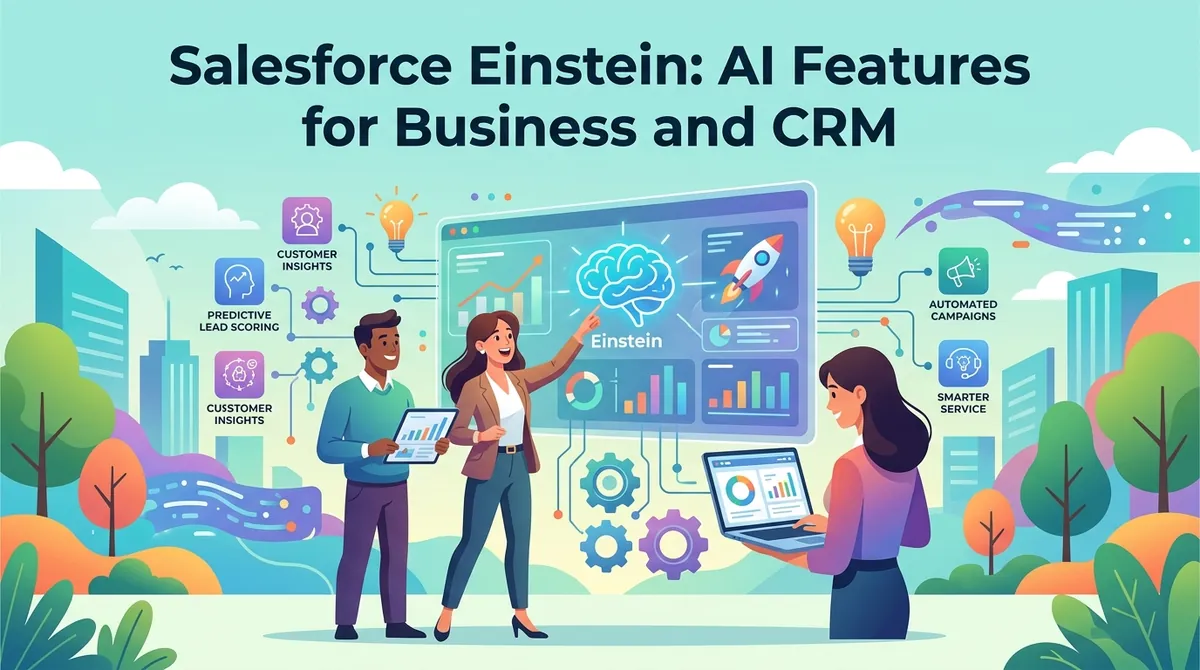
Salesforce Einstein is Salesforce's collection of artificial intelligence capabilities integrated into its CRM and business applications. It combines predictive AI, generative AI, automation, and agentic capabilities to help organizations analyze CRM information, generate content, identify patterns, and automate selected business tasks.
Einstein capabilities are available across sales, service, marketing, analytics, and other Salesforce workflows. Salesforce has increasingly connected these capabilities with Agentforce, its platform for creating and deploying AI agents that can work with Salesforce data and perform authorized actions.
The exact Einstein functionality available depends on the Salesforce edition, product, license, and configuration. Some AI features are included in specific editions, while others require additional licensing or usage-based pricing.
What Is Salesforce Einstein?
Salesforce Einstein is not a single standalone application. It is a collection of AI technologies and features embedded across Salesforce products.
Its capabilities can analyze CRM records, predict outcomes, generate text, summarize information, recommend actions, and automate supported workflows. Salesforce describes Sales Cloud Einstein as using organizational data to provide capabilities such as lead scoring, opportunity scoring, forecasting, and personalized sales content.
The platform has evolved from primarily predictive machine learning toward a broader combination of predictive, generative, and agentic AI.
Einstein for Sales
Sales teams can use Einstein to analyze leads, opportunities, customer activity, and sales information.
Einstein Lead Scoring helps identify leads that are more likely to convert, while Einstein Opportunity Scoring evaluates opportunities and predicts their likelihood of being won. Einstein Forecasting can also provide predictions based on sales information.
These features can give representatives and managers additional information when deciding which opportunities or leads require attention.
The availability of individual features depends on the Salesforce edition and associated licenses.
AI-Generated Sales Emails
Einstein's generative AI capabilities can assist sales representatives with email creation.
Einstein Sales Emails can generate personalized messages for leads and contacts using relevant Salesforce information as context. Salesforce describes this process as grounding generated content in CRM data.
Instead of starting every customer email from a blank page, sales representatives can review and modify an AI-generated draft before sending it.
Other AI capabilities can help summarize records and provide contextual information during sales workflows.
Einstein Activity and CRM Data
Salesforce also uses AI to connect customer interactions with CRM information.
Einstein Activity Capture can automatically associate supported email and calendar activity with Salesforce records. This can reduce some manual data entry and provide sales representatives with a more complete view of customer interactions.
The value of these capabilities depends partly on the quality and completeness of the underlying CRM information. Accurate account, contact, opportunity, and activity data can provide more useful context for AI-powered workflows.
Einstein for Customer Service
Einstein capabilities also extend to customer service and support.
Salesforce provides AI features that can help service representatives summarize cases, generate responses, surface relevant information, and receive recommendations during customer interactions.
Einstein Conversation Insights can analyze supported customer conversations and surface information such as topics, sentiment, and follow-up opportunities.
AI assistance can therefore be used at different stages of the service process, from understanding an incoming case to helping representatives prepare responses and summarize interactions.
Einstein for Marketing
Salesforce incorporates predictive and generative AI into Marketing Cloud.
AI can assist with campaign creation, content generation, segmentation, personalization, engagement analysis, and campaign optimization. Salesforce documentation describes capabilities that can help create campaign briefs and campaign components, suggest relevant segments, and personalize customer experiences.
Einstein Send Time Optimization can use engagement information to determine appropriate delivery times for supported marketing communications.
Marketing teams can therefore use Einstein for both content-generation tasks and data-driven campaign workflows.
Einstein Analytics and Predictive Insights
Einstein can provide predictive information alongside Salesforce's broader analytics capabilities.
Sales teams can use predictive lead and opportunity scoring, forecasting, and other sales signals. Marketing teams can use engagement-related predictions, while service organizations can use AI-generated summaries and recommendations.
The objective is to supplement historical reporting with predictions and contextual information that can help employees prioritize activities.
Agentforce and Einstein
Salesforce's current AI strategy increasingly connects Einstein capabilities with Agentforce.
Agentforce allows organizations to create AI agents that can interact with users, retrieve information, reason over supported business context, and perform authorized actions. Salesforce describes Agentforce as working with trusted organizational data and business actions inside Salesforce.
Agentforce can support use cases such as sales prospecting, lead nurturing, customer service, research, and workflow automation.
Salesforce also supports AI agents in Marketing Cloud, where agents can assist with campaign creation, segmentation, and buyer engagement workflows.
AI Governance and the Einstein Trust Layer
AI governance is important when generative features interact with customer and business information.
Salesforce uses the Einstein Trust Layer as part of its approach to connecting AI capabilities with enterprise data and security controls. Salesforce describes the Trust Layer as providing security and governance mechanisms for generative AI workflows.
Organizations should still review the specific data sources, permissions, configurations, retention policies, and licensing terms applicable to the AI features they enable.
Einstein and Agentforce Pricing
Salesforce uses several pricing models for AI capabilities.
Some Einstein features are included with particular Salesforce editions, while others are sold as add-ons. For example, Salesforce currently lists Agentforce for Sales at $125 per user per month as an available sales add-on for eligible editions.
Agentforce also supports consumption-based pricing. Salesforce currently lists Flex Credits at $500 per 100,000 credits in its US pricing information and $2 per conversation for the Conversations model.
Salesforce explains that AI billing can use consumption-based pricing, per-user licensing, or a hybrid of the two, depending on the product and feature.
Salesforce CRM Pricing Context
The underlying Salesforce edition also affects which AI capabilities are available.
Current US sales pricing lists:
- Starter Suite: $25/user/month
- Pro Suite: $100/user/month
- Core: $195/user/month
- Advanced: $395/user/month
- Max: $550/user/month
These prices are billed monthly or annually depending on the edition, with higher tiers providing progressively broader CRM, AI, security, and platform capabilities.
Because Einstein and Agentforce capabilities can have separate licensing or consumption costs, businesses should calculate the CRM subscription and AI requirements together.
Business Uses for Salesforce Einstein
Organizations can apply Einstein capabilities across areas such as:
- Lead and opportunity scoring
- Sales forecasting
- Personalized email generation
- CRM record summaries
- Customer-service assistance
- Conversation analysis
- Marketing content creation
- Customer engagement prediction
- Campaign optimization
- Automated data capture
- AI-powered research
- Workflow automation
- AI agent deployment
The exact functionality available depends on the Salesforce products and licenses deployed.
How Businesses Evaluate Einstein
Organizations generally consider:
- Existing Salesforce editions
- CRM data quality
- Predictive AI requirements
- Generative AI use cases
- Agentforce requirements
- Data governance
- User permissions
- Integration requirements
- Expected AI consumption
- Security requirements
- Licensing and usage costs
Data quality deserves particular attention because predictive models and AI-generated workflows depend on the information available to Salesforce.
Final Thoughts
Salesforce Einstein brings predictive AI, generative AI, automation, and agentic capabilities into CRM workflows. Its applications range from lead and opportunity scoring to sales emails, customer-service assistance, marketing optimization, and AI-powered business processes.
The expansion of Agentforce moves Salesforce AI beyond recommendations and generated content toward agents capable of interacting with users and performing authorized business actions.
Businesses evaluating Einstein should examine which AI features are included in their Salesforce edition, which require additional licenses, how consumption is billed, and whether their CRM data and governance processes are prepared for expanded AI use.
About the Author
Daniel Brooks, 41, is a business technology consultant at a business advisory publication, specializing in data strategy, operational efficiency, and business intelligence. He helps organizations improve how they manage information and use data to support strategic and operational decisions.
References
- Salesforce — AI for Sales
- Salesforce Help — Einstein Features in Sales
- Salesforce Help — How Sales Cloud Einstein Works
- Salesforce — Sales Add-On Features and Pricing
- Salesforce — Agentforce Pricing
- Salesforce Help — Agentforce and Generative AI Usage and Billing
- Salesforce Help — AI Solutions for Service
- Salesforce Help — AI Features in Marketing Cloud Next