


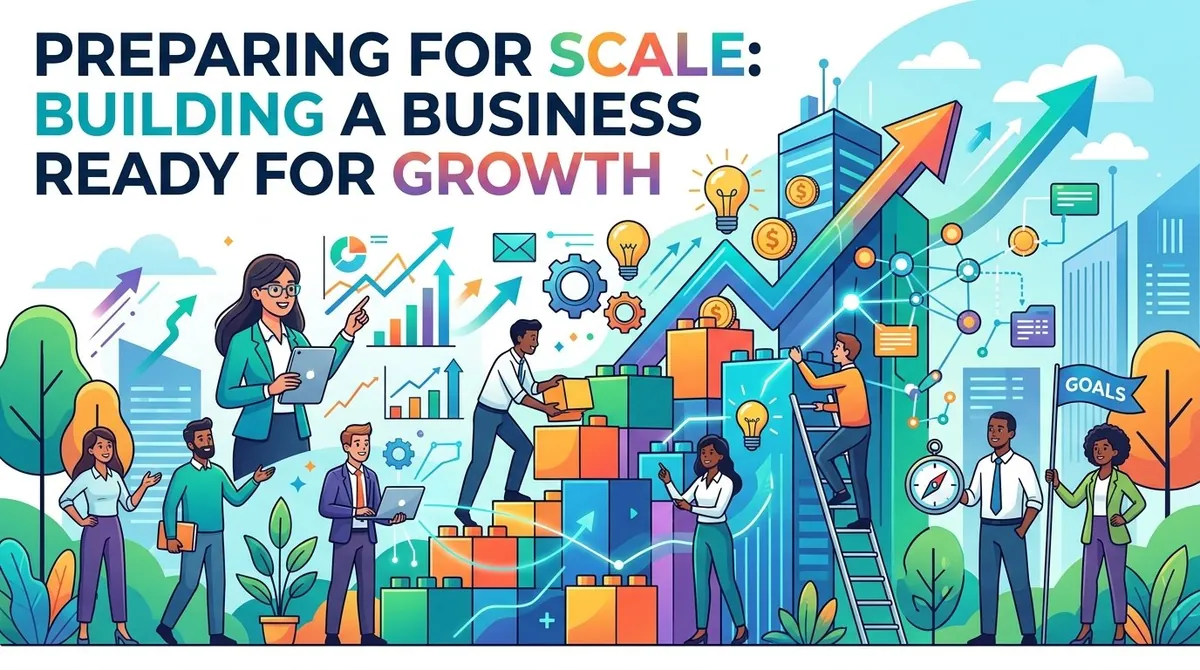
Business growth can create new opportunities, but rapid expansion can also expose weaknesses in a company's processes, technology, finances, and organizational structure. A business that performs well at a smaller size may not automatically be prepared to handle a much larger customer base or higher volume of operations.
Business scalability is therefore about more than increasing sales. It requires building systems, processes, and resources that can support growth without creating disproportionate increases in costs or operational complexity.
What Does It Mean to Scale a Business?
Scaling a business means increasing its capacity to generate revenue or serve customers while maintaining sustainable operations.
Growth and scaling are related but not identical. A company may increase revenue by adding employees, equipment, or other resources at roughly the same rate. A scalable business looks for ways to increase output without requiring every resource to grow at the same pace.
For example, automated processes can allow a company to handle more transactions without adding the same number of employees.
The objective is to create an operating model that can support increasing demand while maintaining quality and financial discipline.
Identifying Barriers to Growth
Before expanding, businesses should evaluate whether their current systems can handle additional volume.
Common areas to review include:
- Operations: Can existing processes support more customers and transactions?
- Technology: Can current systems handle increased data and usage?
- People: Are there enough employees with the skills needed for expansion?
- Finances: Is sufficient capital available to support growth?
- Customer experience: Can service quality remain consistent as demand increases?
Identifying these limitations early can help businesses address bottlenecks before they become larger operational problems.
Building Scalable Business Processes
Processes that depend heavily on manual work can become difficult to manage as a company expands.
Businesses can improve scalability by documenting recurring procedures, establishing clear responsibilities, and automating repetitive tasks where appropriate.
For example, automated billing, customer onboarding, inventory management, or reporting can reduce the amount of manual work required as transaction volume increases.
Standardization can also help maintain consistency. When employees follow clearly defined processes, organizations can make operations easier to manage across larger teams and locations.
Strengthening Technology and Infrastructure
Technology plays an increasingly important role in scaling a business.
Cloud-based systems can provide organizations with flexible access to computing resources and business applications. Integrated software can also reduce duplicated work by allowing information to move between connected systems.
Businesses should consider whether their existing technology can support higher transaction volumes, additional users, and larger datasets.
Technology investments should be connected to specific business requirements rather than made simply because a particular tool is available. The objective is to create infrastructure that supports the company's operating model and future needs.
Preparing the Organization for Growth
Scaling also requires changes in how people and teams work.
As organizations grow, informal communication and centralized decision-making can become increasingly difficult. Businesses may need clearer responsibilities, management structures, performance expectations, and internal processes.
Hiring should also be connected to expected business needs. Bringing in employees too early can increase costs, while hiring too late can create operational bottlenecks.
Leadership teams should therefore consider both current requirements and the capabilities the organization will need as it expands.
Implementation Roadmap and Best Practices
A structured business growth strategy can help organizations prepare for expansion:
- Set growth objectives: Define the level and type of growth the business is targeting.
- Assess current capacity: Identify operational, financial, technological, and staffing limitations.
- Prioritize bottlenecks: Address constraints that could prevent the business from handling additional demand.
- Document processes: Standardize important workflows and responsibilities.
- Automate where practical: Reduce repetitive manual work that may become difficult to manage at scale.
- Monitor performance: Establish KPIs that show whether growth is affecting efficiency, quality, or profitability.
Businesses should expand in stages where possible, using performance data to determine when additional resources or infrastructure are required.
Common Challenges
One common challenge is scaling too quickly. Rapid expansion can place pressure on cash flow, employees, suppliers, and customer service.
Another challenge is allowing processes to become increasingly complex without reviewing them. A workflow that worked for a small organization may become inefficient as transaction volumes and team sizes increase.
Financial management is also important. Revenue growth does not necessarily mean improved profitability if costs increase at an even faster rate.
Finally, businesses need to maintain customer experience during expansion. Increasing capacity while allowing quality or service standards to decline can create long-term problems.
Measuring Scalability
Businesses can monitor several indicators to understand whether their operations are becoming more scalable.
These may include revenue growth, operating costs, profit margins, customer acquisition costs, employee productivity, customer retention, and service quality.
The relationship between growth and costs is particularly important. If every increase in revenue requires a proportional increase in resources, the business may need to identify additional opportunities for automation, standardization, or process improvement.
Regular performance reviews can help management identify emerging constraints and make adjustments before they limit future growth.
The Future of Scalable Business Operations
Automation, cloud computing, artificial intelligence, and integrated business platforms are creating new opportunities for organizations to increase capacity without relying entirely on proportional increases in labor and infrastructure.
However, technology is only one part of scalability. Businesses also need appropriate processes, financial controls, organizational structures, and people.
Preparing for growth therefore requires organizations to think beyond immediate sales targets and consider whether their entire operating model can support increased demand.
Ultimately, preparing for scale means building a business that can grow without allowing complexity, costs, or operational problems to grow at the same pace. By strengthening processes, technology, finances, and organizational capabilities before expansion accelerates, businesses can create a more sustainable foundation for long-term growth.
References
- U.S. Small Business Administration. "Write Your Business Plan."
- U.S. Small Business Administration. "Manage Your Business."
- McKinsey & Company. "The State of Organizations."
- Harvard Business Review. "The Founder's Dilemma."
- IBM. "What Is Business Process Automation?"