


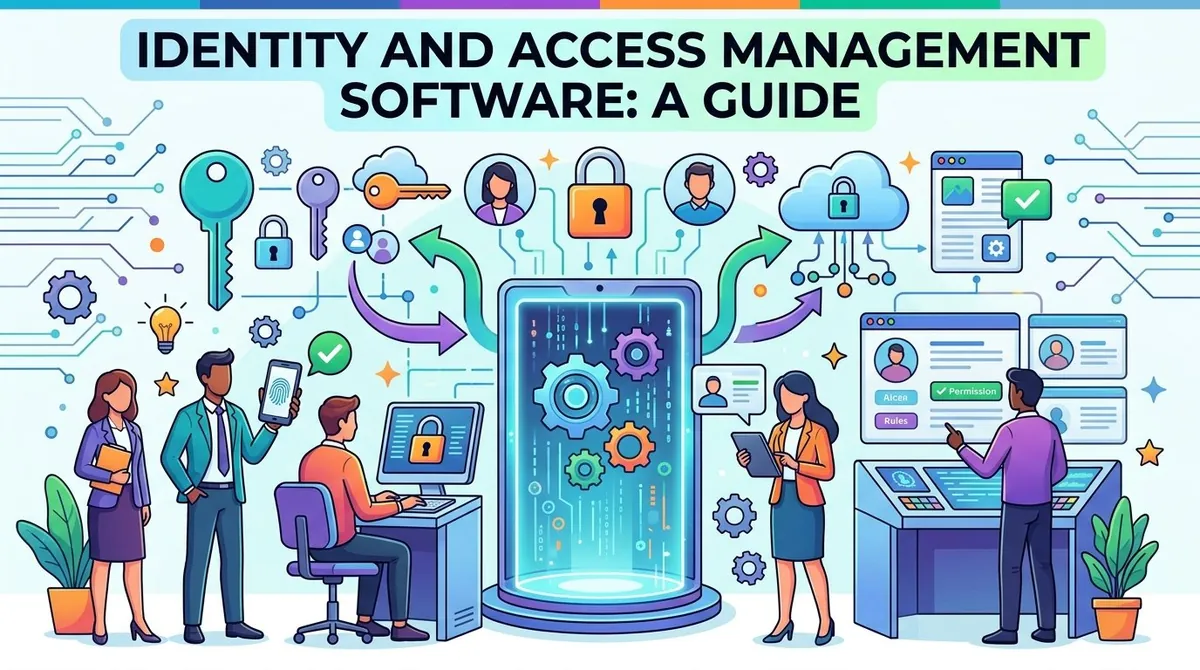
Organizations rely on employees, customers, contractors, applications, devices, and other digital identities to access business systems and information. As companies adopt cloud services and distributed work environments, managing these identities and controlling access becomes an important part of information security and IT operations.
Identity and access management (IAM) software helps organizations manage digital identities and determine who or what can access specific applications, systems, and resources. IAM platforms can support authentication, authorization, access controls, user provisioning, single sign-on, and identity governance.
The right IAM solution depends on an organization's users, applications, infrastructure, security requirements, and operational processes. Businesses should evaluate authentication capabilities, access management, integrations, automation, governance, scalability, security, and cost when selecting a platform.
What Is Identity and Access Management Software?
Identity and access management software is designed to ensure that the right users and other identities have appropriate access to the right resources at the right time. IAM generally covers identity management, authentication, authorization, and access control.
An IAM platform may maintain information about users and groups, authenticate people when they sign in, determine which resources they can access, and enforce policies governing that access.
Modern IAM systems can support cloud and on-premises environments, applications, devices, and different types of identities. Some platforms also provide tools for managing customer identities and non-human identities such as applications and service accounts.
Key Features of IAM Software
Identity Management
Identity management involves creating, maintaining, updating, and removing digital identities. Organizations can use IAM software to manage users, groups, roles, and other identity information from a centralized system.
Identity lifecycle management can also help organizations adjust access when employees join, change roles, or leave the company.
Authentication
Authentication verifies that a person, application, or other identity is who or what it claims to be.
IAM platforms can support passwords, multifactor authentication (MFA), passwordless authentication, security keys, and other authentication methods. Microsoft Entra ID, for example, supports MFA, passwordless authentication, and other sign-in methods.
Authorization and Access Control
After authentication, IAM software determines what the identity is permitted to access. Authorization policies can define which applications, files, systems, or functions are available to specific users or groups.
Role-based access control (RBAC) is one common approach, allowing permissions to be assigned according to a user's organizational role.
Single Sign-On
Single sign-on (SSO) allows users to access multiple applications through a centralized authentication experience rather than maintaining separate sign-in processes for every application.
SSO can simplify the user experience while giving administrators a centralized way to manage application access.
Multifactor Authentication
MFA requires users to provide more than one form of authentication. Depending on the implementation, this may combine a password with a verification code, security key, biometric method, or another authentication factor.
MFA can provide an additional layer of protection if a password is compromised.
Conditional Access
Conditional access allows organizations to make access decisions based on contextual information. Policies can consider factors such as the user's identity, device, location, application, or risk level.
Microsoft Entra ID, for example, provides Conditional Access policies that can use information about users, locations, devices, and other conditions.
User Provisioning and Deprovisioning
Provisioning creates accounts and assigns access when users need applications or resources. Deprovisioning removes or adjusts access when it is no longer required.
Automating these processes can reduce manual administrative work and help organizations maintain more consistent access controls.
Identity Governance
Identity governance focuses on managing and reviewing access throughout the identity lifecycle. Capabilities can include access requests, access reviews, entitlement management, lifecycle workflows, and privileged access management.
Microsoft Entra ID Governance, for example, provides entitlement management, lifecycle workflows, access reviews, and privileged identity management capabilities.
Common Uses of IAM Software
Employee Access
Organizations can use IAM software to manage employee access to business applications, cloud services, internal systems, and data.
Customer Identity
Customer identity and access management (CIAM) solutions can manage registration, authentication, authorization, and account access for customers using digital products and services.
Contractor and Partner Access
IAM platforms can also help businesses manage access for contractors, suppliers, partners, and other external users while limiting permissions to the resources they require.
Application and API Access
IAM can manage access between applications and APIs as well as access by human users. Modern identity platforms may support standards such as OAuth 2.0, OpenID Connect, and SAML for authentication and authorization workflows.
Privileged Access
Privileged access management helps organizations control accounts with elevated permissions. Businesses can use policies and approval processes to limit access to sensitive systems and resources.
Benefits of IAM Software
IAM software can provide several operational and security benefits:
- Centralized access management: Administrators can manage identities and permissions from centralized systems.
- Improved security: Authentication and access policies can help reduce unauthorized access.
- Simplified user experience: SSO and self-service capabilities can make access easier for employees and customers.
- Automation: Provisioning, deprovisioning, approvals, and access reviews can be automated.
- Better visibility: Logs, reports, and access reviews can help organizations understand who has access to resources.
- Support for least privilege: Organizations can limit permissions according to roles, policies, and business requirements.
The effectiveness of these capabilities depends on how IAM policies are designed, configured, monitored, and maintained.
IAM Software and Zero Trust
IAM is an important component of Zero Trust security models, which generally emphasize verifying access requests rather than automatically trusting users or devices based solely on their network location.
Modern identity platforms can combine authentication, conditional access, device information, and risk signals when making access decisions. Microsoft describes Entra ID as supporting a Zero Trust approach through strong authentication and risk-based conditional access.
IAM should therefore be considered alongside endpoint security, network controls, application security, and data protection rather than as an isolated security system.
Key Considerations When Choosing IAM Software
User and Identity Types
Determine whether the platform needs to support employees, customers, contractors, partners, administrators, applications, service accounts, or other identities.
Authentication Requirements
Review available authentication methods, MFA capabilities, passwordless options, adaptive authentication, and support for the organization's security policies.
Application Integration
Check whether the IAM platform integrates with the organization's existing applications, cloud services, directories, SaaS platforms, and infrastructure.
Automation
Consider capabilities for user provisioning, deprovisioning, access requests, approvals, and lifecycle management. Automation can reduce repetitive administrative work and improve consistency.
Security and Compliance
Evaluate encryption, access controls, audit logs, monitoring, risk detection, and compliance capabilities. Organizations should also understand how identity data is stored and processed.
Scalability
An IAM platform should accommodate changes in the number of users, applications, devices, and resources without creating unnecessary administrative complexity.
Total Cost
Consider licensing, implementation, integration, administration, support, and additional features when calculating the total cost of an IAM solution.
Examples of IAM Software
Several technology providers offer IAM platforms for different organizational requirements. Microsoft Entra ID provides cloud-based identity and access management capabilities including authentication, SSO, Conditional Access, role-based access control, application management, and identity governance integrations.
Okta provides identity and access management capabilities covering workforce identity, customer identity, access management, lifecycle management, and identity governance.
Final Thoughts
Identity and access management software helps organizations control digital identities and manage access to applications, data, infrastructure, and other resources. Core capabilities can include authentication, authorization, SSO, MFA, provisioning, access controls, and identity governance.
When evaluating IAM software, organizations should consider the types of identities they need to manage, authentication requirements, application integrations, automation, security controls, governance, scalability, and total cost. A well-designed IAM environment can provide centralized visibility and help organizations manage access more consistently as their technology environments grow.