


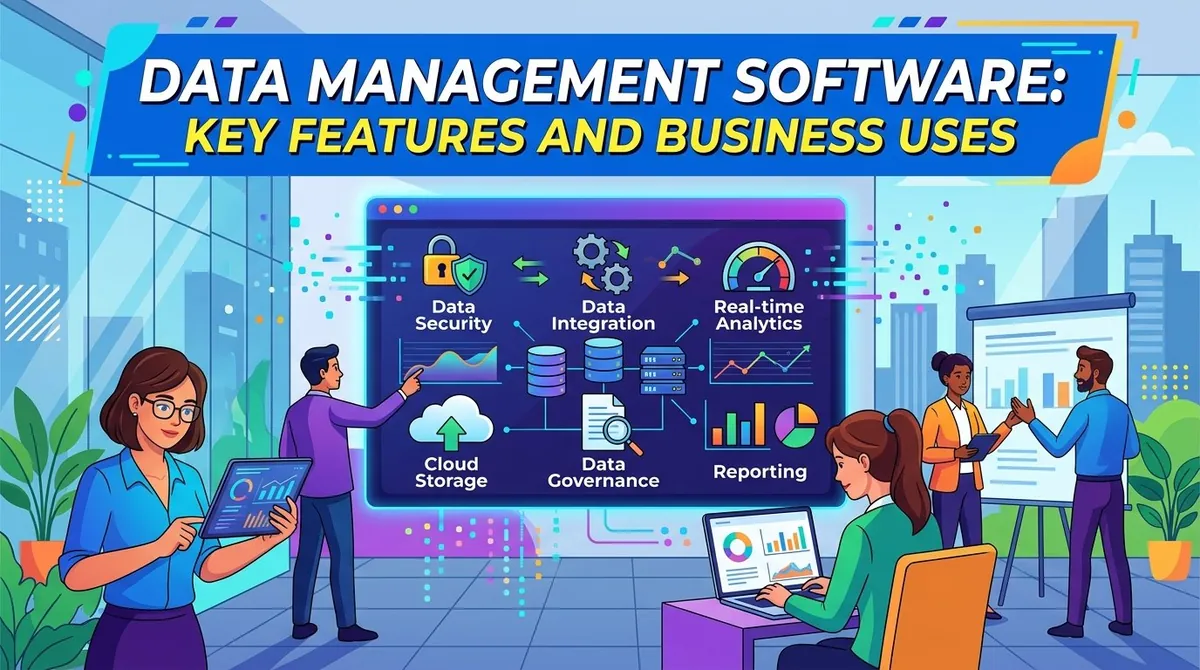
Organizations collect information from databases, applications, websites, customer interactions, financial systems, and other sources. As these data environments become more complex, businesses need reliable ways to organize, protect, maintain, and access their information.
Data management software provides tools for handling data throughout its lifecycle. Depending on the platform, these tools can support data integration, data quality, governance, metadata management, master data management, storage, security, and data discovery.
The right solution depends on the organization's data environment and objectives. Understanding the main features and business uses of data management software can help organizations determine which capabilities are most relevant to their needs.
What Is Data Management Software?
Data management software helps organizations collect, organize, integrate, maintain, govern, and use data. It can bring information together from multiple systems while providing processes for improving data quality and controlling access.
Data management is broader than simply storing information. Organizations also need to understand where data comes from, how it changes, who can access it, and whether it is accurate and consistent. IBM describes "data management as the practice of collecting, processing, and using data securely and efficiently."
Depending on the platform, data management software may address one specific area or combine several capabilities into a broader data management environment.
Key Features of Data Management Software
Data Integration
Organizations often have information distributed across databases, cloud applications, enterprise systems, spreadsheets, and other sources.
Data integration capabilities can connect these sources and make information available for operational systems, reporting, analytics, and other business processes. Integration is particularly important when different departments maintain separate systems that contain overlapping information.
Data Quality Management
Data quality affects how useful information is for reporting and decision-making. Common quality dimensions include accuracy, completeness, consistency, conformity, timeliness, and uniqueness.
Data management software may provide profiling, validation, cleansing, standardization, and monitoring tools to help identify and correct quality problems.
Master Data Management
Master data refers to important business entities such as customers, products, suppliers, and locations.
Master data management (MDM) helps organizations maintain consistent information about these entities across different systems. MDM tools can match duplicate records, reconcile differences, and create unified records that can be shared across applications.
For example, a company may have the same customer represented differently in its sales, billing, and customer-service systems. MDM processes can help establish a consistent customer record.
Data Governance
Data governance establishes policies and responsibilities for how data is collected, managed, protected, and used.
Governance capabilities may include data ownership, access policies, business definitions, quality rules, stewardship workflows, and compliance monitoring. These controls can help organizations establish consistent practices across departments.
Metadata and Data Discovery
Metadata describes information about data, such as where it originates, what it represents, and how it is used.
Data discovery tools can help employees locate relevant datasets and understand their context. Data catalogs and lineage capabilities can also provide visibility into relationships between data sources, transformations, reports, and other assets.
Data Security
Data management platforms may include access controls, authentication, encryption, auditing, and other security capabilities.
Security requirements vary depending on the type of information being managed. Organizations handling financial, customer, employee, or other sensitive information should evaluate how a platform supports their internal security policies and applicable regulatory requirements.
Data Lineage
Data lineage tracks how information moves and changes from its original source through different systems and processes.
For example, lineage can help an analyst determine which source systems contributed to a metric displayed in a business report. This visibility can support troubleshooting, governance, auditing, and confidence in analytical results.
Business Uses of Data Management Software
Data management software can support a wide range of organizational activities.
**Business intelligence:** Organizations can provide analytics teams with more consistent and accessible information for dashboards and reporting.
**Customer management:** Businesses can consolidate customer information from sales, marketing, service, and other systems.
**Operations:** Data management can help organizations maintain consistent product, inventory, supplier, and location information.
**Compliance:** Governance and audit capabilities can help organizations document how important data is managed and accessed.
**Artificial intelligence:** Reliable and well-governed data can provide a stronger foundation for analytics and AI initiatives.
Data Management Software vs. Database Software
Data management software and database software are related but serve different purposes.
A database system primarily provides an environment for storing and retrieving structured information. A data management solution can address a broader range of activities, including integration, quality, governance, metadata, security, lineage, and master data.
In practice, organizations may use databases as part of a larger data management architecture rather than treating the database as the complete data management solution.
How to Choose Data Management Software
Organizations should begin by identifying their most important data challenges.
Key considerations include:
- Data sources: What systems and data types need to be connected?
- Data quality: Does the organization need cleansing, validation, profiling, or monitoring?
- Governance: What policies, ownership structures, and compliance requirements apply?
- Integration: Can the software work with existing databases, applications, and cloud services?
- Scalability: Can it support increasing data volumes and additional users?
- Security: Does it provide appropriate access controls and auditing?
- Usability: Can business users and technical teams work with the platform effectively?
- Deployment: Does the organization require cloud, on-premises, or hybrid deployment?
A practical evaluation should also consider implementation requirements, ongoing administration, licensing costs, and integration effort.
Examples of Data Management Solutions
Data management is a broad category, and vendors offer solutions covering different parts of the data lifecycle.
IBM provides data management, governance, integration, and master data management technologies. Its MDM solutions focus on unifying information across organizational silos and managing critical entities such as customers and products.
Microsoft Purview provides capabilities for data governance, discovery, data quality, and data management across organizational data environments.
The appropriate solution depends on the organization's architecture and requirements rather than simply the number of available features.
Final Thoughts
Data management software can help organizations bring structure to increasingly complex data environments. Its capabilities may range from integration and data quality to governance, security, metadata management, and master data management.
The most important consideration is how well the software addresses the organization's specific data challenges. Businesses should evaluate their existing systems, data quality requirements, governance policies, security needs, and future analytics or AI plans before selecting a solution.
A well-designed data management approach can make information easier to access, maintain, and trust while providing a stronger foundation for business operations and analytics.
References
- IBM. "What Is Data Management?" — IBM Data Management
- IBM. "What Is Master Data Management?" — IBM Master Data Management
- Microsoft. "Master Data Management in Microsoft Purview." — Microsoft Purview Master Data Management
- Microsoft. "Microsoft Purview Data Governance." — Microsoft Purview Data Governance
- IBM. "Master Data Management Solutions." — IBM Master Data Management Solutions