


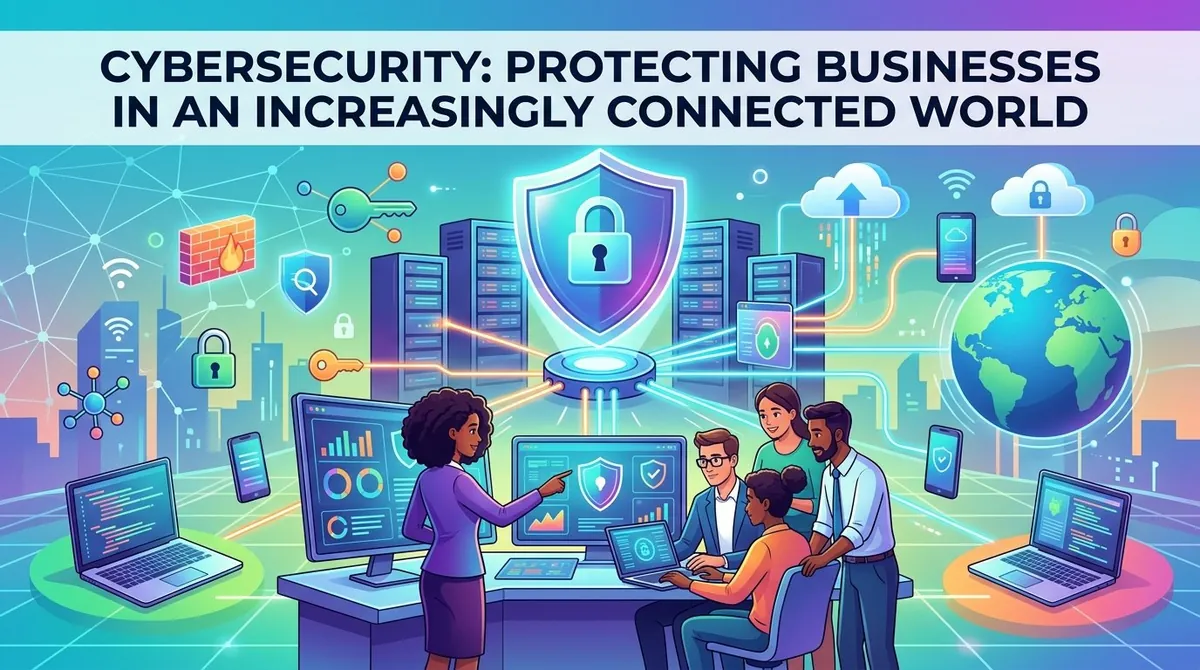
As businesses become more dependent on digital systems, cybersecurity has become an important part of everyday operations. Companies rely on connected applications, cloud platforms, databases, employee devices, and online services to communicate with customers and manage critical processes.
This growing connectivity creates new opportunities but also expands the number of systems that organizations need to protect. Effective cybersecurity is therefore not simply a technical concern for IT departments. It is a business responsibility involving technology, employees, processes, and organizational risk management.
Understanding Cybersecurity in Business
Cybersecurity refers to the practices and technologies used to protect systems, networks, applications, and information from unauthorized access, disruption, alteration, or destruction.
Businesses can face many types of cyber threats, including phishing, malware, ransomware, credential theft, and unauthorized access. The potential consequences can range from temporary operational disruption to financial losses, data exposure, and damage to customer relationships.
A strong cybersecurity strategy aims to reduce these risks while allowing employees and customers to use digital services efficiently.
Why Connected Businesses Face Greater Risk
Modern organizations rarely operate through a single technology system. Employees may access cloud applications from multiple locations, while companies connect internal systems with suppliers, payment platforms, customers, and other external services.
This interconnected environment can increase efficiency but also creates additional points that need to be secured. A compromised employee account, poorly configured application, or vulnerable device can potentially provide an entry point into other systems.
Businesses therefore need to consider cybersecurity across the entire technology environment rather than focusing only on a central network or individual devices.
Protecting Business Data
Data is one of the most important assets that organizations need to protect. Businesses may hold customer information, financial records, employee details, intellectual property, contracts, and other sensitive material.
Access controls can help ensure that employees and systems only have access to information required for their responsibilities. Encryption can provide additional protection by making information more difficult to use if it is accessed without authorization.
Regular backups are also an important part of resilience. Maintaining reliable copies of critical information can help organizations recover from certain forms of data loss or disruption.
Managing Employee and Account Security
Employees play an important role in cybersecurity because many attacks attempt to exploit human behavior. Phishing messages, fraudulent login pages, and social engineering techniques can encourage users to reveal credentials or provide unauthorized access.
Organizations can reduce some of these risks through security awareness training and clear internal procedures. Multi-factor authentication can also provide an additional layer of protection when passwords are compromised.
Businesses should regularly review user permissions as well. Employees who change roles or leave an organization should not retain unnecessary access to systems and information.
Building a Cybersecurity Strategy
A practical cybersecurity strategy should combine preventive controls, monitoring, employee awareness, and recovery planning. Organizations can begin by identifying their most important systems and understanding the risks associated with them.
A structured approach can include:
- Identify critical assets: Determine which systems, applications, devices, and information are essential to business operations.
- Assess risks: Identify potential threats, vulnerabilities, and consequences associated with critical assets.
- Strengthen access controls: Use appropriate authentication, permissions, and account-management procedures.
- Monitor systems: Look for unusual activity that may indicate a security incident.
- Prepare for recovery: Establish backup, incident-response, and business-continuity procedures.
- Review continuously: Update security measures as technology, threats, and business operations change.
This approach helps cybersecurity become part of ongoing business management rather than a one-time technical project.
Cloud Computing and Cybersecurity
The adoption of cloud services has changed how organizations approach security. Businesses may no longer control every physical component of the infrastructure supporting their applications and data.
Cloud providers can provide significant security capabilities, but organizations remain responsible for how they configure services, manage accounts, protect information, and control access.
Businesses should understand the security responsibilities associated with each cloud service they use. Misconfigured permissions, weak credentials, or unnecessary access can create risks even when the underlying cloud infrastructure is professionally managed.
Responding to Cybersecurity Incidents
No security strategy can guarantee that an organization will never experience an incident. Businesses therefore need to prepare for the possibility that an attack or security failure may occur.
An incident-response plan can establish who is responsible for identifying, containing, investigating, and communicating during a security event. Clear procedures can help reduce confusion when decisions need to be made quickly.
Recovery planning is equally important. Businesses should know which systems need to be restored first, where backup information is stored, and how operations can continue while affected systems are being investigated or rebuilt.
Measuring Cybersecurity Performance
Cybersecurity performance can be difficult to measure because preventing an incident is different from generating a conventional business output. Organizations can nevertheless track indicators that provide insight into their security posture.
Useful measures may include the number of unresolved vulnerabilities, employee training participation, multi-factor authentication coverage, incident response times, backup recovery results, and the time required to address identified security issues.
Regular measurement can help management understand whether security processes are improving and where additional resources may be required.
Common Cybersecurity Challenges
Businesses can encounter several obstacles when strengthening cybersecurity. Smaller organizations may have limited technical resources, while larger companies may need to secure complex environments containing many systems and users.
Another challenge is maintaining security without creating unnecessary friction for employees. Excessively complicated procedures can encourage users to look for workarounds, while insufficient controls can leave important systems exposed.
Cybersecurity also needs to evolve continuously. New technologies, business models, and attack techniques can change the risk environment, making regular reviews essential.
The Future of Business Cybersecurity
As businesses continue adopting cloud computing, artificial intelligence, connected devices, and other digital technologies, cybersecurity will become increasingly integrated with broader technology and operational strategies.
Organizations are likely to place greater emphasis on continuous monitoring, identity management, automated security processes, and resilience. Cybersecurity will also increasingly involve collaboration between technology teams, business leaders, employees, suppliers, and other stakeholders.
The goal is not simply to build more defensive technology. Businesses need to create systems and processes that allow them to prevent, detect, respond to, and recover from security incidents while continuing to operate effectively.
In an increasingly connected business environment, cybersecurity is therefore closely connected to operational resilience. Organizations that treat security as an ongoing business discipline can better understand their digital risks and build stronger foundations for long-term growth.