


September 24, 2026 • Daniel Brooks
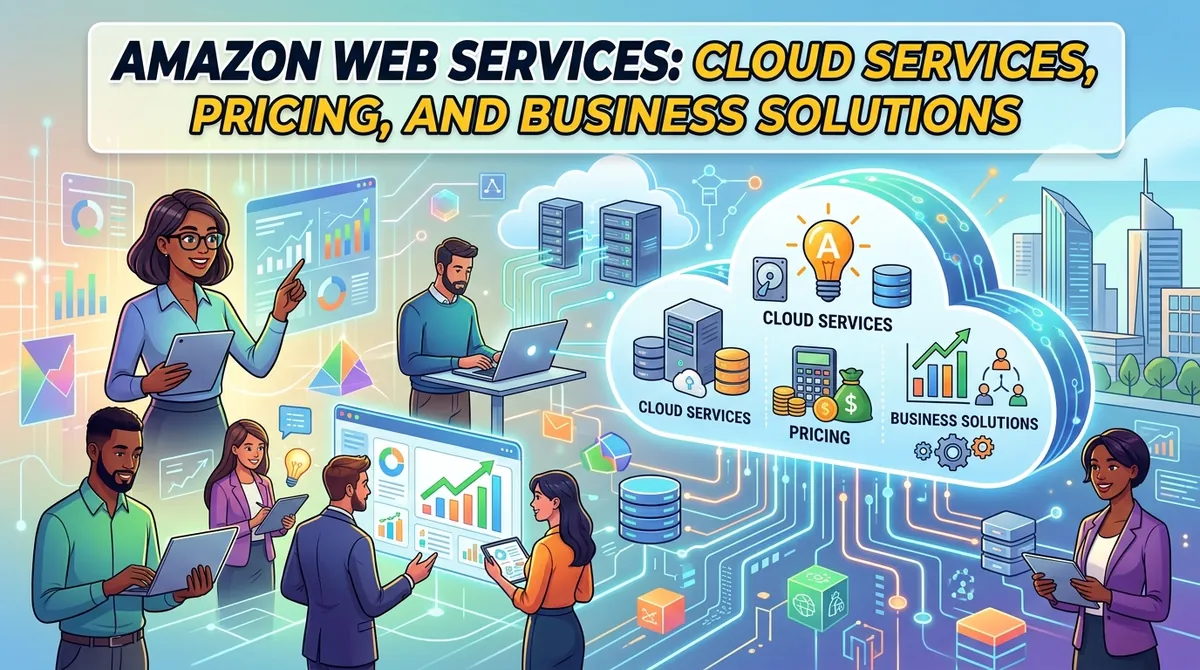
Amazon Web Services (AWS) is a cloud computing platform that provides infrastructure, application development, data storage, databases, networking, security, analytics, artificial intelligence, and other technology services. Organizations can use individual AWS services or combine them into larger cloud architectures according to their technical and business requirements.
AWS operates a broad portfolio of cloud services rather than selling one standardized software package. AWS currently provides more than 240 services across categories including compute, storage, databases, networking, analytics, machine learning, security, migration, developer tools, and business applications.
The platform uses usage-based pricing for most services, allowing organizations to pay for the resources they consume. This model provides flexibility but also means that businesses need to monitor usage and select appropriate pricing options as workloads grow.
What Is Amazon Web Services?
Amazon Web Services is Amazon's cloud computing platform. It provides on-demand access to computing infrastructure and managed services through the AWS Management Console, command-line tools, software development kits, and APIs.
Instead of purchasing and maintaining physical servers, organizations can provision cloud resources when needed. They can increase or decrease capacity based on workload requirements and deploy applications across AWS Regions and Availability Zones.
AWS can therefore support both small development projects and large production environments.
Amazon EC2 and Cloud Computing
Amazon Elastic Compute Cloud (EC2) provides virtual computing capacity in the AWS Cloud. Businesses can select instance types based on processing, memory, storage, networking, and other requirements.
EC2 can be used for websites, applications, databases, development environments, data processing, and many other workloads. Organizations can also scale computing resources as demand changes.
AWS offers several EC2 purchasing models, including On-Demand Instances, Savings Plans, Spot Instances, and Reserved Instances. Each model is designed around different usage and commitment requirements.
Amazon S3 and Cloud Storage
Amazon Simple Storage Service (S3) provides object storage for files, application data, backups, media, datasets, and other information.
Businesses can use S3 for website assets, data lakes, backups, archives, and application storage. Storage classes allow organizations to select different cost and access characteristics depending on how frequently data is expected to be used.
S3 can also integrate with analytics, machine learning, security, and backup services throughout the AWS ecosystem.
AWS Database Services
AWS provides several database technologies rather than requiring every application to use the same database system.
Amazon RDS is a managed relational database service supporting engines such as MySQL, PostgreSQL, MariaDB, Oracle, and SQL Server. Amazon Aurora provides a cloud-oriented relational database compatible with MySQL and PostgreSQL.
For applications requiring NoSQL databases, Amazon DynamoDB provides a managed database designed for applications that need scalable performance without managing traditional database infrastructure.
Businesses can therefore select database technologies according to application architecture and operational requirements.
Serverless Computing with AWS Lambda
AWS Lambda allows developers to run code without provisioning or managing servers. Applications can execute functions in response to events, requests, file uploads, database activity, and other triggers.
This serverless approach can be useful for APIs, automation, event processing, scheduled tasks, and applications with variable workloads.
AWS charges Lambda according to factors such as requests and compute duration, making it different from continuously running virtual servers.
Networking and Content Delivery
AWS provides networking services for connecting cloud resources and delivering applications to users.
Amazon Virtual Private Cloud (VPC) allows organizations to create logically isolated networks for AWS resources. Businesses can configure subnets, routing, security controls, and connectivity according to application requirements.
Other services support DNS, load balancing, content delivery, private connectivity, and global application distribution.
These networking capabilities allow companies to construct architectures that separate application components while controlling how systems communicate.
Artificial Intelligence and Machine Learning
AWS provides a broad collection of artificial intelligence and machine learning services.
Amazon Bedrock provides access to foundation models through managed APIs, while Amazon SageMaker AI provides tools for developing, training, deploying, and managing machine learning models.
AWS also provides specialized AI services for areas such as text analysis, image processing, speech, search, and generative AI applications.
These services allow organizations to add AI capabilities without necessarily building every underlying infrastructure component themselves.
Analytics and Data Services
AWS provides services for collecting, storing, processing, and analyzing large volumes of data.
Organizations can combine services such as S3, Amazon Redshift, Amazon Athena, Amazon Kinesis, and AWS Glue to build data pipelines and analytics environments.
These tools can support business intelligence, data warehousing, real-time analytics, data engineering, and machine learning workflows.
Because AWS services can be combined, organizations can construct architectures ranging from simple reporting environments to large-scale data platforms.
AWS Security and Identity
AWS provides security services for controlling access, protecting workloads, monitoring activity, and supporting compliance requirements.
AWS Identity and Access Management (IAM) allows organizations to define permissions and control which users, applications, and services can access specific AWS resources. IAM supports granular permissions, temporary credentials, multi-factor authentication, and identity federation.
AWS also provides services such as CloudTrail, GuardDuty, Security Hub, WAF, KMS, and Secrets Manager for logging, threat detection, security monitoring, encryption, and credential management.
AWS follows a shared responsibility model: AWS manages security of the underlying cloud infrastructure, while customers remain responsible for security configurations and data within their workloads according to the services they use.
AWS Business Solutions
AWS provides cloud solutions for organizations across many industries and business functions. Common applications include:
- Website and application hosting
- Cloud migration
- Backup and disaster recovery
- Data analytics
- Artificial intelligence
- Ecommerce infrastructure
- Digital media
- Enterprise application modernization
- Software development
- Remote and hybrid workloads
AWS also provides solutions and partner offerings designed to address specific business and industry requirements. Small and medium-sized businesses can use AWS for cloud migration, backup, AI, storage, and other technology requirements.
AWS Pricing
AWS generally uses pay-as-you-go pricing. Customers pay for the individual services and resources they consume rather than purchasing one universal AWS subscription.
This means total costs depend on factors such as computing hours, storage volume, database usage, network transfer, API requests, and other service-specific measurements.
AWS provides a Pricing Calculator that allows organizations to estimate costs based on their planned architecture.
AWS also offers Savings Plans and other pricing models for workloads with predictable usage. Savings Plans provide discounted pricing in exchange for a one- or three-year usage commitment.
For new customers, AWS currently offers a Free Tier structure that can provide up to $200 in credits, including $100 in initial credits and opportunities to earn additional credits. The Free account plan can be used for up to six months, subject to its terms and credit limits.
AWS for Growing Businesses
AWS can support businesses as their technology requirements change. A startup may initially use a small number of services for hosting and storage, while a larger organization can operate distributed applications, data platforms, AI workloads, and enterprise systems across multiple AWS Regions.
The ability to provision resources on demand can reduce the need for businesses to purchase physical infrastructure before they know how much capacity they will require.
At the same time, cloud flexibility makes cost management important. Organizations should establish budgets, monitor usage, review architecture, and evaluate pricing models as workloads develop.
How Businesses Evaluate AWS
Businesses evaluating AWS should consider application requirements, technical skills, data volumes, security requirements, geographic coverage, integration needs, and expected workload growth.
Cost should be evaluated at the architecture level rather than by looking at one service price. Compute, storage, databases, networking, monitoring, support, and third-party services can all contribute to the final bill.
Organizations should also determine whether they need managed services, serverless architecture, dedicated infrastructure, or a combination of different cloud technologies.
Final Thoughts
Amazon Web Services provides a broad cloud platform covering compute, storage, databases, networking, analytics, artificial intelligence, security, and application development.
Its service-based architecture allows businesses to select individual components and combine them into customized cloud environments. The pay-as-you-go model provides flexibility, while Savings Plans and other pricing options can support more predictable workloads.
For businesses evaluating AWS, the main considerations are architecture, security, workload requirements, technical resources, geographic needs, and ongoing cloud costs. AWS's large service portfolio makes detailed planning and cost monitoring important parts of operating the platform.
About the Author
Daniel Brooks, 41, is a business technology consultant at [website name], specializing in data strategy, operational efficiency, and business intelligence. He helps organizations improve how they manage information and use data to support strategic and operational decisions.
References
- AWS — Cloud Services
- AWS — AWS Pricing
- AWS — AWS Free Tier
- AWS Documentation — AWS Services by Category
- AWS Documentation — Choosing an EC2 Purchasing Option
- AWS — AWS Savings Plans
- AWS Documentation — AWS Identity and Access Management
- AWS Documentation — AWS Security and Shared Responsibility
- AWS — Cloud Solutions for Small and Medium Businesses