


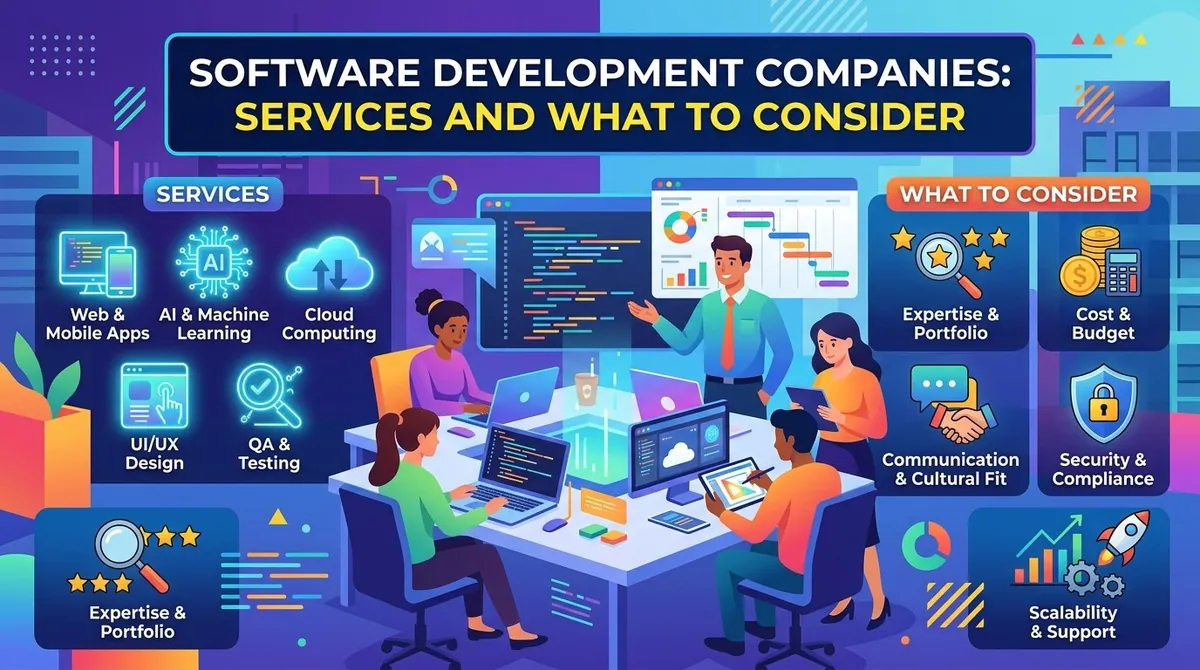
Businesses increasingly rely on software to manage operations, serve customers, analyze information, and deliver digital products. When internal teams do not have the resources or specialized skills required for a project, a software development company can provide the technical expertise needed to design, build, deploy, and maintain applications.
Software development companies can support projects ranging from websites and mobile applications to enterprise platforms, cloud systems, and custom business software. Their services may cover the full development lifecycle or focus on specific areas such as application modernization, testing, cybersecurity, or ongoing maintenance.
Choosing a development company requires more than comparing technical capabilities. Businesses also need to consider project requirements, industry experience, communication, security practices, development methodology, pricing, and long-term support.
What Is a Software Development Company?
A software development company is a technology organization that provides services for designing, developing, testing, deploying, and maintaining software applications. Depending on the provider, services may include custom software development, mobile and web application development, cloud development, software consulting, and application modernization.
Some companies work on complete projects from initial requirements through deployment and maintenance. Others specialize in particular technologies, industries, development stages, or types of applications.
Modern development practices may also include automation, continuous integration and deployment, cloud-native architectures, and security practices integrated throughout the software lifecycle.
Common Services Offered by Software Development Companies
Custom Software Development
Custom software development involves creating applications around a company's specific requirements rather than relying entirely on an off-the-shelf product. Projects may include internal business systems, customer portals, workflow applications, or specialized platforms.
Custom development can be useful when existing software does not provide the required functionality or cannot integrate effectively with existing systems.
Web and Mobile Application Development
Many development companies create web applications, mobile applications, and cross-platform solutions. Services can include user interface development, backend programming, APIs, databases, authentication, testing, and deployment.
Mobile development may target platforms such as iOS and Android, while web applications can be designed for browsers and cloud-based environments. IBM, for example, describes application development services covering mobile applications, APIs, backend systems, and web frameworks.
Cloud Application Development
Cloud development focuses on applications designed to run on cloud infrastructure and services. Development companies may help organizations build new cloud-native applications or adapt existing applications for cloud environments.
Cloud projects can involve containerization, microservices, automated deployment, application integration, and cloud infrastructure.
Application Modernization
Organizations with older applications may use development companies to modernize existing systems. Modernization can involve updating application architecture, moving workloads to cloud environments, replacing outdated components, or improving integration capabilities.
The objective is often to extend the useful life of existing software while improving maintainability, scalability, or compatibility with newer technologies.
Software Testing and Quality Assurance
Testing helps identify functional problems, compatibility issues, performance limitations, and security vulnerabilities before software reaches users.
Development companies may provide automated testing, integration testing, performance testing, regression testing, and user acceptance support. Automated builds and regression testing can also form part of continuous delivery processes.
Maintenance and Application Support
Software development does not necessarily end when an application is launched. Companies may provide ongoing maintenance, bug fixes, performance monitoring, security updates, feature development, and technical support.
Long-term maintenance can be particularly important for business-critical applications that need regular updates as operating systems, cloud platforms, dependencies, and business requirements change.
Benefits of Working With a Software Development Company
Businesses may work with external development companies for several reasons:
- Access to specialized skills: External teams may provide expertise in programming languages, architectures, cloud platforms, or industry-specific technologies.
- Additional development capacity: Companies can supplement internal teams without hiring permanent employees for every project.
- Project flexibility: External resources can be scaled according to project requirements and development stages.
- Technology modernization: Specialized providers can assist with cloud migration, application modernization, and newer development approaches.
- Ongoing support: Some providers offer maintenance and application management after deployment.
The value of outsourcing depends on the project's scope, the provider's capabilities, and how effectively the external team works with internal stakeholders.
What to Consider When Choosing a Software Development Company
Technical Experience
Review the company's experience with the technologies required for the project. Relevant capabilities may include programming languages, databases, cloud platforms, APIs, mobile frameworks, cybersecurity, and data systems.
Past projects can provide useful evidence of whether the provider has worked on applications with similar technical requirements.
Industry and Project Experience
Technical knowledge is only one consideration. Experience with similar industries, business models, regulations, or application types may help a development team understand project requirements more efficiently.
Businesses can review case studies, previous projects, client references, and examples of completed applications where available.
Development Process
Ask how the company manages requirements, development, testing, releases, and changes. A clearly defined process can make responsibilities easier to understand.
Businesses should also determine how the provider handles source control, documentation, code reviews, testing, deployment, and project reporting.
Security
Security should be considered throughout the software development lifecycle rather than only after an application is completed. Secure development practices can include access controls, vulnerability testing, dependency management, code review, and security testing.
Microsoft's Security Development Lifecycle guidance emphasizes integrating security practices into development and DevOps processes.
Communication and Collaboration
Communication can affect project timelines and outcomes. Before selecting a provider, clarify who will manage the project, how frequently updates will be provided, which collaboration tools will be used, and how technical decisions will be documented.
Pricing and Contract Structure
Development pricing can be structured in different ways, including fixed-price projects, time-and-materials arrangements, dedicated development teams, or ongoing service agreements.
Businesses should examine what is included in the quoted price, including development, testing, infrastructure, support, maintenance, and future changes. The lowest initial quote does not necessarily represent the lowest total project cost.
Post-Launch Support
Determine what happens after deployment. Important questions include whether the company provides bug fixes, security updates, monitoring, technical support, and future development.
It is also useful to clarify ownership of source code, documentation, intellectual property, credentials, and other project assets before work begins.
Software Development Company vs. In-House Team
An in-house development team consists of employees working directly for the organization, while an external software development company provides services under a contract or project agreement.
In-house teams can offer close organizational knowledge and direct control over development priorities. External companies can provide additional technical expertise and development capacity without requiring permanent hiring for every skill.
Some organizations use a hybrid model, keeping product ownership and key technical roles internally while using external developers for specialized projects or additional capacity.
Final Thoughts
Software development companies can support businesses across the full application lifecycle, from planning and custom development to testing, deployment, modernization, and ongoing maintenance. Their services can cover web and mobile applications, cloud software, enterprise systems, integrations, and specialized business solutions.
When evaluating a provider, businesses should look beyond technical capabilities and consider development processes, security, communication, pricing, relevant experience, ownership arrangements, and post-launch support. A clear understanding of project requirements and responsibilities can make it easier to establish an effective working relationship and manage software development over time.