


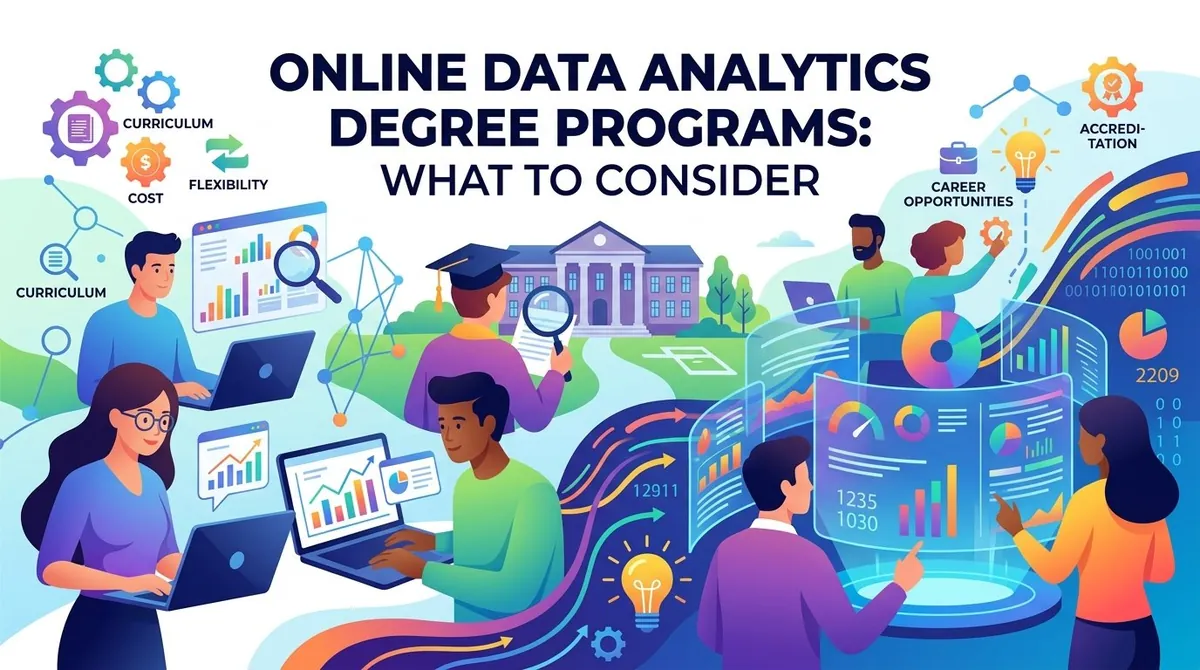
Data analytics has become an important part of how organizations evaluate performance, understand customers, manage operations, and make decisions. As businesses collect information from more sources, professionals need skills that combine data analysis, technology, statistics, and communication.
Online data analytics degree programs provide an alternative to traditional campus-based education. Depending on the institution, students may be able to complete bachelor's or master's programs remotely while developing skills in programming, statistics, databases, visualization, and business analytics.
However, online programs can differ significantly in curriculum, admission requirements, learning format, cost, and technical depth. Students should examine these factors carefully rather than choosing a program based only on its title or online format.
What Is an Online Data Analytics Degree?
An online data analytics degree is an academic program that teaches students how to collect, prepare, analyze, visualize, and communicate information using digital tools and analytical methods.
Programs are available at different educational levels. Bachelor's programs generally provide broader foundational training, while master's programs typically offer more advanced coursework and specialization.
For example, current online programs can include subjects such as data management, programming, statistical analysis, machine learning, data visualization, and data storytelling. WGU's online master's program, for example, includes coursework in data management, analytics programming, data preparation, statistical data mining, and visualization. (WGU)
Types of Online Data Analytics Programs
Online Bachelor's Degrees
A bachelor's degree can provide foundational preparation for students entering the analytics field. Coursework may include statistics, programming, databases, data visualization, business intelligence, and data management.
Some programs also include broader business, communication, or information technology courses.
An online bachelor's degree can be particularly useful for students who want a full undergraduate education without attending classes on a physical campus.
Online Master's Degrees
Master's programs generally provide more advanced analytical training. Students may study predictive analytics, machine learning, advanced statistics, data mining, data engineering, or specialized business applications.
Some programs allow students to select concentrations. For example, WGU's online master's in data analytics offers specialization options in data science, data engineering, and decision process engineering. (WGU)
Certificates and Graduate Certificates
Students who do not need a full degree may consider shorter certificate programs. These can focus on specific skills such as business intelligence, data visualization, SQL, or statistical analysis.
A certificate may be useful for professionals who already have a degree and want to add technical analytics skills.
What Students Learn
The curriculum is one of the most important aspects to compare when evaluating online programs.
**Statistics**
Statistics provides a foundation for understanding distributions, relationships, uncertainty, and analytical results. Coursework may include probability, descriptive statistics, regression, statistical inference, and hypothesis testing.
**Programming**
Programming allows students to automate analytical tasks and work with larger datasets. Depending on the program, students may use Python, R, SQL, or other programming languages.
**Data Management**
Data management courses can cover databases, data structures, data quality, data preparation, and querying. These skills help students understand how information is stored and prepared for analysis.
**Data Visualization**
Students learn how to present analytical findings through charts, dashboards, and other visual formats. Visualization is particularly important when analysts need to communicate results to nontechnical audiences.
**Machine Learning**
More advanced programs may introduce supervised and unsupervised learning, predictive modeling, classification, clustering, and model evaluation.
Not every analytics degree has the same level of machine learning content, so students interested in data science should compare course requirements carefully.
Online Learning Formats
Online degrees do not all operate in the same way.
Synchronous programs may require students to attend live online lectures or discussions at scheduled times.
Asynchronous programs allow students to access lectures, assignments, and other materials according to their own schedules.
Hybrid programs combine online learning with some campus-based requirements.
Students should also determine whether coursework is structured around traditional semesters or more flexible competency-based or self-paced formats. For example, WGU describes its online bachelor's data analytics program as competency-based, allowing students to progress as they demonstrate knowledge. (WGU)
What to Consider When Choosing a Program
**Curriculum**
Review the actual courses rather than relying on the degree name. A strong curriculum for an analytics-focused student may include statistics, SQL, programming, databases, visualization, and data preparation.
**Accreditation**
Students should verify the institution's accreditation status and understand which accrediting organization is involved. Accreditation requirements and recognition can differ by country and institution.
**Technical Requirements**
Online analytics programs may require a reliable computer, internet connection, and access to specialized software or cloud platforms. Students should check technical requirements before enrolling.
**Faculty and Student Support**
Online students may need access to instructors, academic advisers, technical support, tutoring, and career services. These services can affect the overall learning experience.
**Cost**
Students should compare total program costs rather than focusing only on advertised tuition. Additional expenses may include technology, textbooks, software, course materials, and fees.
Financial aid, transfer credits, and employer tuition assistance may also affect the total cost.
**Practical Experience**
A degree can provide theoretical knowledge, but practical experience can help students demonstrate what they can do with that knowledge.
Students can look for programs that include capstone projects, internships, applied assignments, or portfolio development.
For example, a project might involve cleaning a dataset, analyzing trends, creating a dashboard, and presenting recommendations based on the results.
Building independent projects with public datasets can also help students develop a portfolio. Projects can cover subjects such as customer behavior, sales performance, financial data, healthcare, transportation, or environmental information.
Career Paths After an Online Data Analytics Degree
An online degree does not necessarily limit graduates to a particular occupation. Career options depend on the student's education, technical skills, experience, and the requirements of individual employers.
Potential roles include:
Data analyst: Examines datasets, identifies trends, creates reports, and communicates findings.
Business intelligence analyst: Develops dashboards, reports, and performance metrics for organizations.
Business analyst: Uses data and business information to examine processes and support organizational decisions.
Data scientist: Applies statistical and computational methods to analyze data and develop models. The U.S. Bureau of Labor Statistics lists a bachelor's degree as the typical entry-level education for data scientists, while noting that some employers require or prefer graduate education. (BLS)
Operations research analyst: Uses quantitative methods to examine complex business and operational problems. BLS lists a bachelor's degree as the typical entry-level education for this occupation. (BLS)
Online Degree vs. Campus Program
Online and campus programs can cover similar academic subjects, but the learning experience may differ.
Online education can provide greater scheduling flexibility, particularly for students balancing employment or other responsibilities. Campus programs may provide more opportunities for in-person interaction, structured classroom environments, and on-site activities.
The quality of a program should therefore be evaluated based on curriculum, accreditation, faculty, student support, practical opportunities, and outcomes rather than delivery format alone.
How to Prepare for an Online Data Analytics Degree
Students without an analytics background can prepare by developing basic skills before beginning a program.
Useful areas include:
- Algebra and basic statistics
- Spreadsheet skills
- Introductory SQL
- Basic Python or R
- Data visualization
- Problem-solving
- Written and verbal communication
Students can also explore introductory courses or free learning resources before enrolling. This can help them determine whether they are comfortable with the quantitative and technical aspects of analytics.
Final Thoughts
Online data analytics degree programs can provide flexible access to education in statistics, programming, data management, visualization, and analytical methods. Bachelor's programs can establish foundational skills, while master's programs may provide greater technical depth or opportunities for specialization.
When comparing programs, students should examine the curriculum, accreditation, learning format, technical requirements, cost, student support, and opportunities for practical experience.
The most useful program is not necessarily the one with the most courses or the most flexible schedule. Students should look for an education that matches their existing background and provides the specific analytical and technical skills needed for their intended career path.
References
- U.S. Bureau of Labor Statistics — "Data Scientists"
- U.S. Bureau of Labor Statistics — "Occupational Employment and Wage Statistics"
- Western Governors University — "Online Bachelor's in Data Analytics"
- Western Governors University — "Online Master's in Data Analytics"
- National Center for Education Statistics — "Accreditation in the United States"
- U.S. Bureau of Labor Statistics — "Education and Training Assignments by Detailed Occupation"