


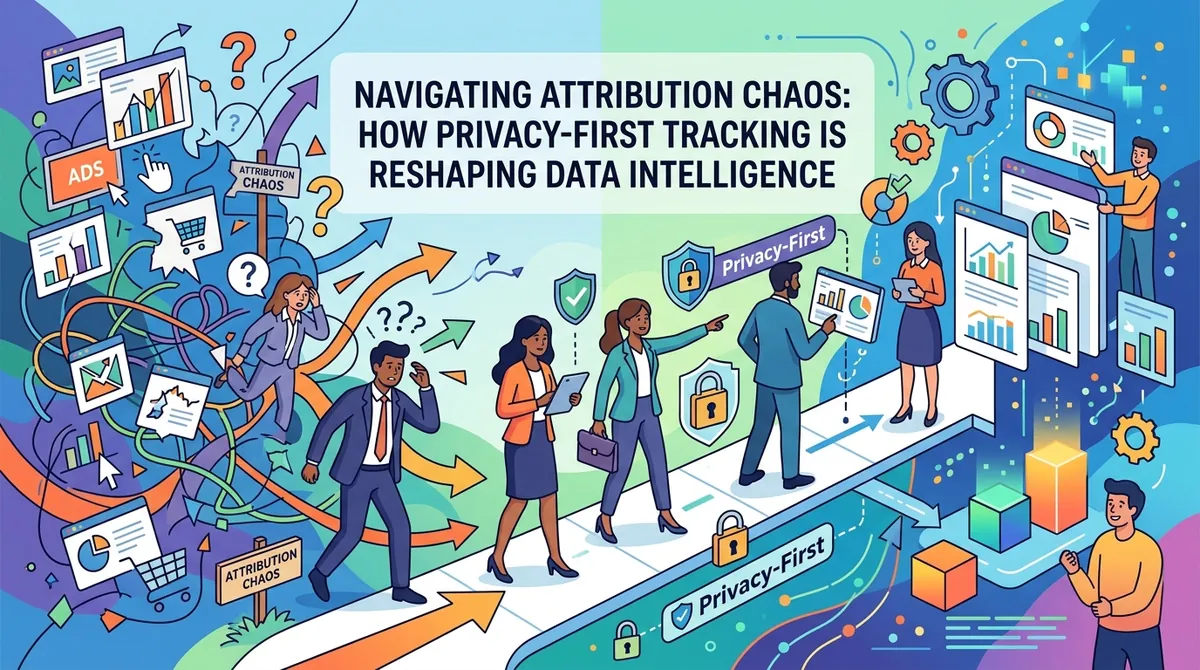
For over a decade, digital marketing operated on a comfortable illusion: deterministic tracking. Every click, scroll, add-to-cart, and conversion could be neatly stitched together across devices and domains using third-party cookies and mobile advertising identifiers (like Apple's former IDFA). Media buyers treated user journeys like transparent pipelines, optimizing campaigns down to the exact keyword or ad variant with surgical precision.
That pipeline is gone.
Between sweeping regulatory updates (GDPR, CCPA), native platform restrictions (Apple's App Tracking Transparency), and the ongoing deprecation of third-party cookies across major browsers, the digital ecosystem has plunged into attribution chaos. For modern organizations, the challenge is no longer about optimizing within a walled garden—it is about extracting actionable intelligence from a fragmented, privacy-first world where probabilistic modeling and server-side infrastructure have become mandatory survival tools.
1. The Anatomy of Signal Loss
To understand why traditional reporting dashboards are breaking down, we have to look at where the data is actually disappearing. Signal loss isn't a single event; it's a cumulative erosion happening across three main vectors:
- Browser-Level Restrictions: Safari's Intelligent Tracking Prevention (ITP) and Firefox's enhanced tracking protection systematically cap cookie lifespans and block cross-site tracking scripts, blinding client-side pixels within days or even hours of a user's initial touchpoint.
- Consent Opt-Outs: When presented with explicit consent banners, a significant percentage of users opt out of tracking entirely. This creates severe survivorship bias in analytics tools, as reporting is often skewed toward a non-representative subset of the actual audience.
- Device Fragmentation: Cross-device journeys—where a user discovers a brand on a mobile browser, researches on a desktop, and converts via a native app—defy simple last-click or linear attribution models when identity graphs fail to bridge the gaps.
When client-side pixels miss 30% to 50% of conversion events, automated bidding algorithms in ad platforms receive corrupted feedback loops. Scaling spend on incomplete data quickly leads to bloated Customer Acquisition Costs (CAC) and misallocated budgets.
2. Shifting the Architecture: From Client-Side to Server-Side
The first line of defense for data-mature organizations is migrating away from traditional browser-based tags toward Server-Side Tagging (SST).
In a legacy setup, a user's browser communicates directly with dozens of third-party vendors (Meta, TikTok, Google, analytics platforms), creating heavy page loads and exposing data to ad blockers. Server-side tracking routes that data through a centralized cloud container—such as Google Tag Manager Server-Side hosted on Cloud Run or AWS—before distributing cleaned, first-party data to your ad platforms and data warehouses.
This architecture flows in three clear steps:
- 1The First-Party Request: The user's browser sends event data directly to your server-side cloud container rather than third-party domains.
- 2Data Processing: Inside the cloud container, the system strips unauthorized cookies, enriches the payload with secure first-party context, and respects granular user consent signals.
- 3Secure Distribution: Cleaned data is dispatched via secure APIs (such as Meta's CAPI or Google's Measurement Protocol) to your downstream ad platforms and data storage.
Strategic Advantages of Server-Side Infrastructure
- Extended Cookie Lifespan: Because tracking requests originate from a custom domain rather than a third-party script, cookies can be set as HTTP-only and first-party, significantly bypassing aggressive browser restrictions.
- Data Governance & Privacy Compliance: Organizations gain absolute control over what data leaves their perimeter. PII (Personally Identifiable Information) like email addresses or phone numbers can be hashed before reaching external ad networks, satisfying strict privacy mandates.
- Performance Gains: Removing heavy client-side JavaScript scripts improves site speed, directly boosting conversion rates and Core Web Vitals scores.
3. Embracing the Post-Cookie Measurement Stack
With deterministic multi-touch attribution (MTA) effectively obsolete for cross-domain traffic, data intelligence teams are shifting toward a hybrid measurement framework. Relying on a single source of truth is a structural vulnerability; resilience now requires triangulation.
A. Marketing Mix Modeling (MMM) Makes a Comeback
Long dismissed by digital marketers as an outdated, top-down statistical method used by enterprise TV advertisers, MMM has undergone a massive renaissance. Modern machine learning-driven MMM uses time-series econometrics to analyze macro-level inputs (spend across channels, macroeconomic indicators, seasonality, pricing changes) against business outcomes (revenue, profit) without requiring user-level tracking. It answers the fundamental boardroom question: If I increase budget on Channel X by 20%, what is the true incremental lift on total revenue?
B. Incrementality Testing as the New Gold Standard
Instead of asking "Who clicked what?", forward-thinking teams run geo-based or audience-split incrementality experiments. By holding out specific geographic regions or user cohorts from seeing ads, brands can measure true additionality—proving whether a conversion actually happened because of the ad, or if the user would have converted organically anyway.
C. Advanced Conversion Modeling
Platforms like Meta and Google now rely heavily on machine learning to bridge conversion gaps. By feeding hashed first-party data and server-side Conversion API (CAPI) signals into ad platforms, algorithmic models predict missed conversions based on historical correlations, restoring directional accuracy to campaign reporting.
4. Operationalizing Privacy-First Data Intelligence
Transitioning an organization out of attribution chaos requires structural changes across both technology stacks and team workflows.
- 1Audit Your Data Ingestion: Move away from relying solely on out-of-the-box front-end pixels. Implement server-side containerization to secure your data pipeline and protect against signal degradation.
- 2Realign KPIs Around Blended Metrics: Stop obsessing over platform-reported ROAS (Return on Ad Spend), which is inherently prone to double-counting and self-attribution bias. Focus instead on Blended CAC and Contribution Margin at the portfolio level.
- 3Upskill the Analytics Function: Digital marketers can no longer just be media buyers or creative directors; they must understand data plumbing, data hygiene, and basic statistical validation to interpret MMM outputs and incrementality experiments accurately.
Conclusion
Attribution chaos is not a temporary glitch to be patched over with a new browser extension; it is the permanent baseline of the modern digital economy. Organizations that cling to the illusion of perfect, deterministic user-level tracking will continue to bleed capital on misinformed optimizations.
Conversely, those that embrace server-side infrastructure, statistical triangulation (combining MMM with incrementality testing), and privacy-first data governance will turn regulatory constraints into a competitive moat. In the new era of data intelligence, clarity doesn't come from watching every single footstep—it comes from understanding the macroeconomic tide that moves the entire market.