


Businesses generate large amounts of information through sales, marketing, finance, customer interactions, and daily operations. However, collecting data is only the first step. Organizations also need effective ways to understand that information and use it to support better decisions.
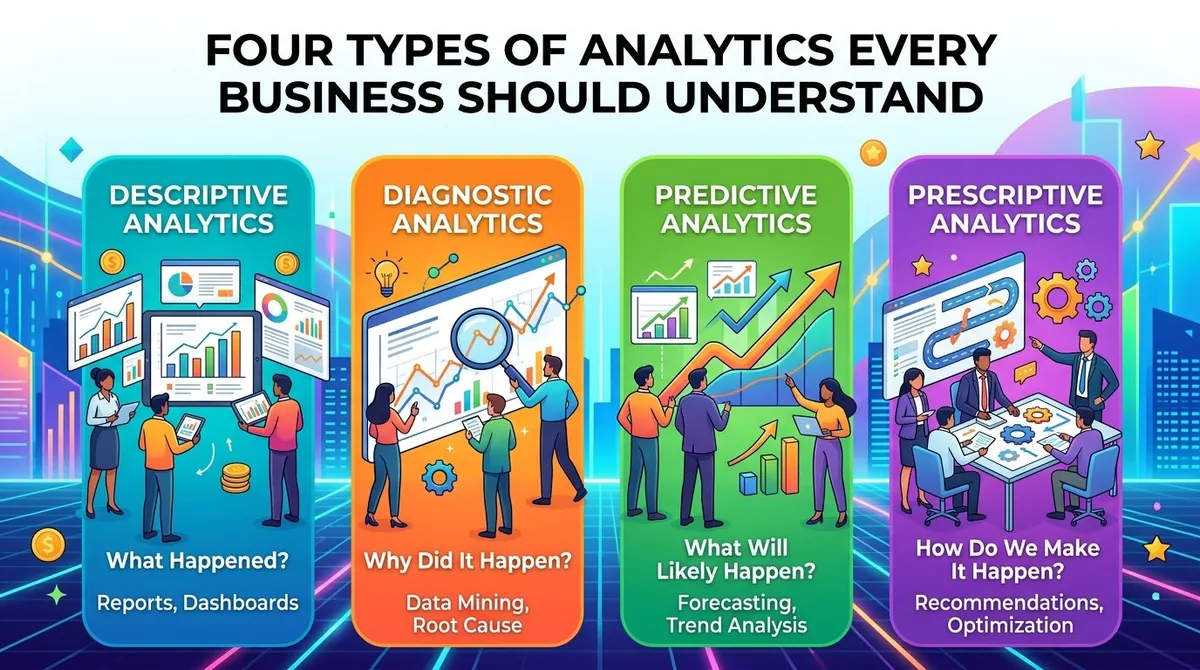
Business analytics is commonly divided into four main types: descriptive, diagnostic, predictive, and prescriptive analytics. Each approach answers a different question and can help organizations move from understanding past performance toward evaluating future possibilities and potential actions.
What Are the Four Types of Analytics?
The four types of analytics provide different perspectives on business information:
- Descriptive analytics: What happened?
- Diagnostic analytics: Why did it happen?
- Predictive analytics: What could happen next?
- Prescriptive analytics: What actions could be taken?
These approaches can be used independently, but they are often most useful when combined. Together, they provide a framework for understanding business performance and supporting data-driven decision-making.
Descriptive Analytics: Understanding What Happened
Descriptive analytics examines historical and current data to explain what has already happened.
Businesses commonly use dashboards, reports, summaries, and key performance indicators to monitor metrics such as revenue, sales volume, website traffic, customer acquisition, or operating costs.
For example, an e-commerce company might compare monthly sales across different product categories. A marketing team could examine campaign performance and identify which channels generated the most traffic or conversions.
Descriptive analytics provides the foundation for further analysis because organizations need a clear understanding of current and historical performance before investigating causes or future possibilities.
Diagnostic Analytics: Understanding Why It Happened
While descriptive analytics focuses on what happened, diagnostic analytics investigates why it happened.
Organizations can compare different variables, segments, time periods, or business activities to identify relationships and potential contributing factors.
For example, if sales decline during a particular period, diagnostic analysis could examine changes in pricing, customer demand, marketing activity, product availability, or geographic performance.
The goal is to move beyond reporting a result and investigate the factors associated with that result. This can help decision-makers understand where additional attention or investigation may be required.
Predictive Analytics: Estimating What Comes Next
Predictive analytics uses historical and current data to estimate potential future outcomes.
Organizations can use statistical models, forecasting techniques, and machine learning to identify patterns that may provide information about future demand, customer behavior, financial performance, or potential risks.
For example, a retailer could analyze previous purchasing patterns and seasonal trends to estimate future product demand. A business might also use customer data to identify patterns associated with potential churn.
Predictive analytics does not guarantee a particular outcome. Instead, it provides estimates that can help businesses prepare for different possible scenarios.
Prescriptive Analytics: Evaluating Potential Actions
Prescriptive analytics goes a step further by examining possible actions and their potential consequences.
Rather than only asking what might happen, organizations can use prescriptive approaches to evaluate different responses to a business situation.
For example, a company facing increased demand might evaluate different inventory, staffing, or pricing strategies. Analytical models can help compare potential scenarios and provide additional information for decision-makers.
Prescriptive analytics can therefore support more structured planning, particularly when organizations need to evaluate multiple possible actions.
Using the Four Types Together
The four types of analytics can form a connected decision-making process:
What happened? → Why did it happen? → What could happen next? → What could we do?
Consider a company experiencing declining customer retention. Descriptive analytics can identify the decline and determine where it is occurring. Diagnostic analytics can investigate possible factors associated with the change.
Predictive analytics can then estimate which customers may be at greater risk of leaving, while prescriptive analytics can help evaluate potential retention strategies.
This progression allows businesses to move from reporting toward analysis, forecasting, and action.
Implementation Roadmap and Best Practices
Organizations can begin developing an analytics strategy by connecting each analytical approach to a specific business question.
First, establish reliable data sources and consistent definitions for important metrics. Next, determine which type of analysis is appropriate for the decision being considered.
Businesses should also focus on communicating analytical findings clearly. Complex models are less useful when decision-makers cannot understand how the results relate to a practical business problem.
Finally, organizations should measure outcomes after decisions are implemented. Comparing actual results with expectations can help teams improve future analyses and refine their decision-making processes.
Common Challenges
One of the most common challenges is data quality. Incomplete, inconsistent, or inaccurate information can affect analytical results at every stage.
Another challenge is selecting the appropriate analytical method. Not every business question requires predictive models or advanced machine learning. In many situations, a well-designed descriptive or diagnostic analysis may provide the information needed.
Organizations also need to distinguish correlation from causation. A relationship between two variables does not necessarily mean that one directly caused the other.
Finally, analytics should support rather than replace business judgment. Context, experience, operational constraints, and uncertainty remain important when interpreting analytical results.
The Future of Business Analytics
Advances in artificial intelligence, machine learning, cloud computing, and data visualization are making analytics increasingly accessible to organizations of different sizes.
Modern business analytics tools can automate parts of data preparation, reporting, forecasting, and pattern identification. This can allow teams to spend more time interpreting results and considering potential actions.
The four analytical approaches are likely to remain important even as technology changes. Understanding what happened, why it happened, what may happen next, and which actions could be considered provides a practical framework for turning business data into useful insights.
Ultimately, organizations that understand how to apply descriptive, diagnostic, predictive, and prescriptive analytics can develop a more structured approach to data-driven decision-making and business planning.
References
- IBM. "What Is Data Analytics?"
- IBM. "What Is Business Analytics?"
- IBM. "What Is Predictive Analytics?"
- Microsoft. "What Is Business Intelligence?"
- Microsoft. "What Is Data Visualization?"
- SAS. "Analytics."
- Harvard Business Review. "The Rise of Data-Driven Decision Making Is Real but Uneven."