


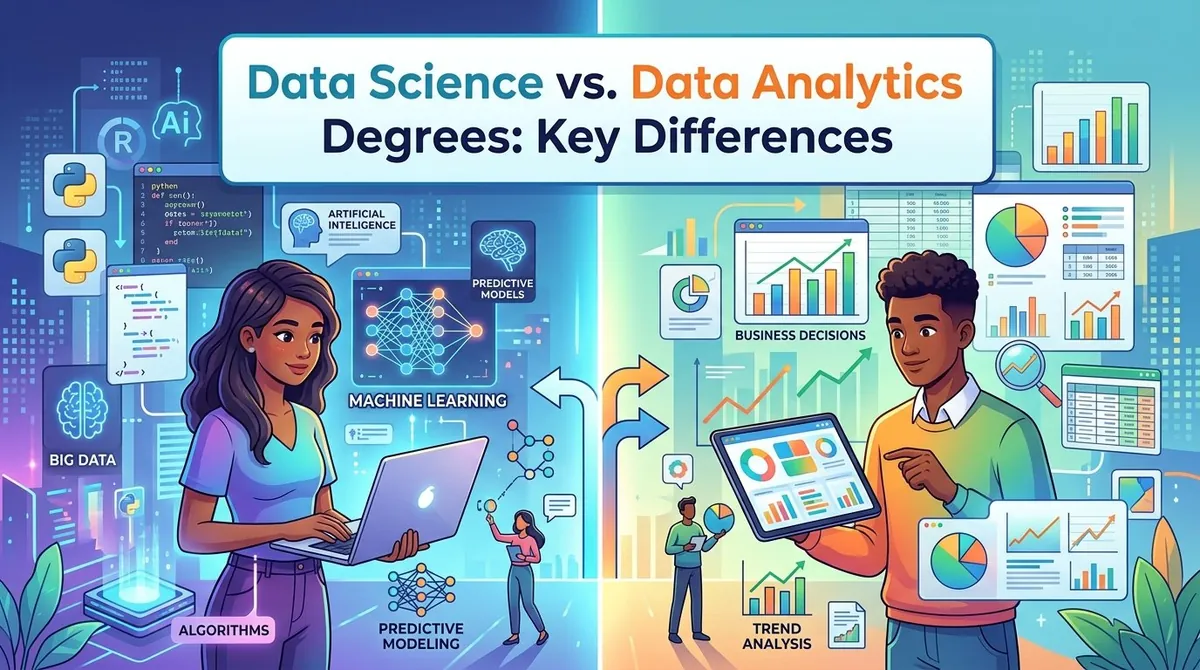
Data science and data analytics are closely related fields that both involve working with information to identify patterns, answer questions, and support decisions. Because degree programs in these areas can have similar names and overlapping coursework, students may find it difficult to understand how they differ.
A data analytics degree generally focuses on examining data, identifying trends, creating reports and visualizations, and using information to support business or organizational decisions. A data science degree can cover these areas while placing greater emphasis on programming, statistical modeling, machine learning, and computational methods.
The distinction is not identical across every university. Course requirements, program titles, and career preparation can vary, so students comparing degrees should examine the actual curriculum rather than relying only on the name of the program.
Understanding Data Analytics Degrees
Data analytics programs typically teach students how to collect, organize, analyze, and communicate information.
Common subjects may include:
- Statistics
- Data analysis
- SQL and databases
- Data visualization
- Business intelligence
- Spreadsheet analysis
- Predictive analytics
- Reporting
Many programs also connect analytical methods with business applications. Students may work with datasets involving sales, marketing, finance, operations, or customer behavior.
The goal is often to help students understand existing data and use it to answer practical questions. For example, an analyst might examine sales performance, identify changes in customer behavior, or evaluate the results of a marketing campaign.
The University of Michigan-Dearborn's business analytics curriculum includes statistics, data visualization, programming, machine learning, forecasting, and other analytical subjects, illustrating how analytics programs can combine technical and business-focused coursework.
Understanding Data Science Degrees
Data science programs generally combine statistics, mathematics, programming, and computational methods.
Students may study:
- Statistical modeling
- Programming
- Machine learning
- Data mining
- Databases
- Algorithms
- Data visualization
- Predictive modeling
Data science can involve not only analyzing existing information but also developing models that identify patterns or generate predictions.
The U.S. Bureau of Labor Statistics states that "data scientists use analytical tools and techniques to extract meaningful insights from data" and typically need at least a bachelor's degree in mathematics, statistics, computer science, or a related field.
The amount of mathematics and computer science included in a data science program varies by institution.
Key Differences in Coursework
One of the clearest ways to compare the degrees is to examine the coursework.
Data analytics programs may place greater emphasis on analyzing existing datasets, reporting, visualization, business intelligence, and applying analytical methods to organizational questions.
Data science programs may place greater emphasis on programming, machine learning, statistical modeling, algorithms, and computational analysis.
There is considerable overlap. Both programs can include statistics, programming, databases, visualization, and predictive analytics.
Students should therefore compare required courses rather than assuming that every data analytics or data science degree follows the same structure.
Mathematics and Statistics
Both fields can require quantitative skills, but the level of mathematical and statistical training can differ.
Analytics programs may introduce statistics primarily as a tool for understanding and interpreting business data. Students may learn descriptive statistics, probability, regression, and other methods.
Data science programs can go further into statistical modeling and mathematical concepts that support machine learning and computational methods.
Students who prefer a stronger mathematical focus can review prerequisites and required mathematics courses when comparing programs.
Programming and Technical Skills
Programming is another area where programs can differ.
Data analytics programs may introduce SQL and programming languages such as Python or R, particularly when the program includes advanced analytics.
Data science programs often place greater emphasis on programming because students may need to build models, process large datasets, implement algorithms, and work with machine learning techniques.
The amount of programming required should therefore be an important consideration for students comparing the two fields.
Machine Learning and Predictive Modeling
Machine learning is commonly associated with data science, although it can also appear in advanced analytics programs.
Data science programs may cover machine learning algorithms in greater depth, including how models are developed, evaluated, and improved.
Analytics programs may use predictive techniques more directly for business applications such as forecasting demand, identifying customer segments, or estimating business outcomes.
The distinction depends on the specific curriculum, so students should review the individual machine learning and predictive analytics courses offered by each institution.
Potential Career Paths
Both degrees can prepare students for roles involving data, but the career paths may differ depending on the program and the student's technical skills.
Potential areas for data analytics graduates can include:
- Data analysis
- Business analysis
- Business intelligence
- Operations analysis
- Market research
- Reporting and visualization
Potential areas for data science graduates can include:
- Data science
- Machine learning
- Statistical analysis
- Data engineering-related work
- Quantitative analysis
- Predictive modeling
These categories are not absolute. Graduates can move between related roles depending on their education, experience, and technical abilities.
The Bureau of Labor Statistics projects employment of data scientists to grow 35% from 2025 to 2035, with approximately 24,800 openings projected each year on average. This projection applies specifically to the data scientist occupation rather than to all positions associated with data analytics or data science degrees.
Comparing Data Science and Data Analytics Degrees
Students can consider several factors when comparing the two:
Curriculum: Review the required courses rather than relying on the degree title.
Mathematics: Check how much probability, statistics, calculus, linear algebra, or other quantitative coursework is required.
Programming: Determine whether students learn SQL, Python, R, or other programming technologies.
Machine learning: Review whether machine learning is introductory or a major component of the program.
Business focus: Analytics programs may provide more coursework connected directly to business functions, although this varies by institution.
Career objectives: Consider the types of positions the program is intended to prepare students for.
Practical experience: Look for internships, projects, case studies, and capstone courses that allow students to work with real datasets.
Which Degree Fits Different Interests?
A student primarily interested in business reporting, dashboards, performance analysis, and decision support may find that an analytics-focused curriculum aligns closely with those interests.
A student interested in programming, machine learning, statistical modeling, and computational methods may want to investigate data science programs more closely.
These are general distinctions rather than fixed rules. A technically focused analytics program may include substantial programming and machine learning, while a business-oriented data science program may include significant management and business coursework.
Comparing actual course requirements is therefore more useful than choosing based solely on the degree title.
Final Thoughts
Data science and data analytics degrees share many subjects, but their emphasis can differ. Data analytics programs often focus on analyzing information and communicating findings for business or organizational purposes, while data science programs can place greater emphasis on programming, statistical modeling, machine learning, and computational methods.
Neither degree follows one universal curriculum. Universities use different program structures, course requirements, and specializations, which means students should examine the details of each program before applying.
Reviewing coursework, technical requirements, mathematics, programming, practical projects, and potential career paths can help students understand what each degree offers and determine which educational direction aligns with their interests.
References
- U.S. Bureau of Labor Statistics. "Data Scientists."
- BLS — Data Scientists
- National Center for Education Statistics. "Data Analytics, General."
- NCES — Data Analytics, General
- University of Michigan-Dearborn. "Business Analytics."
- University of Michigan-Dearborn — Business Analytics
- University of Michigan Ross. "Master of Business Analytics Curriculum."
- Michigan Ross — Master of Business Analytics