


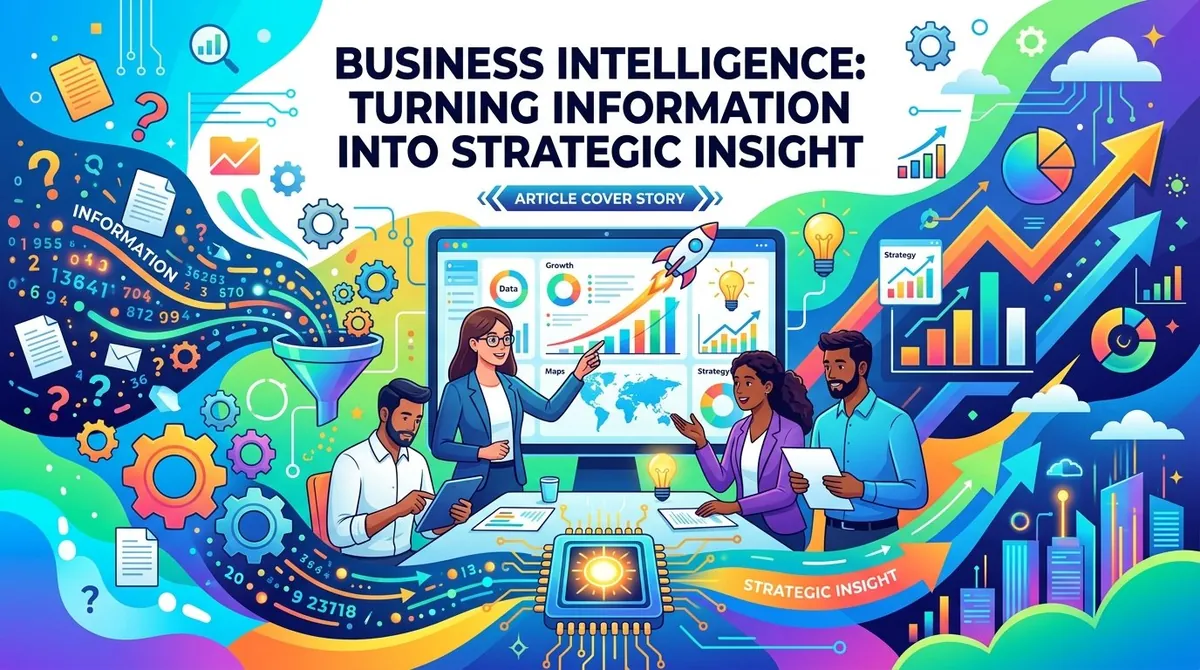
Businesses collect information from nearly every part of their operations. Sales transactions, customer activity, financial records, marketing campaigns, and operational systems can all provide valuable information, but raw data alone does not explain what a business should do next.
Business intelligence (BI) helps organizations transform this information into reports, dashboards, and analytical insights that can support better decisions. By bringing relevant information together and making it easier to interpret, business intelligence can help organizations understand performance, identify trends, and respond to changing business conditions.
What Is Business Intelligence?
Business intelligence refers to the technologies, processes, and practices organizations use to collect, analyze, and present business information.
A BI system may bring together information from multiple sources and make it available through interactive dashboards, reports, and visualizations.
For example, a management team could use a business intelligence dashboard to monitor revenue, sales performance, customer activity, and operating costs in one place.
The purpose is to make important information more accessible so that employees and decision-makers can use it when evaluating business performance and planning future actions.
From Data to Strategic Insight
The value of business intelligence comes from connecting data with meaningful business questions.
A sales report may show that revenue has declined, but additional analysis can help determine where the change occurred. Managers might examine performance by product, region, customer segment, or sales channel.
This allows organizations to move from simply observing a result toward investigating the factors behind it.
The process can be viewed as:
Data → Analysis → Insight → Decision → Measurement
This approach makes BI part of an ongoing decision-making process rather than simply a tool for producing periodic reports.
Core Components of Business Intelligence
Modern business intelligence tools typically combine several capabilities.
Data integration allows information from different systems to be brought together for analysis.
Data visualization presents information through charts, graphs, and dashboards, making trends and comparisons easier to understand.
Reporting and dashboards provide structured views of important business metrics and key performance indicators.
Analytics allows users to investigate patterns, relationships, and changes within business information.
Together, these capabilities can provide organizations with a more complete view of business performance.
Business Intelligence Across Organizations
BI can support decision-making across many business functions.
Finance teams can use dashboards to monitor revenue, expenses, margins, cash flow, and other financial indicators.
Sales teams can analyze pipelines, conversion rates, customer segments, and product performance.
Marketing teams can compare campaign results, traffic, engagement, and customer acquisition metrics.
Operations teams can monitor productivity, inventory, delivery times, and other performance indicators.
Management teams can combine information from different departments to develop a broader view of organizational performance.
When teams work with consistent information, BI can also help create a shared understanding of important business metrics.
Implementation Roadmap and Best Practices
Organizations can build an effective business intelligence strategy by starting with clear business objectives.
First, identify the decisions or performance questions that BI should support. Then determine which data sources and metrics are relevant to those objectives.
Data quality should also be addressed before information is incorporated into dashboards. Inconsistent definitions or inaccurate records can reduce the reliability of analytical results.
Organizations should keep dashboards focused on the information their users actually need. Including too many metrics can make it harder to identify important changes.
Finally, BI should be connected to action. Teams should establish processes for reviewing insights, making decisions, and measuring the results of those decisions.
Common Challenges
One challenge is integrating information from different systems. Organizations may have data stored across multiple platforms with different structures and definitions.
Data quality can create another problem. Missing, duplicated, or outdated information can affect the reliability of reports and dashboards.
User adoption is also important. A technically advanced BI platform provides limited value if employees do not understand how to use it or do not trust the information it provides.
Organizations may also need to balance accessibility with security. Employees should have access to the information required for their roles while sensitive business and customer information remains appropriately protected.
The Future of Business Intelligence
Cloud computing, automation, artificial intelligence, and advanced analytics are expanding the capabilities of modern BI platforms.
Instead of relying only on static reports, organizations can increasingly use interactive dashboards and automated analytics to monitor changing conditions.
AI-assisted capabilities can also help users explore information, identify unusual patterns, and generate analytical questions more quickly. However, the quality of these capabilities still depends on reliable data and appropriate interpretation.
As businesses generate increasing amounts of information, the ability to organize and communicate that information effectively will remain important.
Ultimately, business intelligence turns information into strategic insight by connecting data, analysis, and decision-making. When organizations combine reliable information with clear objectives and effective visualization, BI can help them understand performance, identify opportunities, and make more informed business decisions.
References
- Microsoft. "What Is Business Intelligence?"
- IBM. "What Is Business Intelligence?"
- Microsoft. "What Is Power BI?"
- IBM. "What Is Data Analytics?"
- Microsoft. "What Is Data Visualization?"
- Harvard Business Review. "The Rise of Data-Driven Decision Making Is Real but Uneven."