


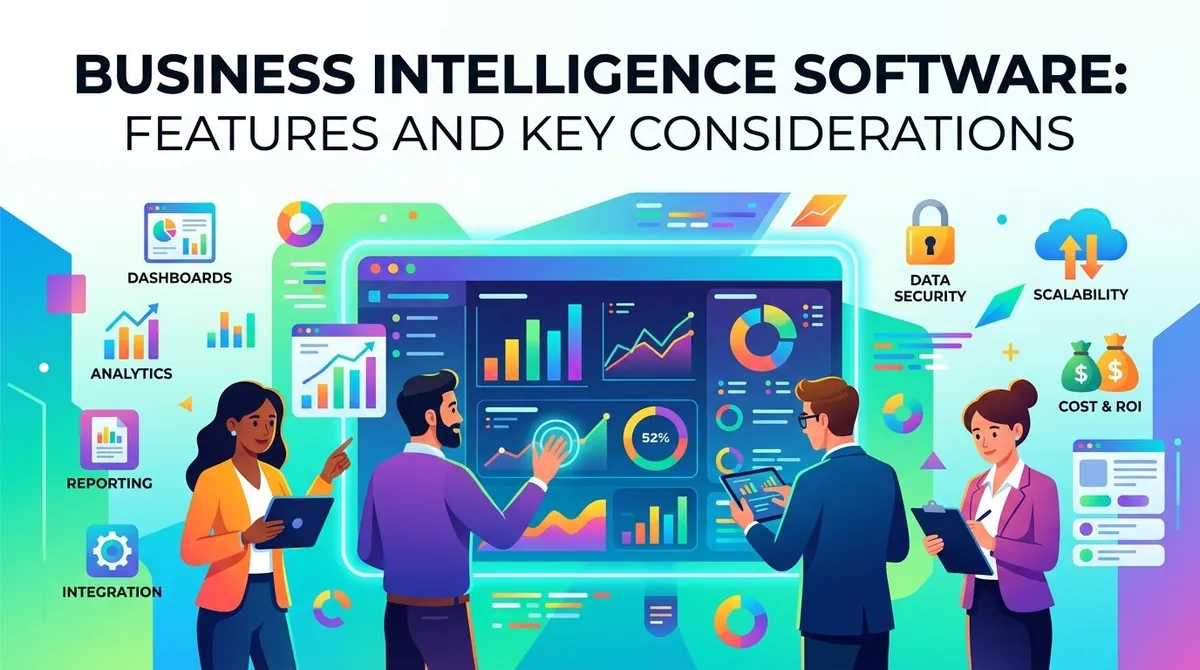
Organizations gather data from numerous platforms—sales systems, customer databases, financial applications, websites, and marketing tools. As data volumes increase, companies require effective methods to organize and convert this information into actionable business insights.
Business intelligence software enables organizations to collect, analyze, visualize, and distribute business data. Platforms may offer dashboards, KPI monitoring, multi-source data combination, and trend exploration capabilities that reduce reliance on manual reporting processes.
BI applications span departments and industries, though different platforms provide varying features, technical complexity levels, and integration capabilities. Evaluating these distinctions helps organizations select appropriate solutions.
Understanding Business Intelligence Software
BI software helps organizations leverage data to understand performance metrics. It consolidates information from diverse sources into centralized environments for analysis and visualization.
According to IBM, "business intelligence involves technologies and processes that allow organizations to collect, analyze, and transform data into actionable insights." Common applications include sales analysis, financial reporting, customer analysis, marketing tracking, operational reporting, inventory monitoring, performance measurement, and trend analysis.
Key Features
**Data Integration** BI platforms connect databases, spreadsheets, cloud applications, CRM systems, and other sources. This consolidation simplifies cross-departmental analysis without manual file combining.
**Data Visualization** Charts, graphs, and maps replace raw numbers, enabling trend identification and improved comprehension for non-technical audiences.
**Interactive Dashboards** Centralized metric monitoring through dashboards allows filtering, time-period examination, and targeted report exploration.
**Reporting** Organizations deploy departmental or audience-specific reports, with many platforms supporting automated scheduling.
**Self-Service Analytics** Employees explore data and create reports independently. Oracle notes this approach "gives business users tools to access, analyze, and visualize data without depending entirely on IT departments."
**KPI and Performance Tracking** Dashboards display key performance indicators, enabling comparison against historical data, targets, or benchmarks.
**Security and Data Governance** User permissions, authentication, encryption, and access controls protect sensitive information while maintaining consistent metric definitions.
**Ease of Use** Intuitive interfaces accommodate varying technical skill levels across organizational roles.
**Integration With Existing Systems** Compatibility with accounting software, CRM platforms, marketing systems, and databases reduces manual data transfers.
**Scalability and Performance** Solutions should accommodate expected user growth, data volume expansion, and analytical complexity increases.
Evaluation Criteria
Organizations should assess data sources, dashboard capabilities, analytical features, usability, security measures, system compatibility, growth potential, licensing costs, and available support resources. Demonstrations and trials provide practical insights.
Applications Across Departments
Sales teams monitor revenue and pipelines. Marketing teams analyze campaigns and acquisition. Finance departments handle reporting and budgeting. Operations track inventory and supply chains. Management monitors organizational KPIs.
Selecting Appropriate Solutions
No single platform serves all organizations identically. Small businesses prioritize affordability and simplicity; larger enterprises require advanced governance and multiple integrations. Organizations should identify key business questions, determine necessary data sources, and involve end-users in evaluation processes.
BI software transforms organizational data into actionable reports, dashboards, and analytical insights supporting informed business decisions.
---
References
- IBM. "What Is Business Intelligence (BI)?" IBM — What Is Business Intelligence?
- IBM. "What Is Data Integration?" IBM — Data Integration
- Microsoft Power BI. "What Is Data Visualization?" Microsoft Power BI — Data Visualization
- Microsoft Power BI. "Business Intelligence Tools." Microsoft Power BI — Business Intelligence Tools
- Oracle. "What Is Business Intelligence?" Oracle — What Is Business Intelligence?