


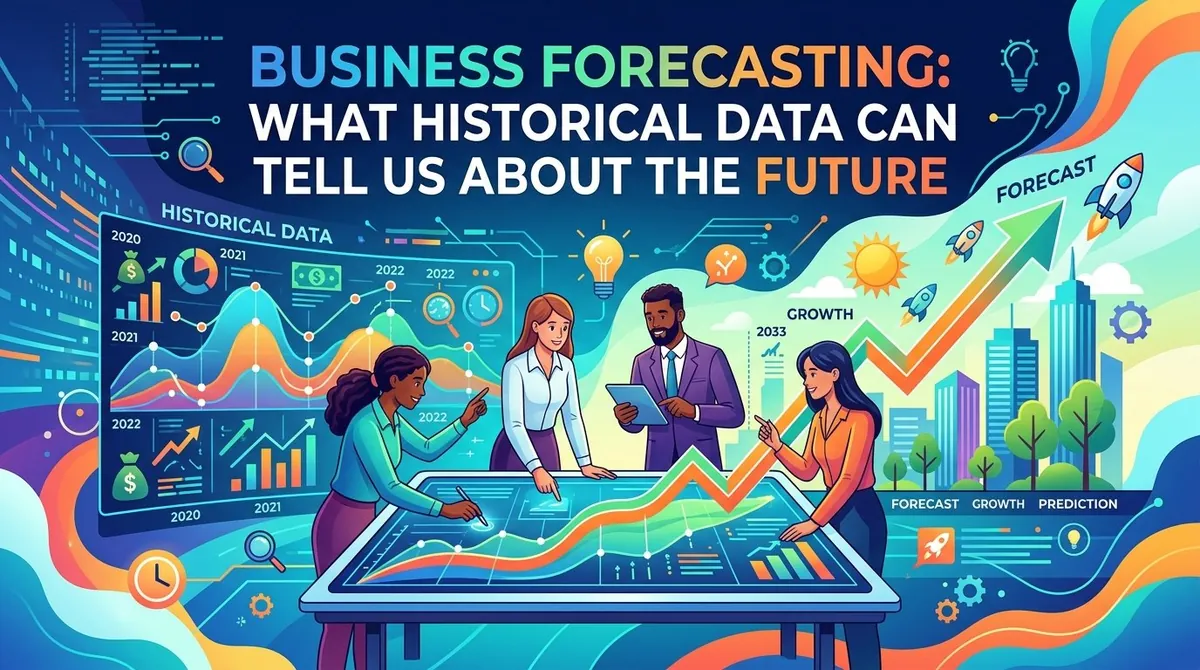
Business leaders regularly make decisions about sales, budgets, staffing, inventory, investments, and growth while facing uncertain future conditions. Historical business data cannot guarantee what will happen next, but it can provide useful evidence for identifying patterns and preparing for potential changes.
Business forecasting uses historical information, current data, and analytical methods to estimate future business conditions. When incorporated into a broader data-driven decision-making process, forecasting can help organizations plan resources, evaluate scenarios, and respond more deliberately to changing circumstances.
What Is Business Forecasting?
Business forecasting is the process of using available information to estimate future business outcomes. Forecasts can cover areas such as revenue, sales demand, expenses, cash flow, inventory requirements, or customer activity.
Historical data is often an important starting point. For example, a retailer may examine previous sales by month to identify seasonal patterns and use those patterns when planning future inventory.
Forecasting is not about predicting the future with complete certainty. Instead, it provides an estimate that can help businesses prepare for different possible outcomes.
How Historical Data Supports Forecasting
Historical information can reveal recurring patterns, changes over time, and relationships between different business variables.
A company might examine several years of sales data and discover that demand consistently increases during certain periods. A financial team could compare previous revenue and expenses to identify trends that may be relevant to future planning.
However, historical patterns need to be interpreted in context. Changes in pricing, customer behavior, competitors, economic conditions, or business strategy can affect whether past relationships remain relevant.
For this reason, effective forecasting combines historical information with current business conditions rather than assuming that the past will simply repeat itself.
Common Business Forecasting Methods
Organizations can use different approaches depending on the type of information available and the decision they need to support.
Time-series forecasting examines observations over time to identify trends, seasonal patterns, or recurring movements.
Regression analysis evaluates relationships between variables and can help estimate how changes in one factor may be associated with changes in another.
Scenario analysis considers multiple possible future conditions rather than relying on a single forecast. Businesses might develop different scenarios based on changes in demand, costs, or market conditions.
Qualitative forecasting incorporates expert knowledge and business judgment, which can be useful when historical data is limited or when significant changes make past patterns less reliable.
The appropriate method depends on the business question, data quality, and level of uncertainty involved.
Applications of Business Forecasting
Forecasting can support decisions across many areas of an organization.
Sales teams can use forecasts to estimate future demand and set expectations for sales activity.
Finance teams can forecast revenue, expenses, cash flow, and other financial measures to support budgeting and resource planning.
Operations teams can estimate future demand to help manage inventory, production, staffing, and capacity.
Marketing teams can use historical campaign and customer data to inform planning for future activities.
These applications demonstrate how business forecasting using historical data can connect past performance with practical planning decisions.
Implementation Roadmap and Best Practices
Organizations can improve their forecasting process by starting with a clearly defined objective.
First, determine what needs to be forecast and the time period involved. Then collect relevant historical and current information and check its quality before using it in an analytical model.
Businesses should also identify unusual events that may have affected historical results. A one-time disruption, major promotion, supply problem, or exceptional market event may not provide a reliable indication of future conditions.
Forecasts should then be compared with actual results. Tracking forecast accuracy over time allows organizations to identify weaknesses and adjust their methods when necessary.
Common Challenges
One of the main challenges in business forecasting is uncertainty. Even a well-designed forecast can be affected by unexpected changes in customer behavior, markets, costs, or external conditions.
Data quality is another important consideration. Missing or inconsistent historical information can affect the reliability of analytical results.
Organizations should also avoid excessive confidence in a single forecast. Presenting a range of possible outcomes or using scenario analysis can provide additional context when uncertainty is significant.
Finally, forecasting should support business judgment rather than replace it. Decision-makers need to consider information that may not be fully represented in historical datasets.
The Future of Business Forecasting
Advances in cloud computing, artificial intelligence, machine learning, and business analytics are expanding the tools available for forecasting.
Modern systems can process larger datasets and incorporate information from multiple sources. Automated forecasting can also allow organizations to update estimates more frequently as new data becomes available.
At the same time, the fundamentals remain important. A sophisticated model cannot eliminate uncertainty or compensate completely for poor-quality information.
The most useful forecasting processes combine reliable data, appropriate analytical methods, current business context, and regular evaluation of results.
Ultimately, business forecasting helps organizations use historical data to prepare for potential future conditions. By identifying patterns, evaluating scenarios, and comparing forecasts with actual outcomes, businesses can make planning more structured and develop a clearer understanding of what their data may indicate about the future.
References
- IBM. "What Is Predictive Analytics?"
- IBM. "What Is Data Analytics?"
- Microsoft. "What Is Predictive Analytics?"
- SAS. "Forecasting."
- Oracle. "What Is Forecasting?"
- Harvard Business Review. "The Rise of Data-Driven Decision Making Is Real but Uneven."