


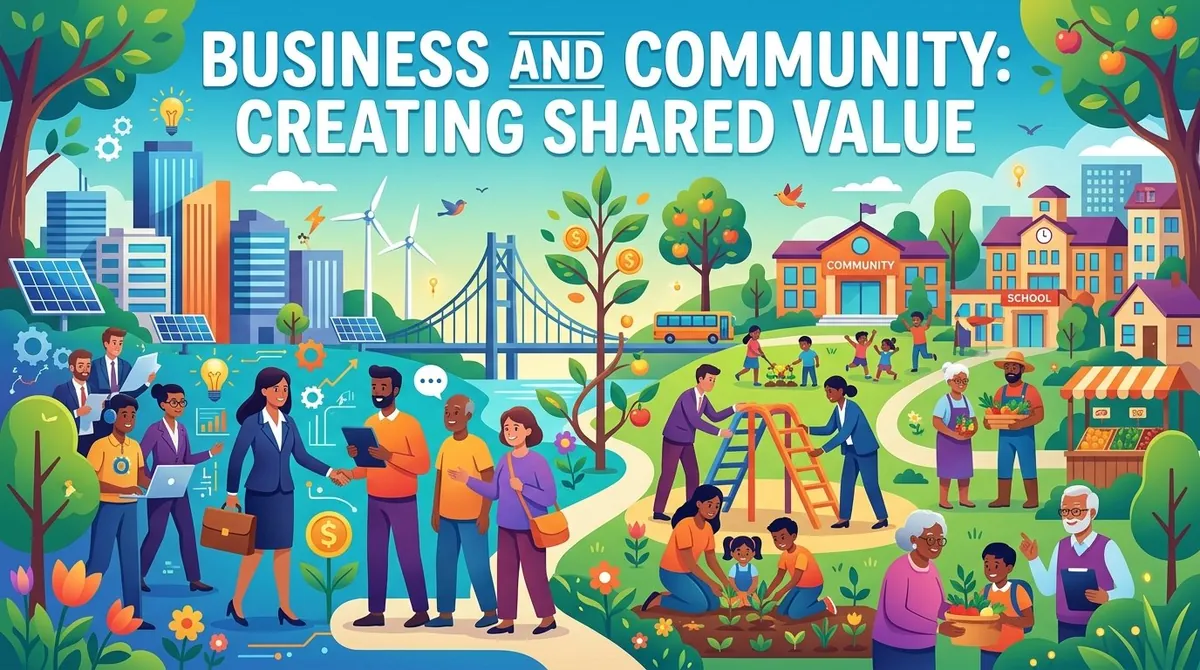
Businesses do not operate separately from the communities around them. They depend on employees, customers, suppliers, infrastructure, and local economies, while their activities can also influence employment, resources, and social conditions.
The idea of shared value focuses on finding ways for businesses to create economic value while also addressing relevant social or community needs. Rather than treating business performance and community impact as completely separate objectives, organizations can look for opportunities where the two reinforce each other.
Understanding Shared Value
Shared value describes business strategies that create economic benefits while addressing social or community challenges. The concept differs from traditional charitable giving because the social impact is connected directly to the organization's business activities.
For example, a company might develop products that address an important community need while generating revenue, or invest in employee development in ways that strengthen both workforce capabilities and local employment.
The specific opportunities vary by industry and location. What matters is establishing a clear connection between the organization's capabilities, its business objectives, and a meaningful community need.
Why Business and Community Are Connected
Companies rely on healthy business environments to operate effectively. Access to skilled workers, reliable infrastructure, strong suppliers, and stable communities can all influence long-term business performance.
At the same time, business decisions can affect the communities in which organizations operate. Hiring practices, purchasing decisions, environmental impacts, and investments can have consequences beyond the company's immediate operations.
Recognizing these connections can encourage organizations to consider community impact as part of broader strategic planning rather than as a completely separate activity.
Creating Economic and Social Value
Businesses can pursue shared value through different areas of their operations. The appropriate approach depends on the company's resources and the needs of its stakeholders.
Examples include:
- Workforce development: Investing in training and skills that improve employee capabilities while strengthening the local talent pool.
- Local procurement: Working with local suppliers where appropriate, supporting regional businesses while developing reliable supply relationships.
- Accessible products and services: Designing offerings that address underserved needs while creating sustainable commercial opportunities.
- Operational improvements: Reducing resource consumption or waste in ways that can lower costs while producing environmental benefits.
- Community partnerships: Working with local organizations on initiatives connected to the company's expertise and business objectives.
These approaches are most effective when they are integrated into normal business operations rather than treated as isolated projects.
The Role of Employees
Employees are an important connection between businesses and their communities. Organizations can contribute to communities through employment, professional development, workplace practices, and opportunities for people to build skills.
Training programs can provide employees with capabilities that improve their current roles while supporting longer-term professional development. Businesses can also work with educational institutions or community organizations to create pathways into relevant industries.
These initiatives need to be designed carefully. The strongest programs generally connect genuine workforce needs with opportunities that provide meaningful value to participants.
Building Community Partnerships
Businesses do not need to address community challenges independently. Partnerships with nonprofit organizations, educational institutions, local authorities, and other businesses can provide access to expertise and local knowledge.
Effective partnerships begin with a clear understanding of responsibilities and objectives. Organizations should establish what each participant contributes, what outcomes are expected, and how progress will be evaluated.
Listening to community stakeholders is particularly important. Businesses may have financial or technical resources, but local organizations and residents often have a deeper understanding of the challenges being addressed.
Developing a Shared Value Strategy
Organizations can incorporate community considerations into their existing strategic planning processes.
A practical approach can include:
- 1Identify relevant community needs: Understand issues that are connected to the organization's operations, capabilities, or stakeholders.
- 2Assess business opportunities: Determine where addressing a community need could also support sustainable business activity.
- 3Engage stakeholders: Speak with employees, customers, suppliers, and community organizations to understand different perspectives.
- 4Develop measurable initiatives: Define specific activities, responsibilities, and expected outcomes.
- 5Measure both dimensions: Track business performance alongside relevant social or community indicators.
- 6Improve over time: Use results and stakeholder feedback to adjust the approach.
This helps prevent community initiatives from becoming disconnected from the organization's broader strategy.
Measuring Shared Value
Measuring shared value requires looking beyond financial performance alone. Businesses can track conventional measures such as revenue, costs, customer growth, productivity, or employee retention while also monitoring relevant community outcomes.
The appropriate social indicators depend on the initiative. A workforce program might measure training participation, skills development, or employment outcomes. A local procurement program could examine spending with regional suppliers and supplier development.
Measurement should remain connected to the original objectives. Businesses should avoid using broad claims about social impact without evidence showing how the initiative produced the reported results.
Common Challenges
Creating shared value can be difficult when business and community objectives are not naturally aligned. Organizations may also struggle to identify initiatives where social outcomes can be connected meaningfully to their capabilities.
Another challenge is measuring long-term impact. Some community outcomes take years to develop, while business performance may be evaluated over much shorter periods.
Stakeholder expectations can also differ. Employees, customers, investors, community organizations, and management may have different views about which issues should receive attention. Clear objectives and transparent communication can help organizations navigate these differences.
The Future of Business and Community Relationships
Businesses are increasingly operating in environments where stakeholders pay attention not only to financial results but also to how organizations affect employees, customers, communities, and the wider environment.
This does not mean every company needs to pursue the same social initiatives. The most relevant opportunities depend on the organization's industry, capabilities, location, and stakeholders.
The broader opportunity is to identify areas where business activity can produce benefits beyond the organization itself. When companies develop products, workforce programs, supplier relationships, and operational practices that address genuine community needs while supporting sustainable business objectives, they can create value across multiple groups.
Creating shared value is therefore less about separating business performance from community impact and more about understanding where the two can work together. With clear objectives, meaningful stakeholder engagement, and measurable outcomes, businesses can build stronger relationships with the communities that contribute to their long-term success.
References
- Harvard Business Review — Creating Shared Value
- FSG — Shared Value Initiative
- United Nations Global Compact — Sustainable Development Goals
- OECD — Responsible Business Conduct
- World Business Council for Sustainable Development — Social Impact
- International Labour Organization — Skills and Lifelong Learning
- U.S. Small Business Administration — Community and Business Resources