


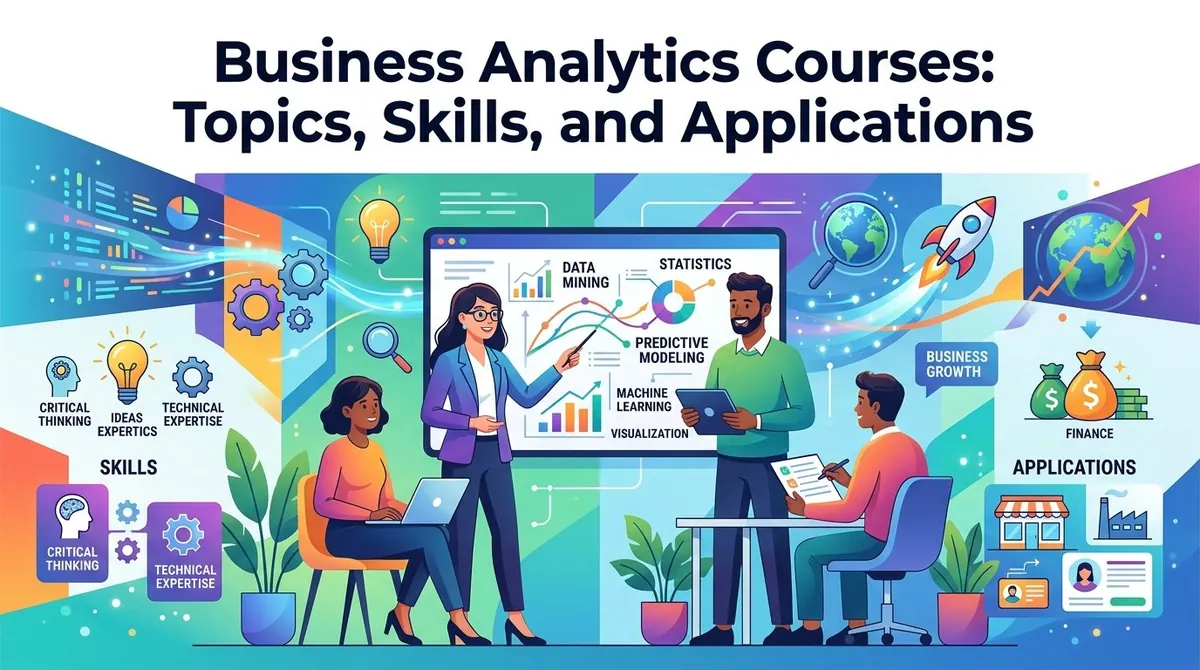
Businesses use data to evaluate performance, understand customers, manage operations, and make decisions. As organizations collect information from more systems and sources, employees increasingly need to understand how to analyze that information and turn it into useful business insights.
Business analytics courses are designed to develop these skills by combining business concepts with statistics, technology, data analysis, and problem-solving. Depending on the program, students may study subjects such as business statistics, data visualization, programming, forecasting, machine learning, databases, and predictive analytics.
Course content can vary significantly between institutions. Some programs focus primarily on business applications, while others provide more technical training. Reviewing the curriculum can therefore help students understand what skills a particular course or program is designed to develop.
Understanding Business Analytics Courses
Business analytics courses focus on using data to understand business problems and support decisions. Students may learn how to collect and organize information, identify patterns, analyze results, and communicate findings.
For example, "the University of Michigan-Dearborn's business analytics curriculum includes machine learning, prescriptive analytics, business forecasting with Python, programming, data visualization, and advanced business statistics."
Common topics include:
- Business statistics
- Data analysis
- Data visualization
- Spreadsheet analysis
- SQL and databases
- Programming
- Predictive analytics
- Forecasting
- Machine learning
- Business intelligence
- Decision-making
The combination of subjects depends on the level and focus of the course.
Business Statistics and Data Analysis
Statistics is a common foundation of business analytics education. Students can learn how to summarize datasets, identify relationships between variables, evaluate uncertainty, and interpret analytical results.
Business analytics courses may also teach students how to gather, organize, and analyze business data. This can involve working with real datasets and applying statistical methods to questions involving finance, marketing, operations, or management.
The University of Michigan's Business Analytics and Statistics course includes hands-on work with real datasets, model building, analysis, and communicating recommendations across different business contexts.
Data Visualization
Data visualization courses teach students how to communicate analytical findings through charts, dashboards, and other visual formats.
Students may learn how to select appropriate visualizations, identify trends, compare categories, and present results to audiences with different levels of technical knowledge.
Visualization is particularly useful in business settings because analytical findings often need to be communicated to managers and other decision-makers rather than only to data specialists.
Programming and Databases
Some business analytics courses include programming and database subjects, particularly at the university level or in more technical programs.
Students may learn programming languages such as Python and develop an understanding of how databases store and organize information. SQL can also be introduced as a way to retrieve and work with data stored in relational databases.
"The University of Michigan's Master of Business Analytics curriculum includes introductory data programming, data architecture and acquisition, and other technical subjects alongside business coursework."
Programming requirements vary considerably, however. Students interested in technical analytics roles should compare the programming and database components of individual programs.
Predictive Analytics and Forecasting
Business analytics courses may also cover methods for using historical information to understand possible future outcomes.
Predictive analytics can involve statistical models and machine learning techniques designed to identify patterns and generate predictions.
Forecasting can be applied to areas such as sales, demand, inventory, financial performance, and other business measures.
More advanced courses may also introduce prescriptive analytics, which focuses on evaluating possible actions based on analytical results.
These subjects are increasingly included in business analytics programs. For example, the University of Michigan-Dearborn includes predictive, prescriptive, and forecasting-related coursework in its business analytics major.
Skills Developed Through Business Analytics Courses
A business analytics course can develop both technical and broader professional skills.
**Analytical thinking:** Students learn how to examine information, identify relevant patterns, and evaluate possible explanations.
**Problem-solving:** Analytics often begins with a business question rather than a specific dataset. Students learn how to define problems and determine what information is needed.
**Technical skills:** Depending on the program, students may develop experience with spreadsheets, SQL, Python, databases, visualization platforms, or statistical software.
**Communication:** Analytical results need to be explained clearly so that decision-makers can understand their meaning and limitations.
**Business understanding:** Business analytics programs connect technical analysis with areas such as finance, marketing, operations, and management.
The U.S. Bureau of Labor Statistics identifies "critical and analytical thinking, problem-solving and decision-making, mathematics, communication, and computer and information technology" among the skills measured across occupations.
Applications of Business Analytics
Business analytics can be applied across many areas of an organization.
**Marketing:** Businesses can analyze customer behavior, campaign performance, acquisition costs, and engagement.
**Finance:** Analytics can support budgeting, forecasting, financial reporting, and performance analysis.
**Sales:** Organizations can examine sales trends, customer activity, conversion rates, and revenue.
**Operations:** Companies can analyze inventory, supply chains, productivity, and demand.
**Human resources:** Analytics can be used to examine workforce information, recruitment, compensation, and employee-related metrics.
**Management:** Managers can use analytical reports and dashboards to monitor performance and evaluate business decisions.
The specific applications depend on the data available and the objectives of the organization.
How to Choose a Business Analytics Course
Students comparing business analytics courses can consider several factors:
- Course topics: Review the subjects covered and determine whether they match your interests.
- Technical content: Check whether the course includes SQL, programming, databases, or statistical software.
- Business applications: Look for opportunities to apply analytics to finance, marketing, operations, or other areas.
- Practical projects: Real datasets, case studies, and projects can provide opportunities to apply concepts.
- Course level: Determine whether the material is introductory, intermediate, or advanced.
- Format: Consider whether online, in-person, or hybrid learning fits your schedule.
- Prerequisites: Some advanced courses may require previous coursework in mathematics, statistics, or programming.
- Career alignment: Compare the skills taught with the requirements of roles you are considering.
Students should also distinguish between a single business analytics course and a complete degree or certificate program. A single course may introduce a specific skill, while a broader program can provide a more structured progression across several areas.
Business Analytics Courses and Career Preparation
Business analytics education can support preparation for several data- and business-related roles. Depending on the program and additional experience, potential areas include business analysis, operations analysis, market research, business intelligence, financial analysis, and data analysis.
The skills required vary by occupation. BLS data shows that business and financial operations occupations place importance on skills including adaptability, writing and reading, and problem-solving and decision-making.
A course alone does not guarantee qualification for a particular position. Students may also need relevant degrees, technical experience, internships, or additional specialized training depending on the role.
Final Thoughts
Business analytics courses can combine statistics, data analysis, technology, and business knowledge to help students understand how organizations can use information to support decisions.
Topics may range from business statistics and visualization to SQL, programming, forecasting, predictive analytics, and machine learning. The depth of each subject depends on the course and institution.
Students can compare curricula, prerequisites, practical projects, technical requirements, and career applications when deciding which course or program fits their goals. Building both analytical and communication skills can also help students apply what they learn beyond the classroom.
Ultimately, the most useful business analytics education is one that connects technical methods with real business questions and provides students with opportunities to apply analytical concepts to practical situations.
References
- University of Michigan-Dearborn. "Business Analytics." Michigan Ross — Business Analytics
- University of Michigan Ross. "Business Analytics and Statistics." Michigan Ross — Business Analytics and Statistics
- University of Michigan Ross. "Master of Business Analytics Curriculum." Michigan Ross — Master of Business Analytics Curriculum
- U.S. Bureau of Labor Statistics. "Skills Data." BLS — Skills Data
- U.S. Bureau of Labor Statistics. "Critical and Analytical Thinking." BLS — Critical and Analytical Thinking