


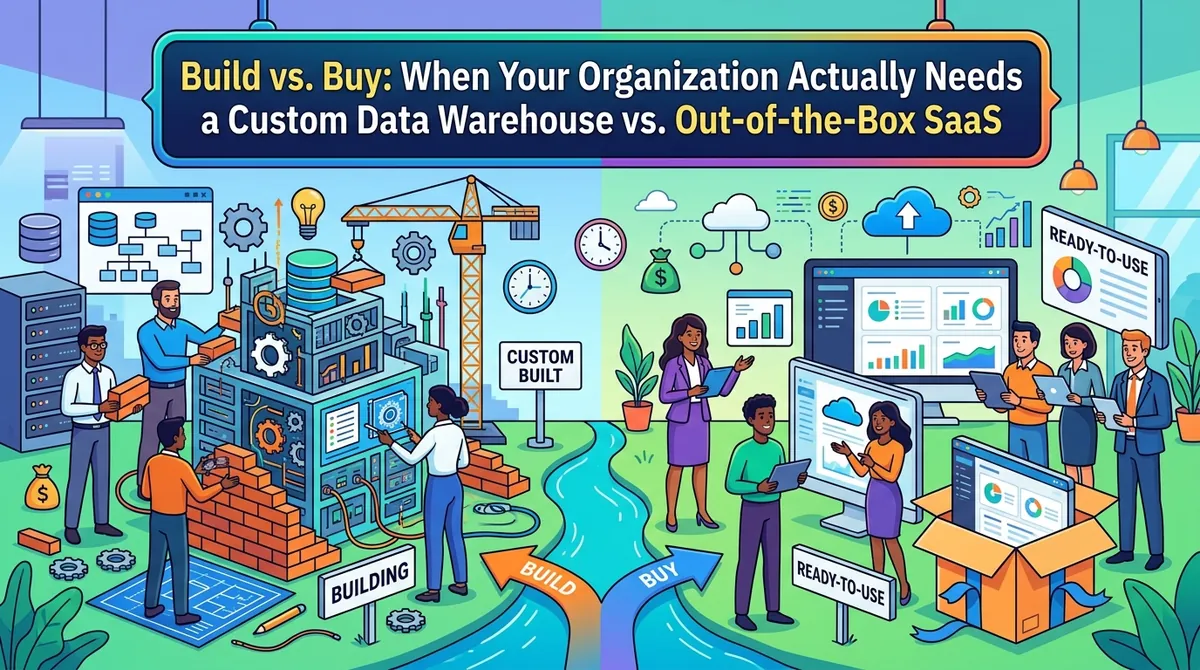
Every growing company eventually faces a pivotal architectural crossroads. As data volume swells and analytical demands multiply, out-of-the-box SaaS tools—all-in-one analytics suites, rigid CRM reporting dashboards, and plug-and-play BI solutions—start to buckle under the strain.
Inevitably, someone in leadership asks the million-dollar question: "Should we build our own custom data warehouse and data stack, or should we just upgrade our SaaS subscription?"
It is a high-stakes dilemma. Choose wrong, and you either burn hundreds of thousands of engineering dollars maintaining custom infrastructure you didn't need, or you strangle your company's growth with rigid software limits that prevent you from answering critical business questions. Navigating the build-versus-buy decision requires looking past vendor marketing and evaluating your organization's data maturity, resource realities, and long-term strategic moat.
1. The Allure and Trap of Out-of-the-Box SaaS
For early-stage and mid-market organizations, out-of-the-box SaaS is almost always the correct starting point. These platforms offer undeniable advantages:
- Speed to Value: You can spin up an account, connect a few standard data sources (like Stripe, Shopify, or Google Ads), and have pre-built dashboards running in an afternoon.
- Low Initial Overhead: No dedicated data engineers, infrastructure architects, or cloud database administrators are required.
- Standardized Workflows: For common business questions—such as tracking monthly recurring revenue or basic funnel conversion rates—SaaS tools provide reliable, battle-tested templates.
Where SaaS Breaks Down
The moment your business model diverges from the software vendor's rigid assumptions, the friction begins:
- Data Silos and Schema Lock-in: SaaS tools are notoriously selfish. Getting your data into them is easy; getting raw, unaggregated data out to join with other enterprise sources is often difficult or artificially throttled behind expensive enterprise tiers.
- Custom Business Logic Failures: If your company relies on nuanced attribution models, multi-currency cohort analysis, or complex usage-based pricing metrics, trying to force standard SaaS dashboards to accommodate your logic results in messy workarounds and broken reports.
- Escalating Per-Seat Costs: As your team grows, SaaS pricing models based on user seats or monthly event volumes scale punishingly, often making custom cloud storage look economical by comparison.
2. The Case for a Custom Data Warehouse Stack
Building a custom modern data stack—typically anchored by a cloud data warehouse (such as Snowflake, Google BigQuery, or Databricks), modern ELT pipelines (like Fivetran or Airbyte), and transformation layers (dbt)—is a commitment to treating data as a first-class engineering asset.
When You Actually Need a Custom Stack
- 1Multi-Source Data Fusion: When your operational truth requires stitching together data from your product database, custom CRM, marketing attribution logs, and financial ledger into a single unified customer 360-degree view.
- 2Advanced Modeling and Machine Learning: When your growth strategy depends on feeding clean, transformed historical features into predictive machine learning models or custom attribution algorithms.
- 3Strict Data Governance and Compliance: When regulatory mandates or enterprise security requirements demand absolute control over data residency, row-level security, and PII masking before it touches any third-party tool.
The primary trade-off is operational ownership. When you build custom, your engineering team inherits the responsibility of monitoring pipeline failures, managing schema migrations, and optimizing query costs.
3. The Decision Framework: How to Evaluate Your Path
To determine whether your organization is ready to move beyond SaaS or if you should stay put, evaluate your operations against three core pillars:
Data Complexity
- Stick with Out-of-the-Box SaaS: Standard event tracking; single-product e-commerce or simple SaaS model.
- Build a Custom Data Stack: Multi-product ecosystem; complex usage-based billing; custom business logic.
Engineering Bandwidth
- Stick with Out-of-the-Box SaaS: Limited technical resources; no dedicated data engineers or analytics engineers.
- Build a Custom Data Stack: Dedicated data/analytics engineering talent available to maintain pipelines.
Strategic Value of Data
- Stick with Out-of-the-Box SaaS: Data is used strictly for high-level historical reporting and basic status updates.
- Build a Custom Data Stack: Data is your core competitive advantage (e.g., dynamic pricing, algorithmic personalization).
4. Avoiding the "Not Invented Here" Syndrome
One of the most expensive mistakes engineering leaders make is building custom data infrastructure simply because it is more intellectually satisfying than configuring SaaS tools.
Before committing to a custom data warehouse build, enforce a strict cost-benefit audit:
- The "Build vs. Rent" Math: Calculate the fully loaded cost of engineering hours required to build and maintain custom ELT pipelines over two years versus the cost of an enterprise SaaS tier. In many cases, buying the tool is cheaper until your data volume or complexity crosses a definitive threshold.
- Start with Modular Hybrid Approaches: You don't have to choose an all-or-nothing approach. Many organizations use standard SaaS tools for front-end visualization while feeding raw event streams into a lightweight cloud data warehouse via modern ELT pipelines, giving them the best of both worlds.
Conclusion
The build-versus-buy debate is not a permanent ideological choice; it is an evolutionary milestone. Out-of-the-box SaaS gets companies off the ground with speed and efficiency, but eventually, successful businesses outgrow the constraints of pre-packaged software.
Knowing when to transition to a custom data warehouse stack is about recognizing the exact moment your data needs shift from simple reporting to strategic operational leverage. By aligning your architecture with your actual business complexity—rather than chasing engineering trends—you ensure that your data stack acts as an accelerator for growth rather than an anchor.