


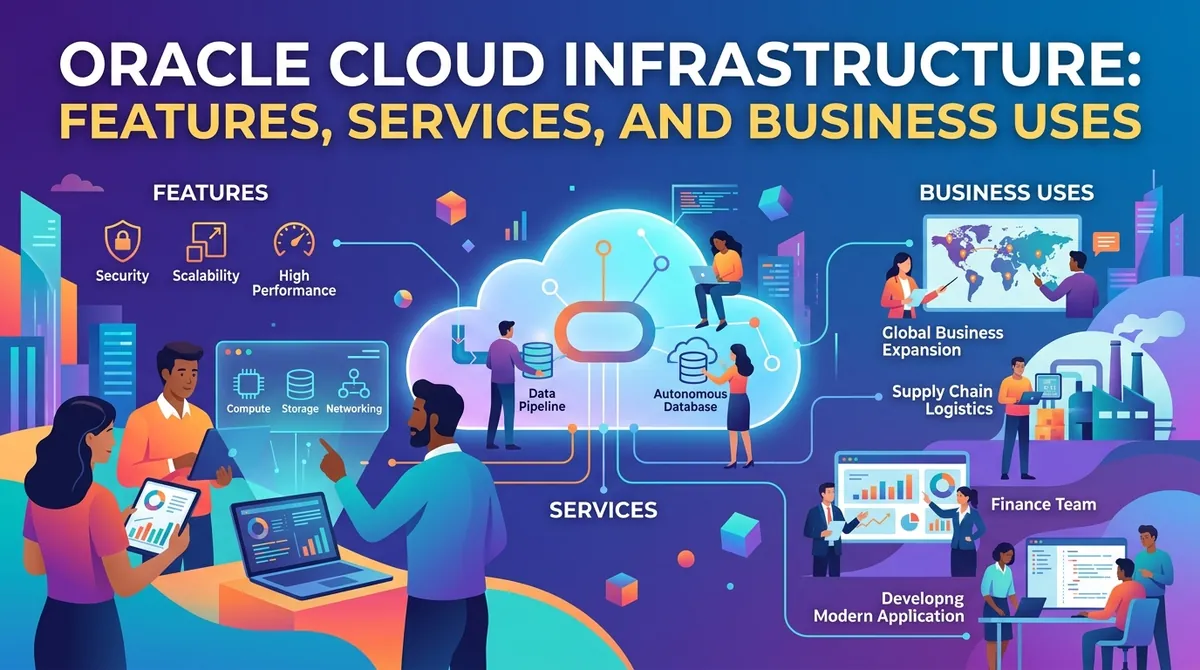
Oracle Cloud Infrastructure (OCI) is Oracle's cloud computing platform for running applications, databases, analytics workloads, artificial intelligence, networking, storage, and enterprise infrastructure. It provides infrastructure-as-a-service and platform-as-a-service capabilities that organizations can use to migrate existing systems, build new applications, and operate business workloads in the cloud.
OCI includes more than 200 cloud services across its regions, covering compute, storage, networking, databases, containers, developer tools, AI, analytics, security, observability, and governance. Oracle also provides hybrid, multicloud, and dedicated-cloud deployment options for organizations with specialized infrastructure or data-residency requirements.
The platform is particularly integrated with Oracle's database and enterprise application ecosystem, but organizations can also use OCI for general-purpose cloud workloads and applications built with open-source technologies.
What Is Oracle Cloud Infrastructure?
OCI provides the underlying infrastructure and managed services required to run applications and data platforms. Organizations can provision virtual machines, bare-metal servers, storage, networks, databases, containers, and other resources through the Oracle Cloud Console, APIs, command-line tools, and infrastructure-as-code services.
Oracle organizes OCI into categories including compute, storage, networking, databases, containers, developer services, AI and machine learning, analytics, security, and governance.
Businesses can use these services individually or combine them into larger application architectures.
OCI Compute
OCI Compute provides virtual machines and bare-metal instances for running applications and workloads.
Virtual machine configurations can be selected according to CPU, memory, storage, and workload requirements. OCI also provides Arm-based instances, high-performance computing resources, and GPU-accelerated compute for demanding workloads.
Oracle supports both virtualized and bare-metal infrastructure, allowing organizations to select an environment based on performance, isolation, and application requirements.
Compute resources can be integrated with OCI networking, block storage, load balancing, monitoring, and security services.
Storage Services
OCI provides several storage options for different application requirements.
Object Storage is designed for unstructured data such as backups, media, application files, and data-lake workloads. Block Volumes provide persistent storage that can be attached to compute instances, while File Storage provides shared file-system access.
OCI also provides Archive Storage for data that is accessed less frequently but needs to be retained for longer periods.
These services allow businesses to separate storage requirements according to performance, accessibility, and retention needs.
Oracle Database Services
Databases are one of OCI's major areas of focus.
The platform supports Autonomous AI Database, Exadata Database Service, Base Database Service, MySQL HeatWave, NoSQL Database, PostgreSQL, and other database technologies.
Autonomous AI Database automates many database-management tasks and can support transaction processing, analytics, JSON workloads, and application development.
OCI also provides Exadata-based services for organizations running demanding Oracle database workloads. Businesses can use these services to move existing Oracle databases to cloud infrastructure while maintaining compatibility with their established database environments.
Networking
OCI provides networking services based around Virtual Cloud Networks (VCNs).
Organizations can create isolated virtual networks and configure subnets, routing, security rules, gateways, load balancers, and other network components.
FastConnect provides dedicated connectivity between customer environments and OCI, while VPN services can provide encrypted connectivity over the public internet. OCI also offers DNS, network firewalls, service gateways, and private endpoints.
These capabilities support architectures ranging from individual cloud applications to hybrid enterprise environments.
Containers and Kubernetes
OCI supports cloud-native application development through managed container services.
Oracle Kubernetes Engine (OKE) provides managed Kubernetes infrastructure, while Container Instances allow organizations to run containers without managing the underlying servers.
OCI also provides Container Registry for storing and managing container images and Functions for serverless application workloads.
This combination can support microservices, APIs, event-driven applications, and applications that need to scale independently.
Developer and DevOps Services
OCI includes tools for application development, infrastructure automation, and software delivery.
OCI DevOps provides continuous integration and continuous delivery capabilities, while Resource Manager provides managed Terraform-based infrastructure automation.
Developers can also use API Gateway, Events, Queue, Streaming, Notifications, Functions, and other services to build distributed applications and event-driven architectures.
These services allow development teams to automate infrastructure and application deployment without relying entirely on manually configured cloud resources.
AI and Machine Learning
OCI provides a growing collection of AI and machine-learning services.
OCI Generative AI provides access to large language models for tasks such as text generation, summarization, and embeddings. Businesses can use embeddings for semantic search, classification, recommendation systems, and other AI applications.
OCI also provides AI services for speech, language, vision, and document understanding. OCI Data Science provides an environment where data scientists can develop, train, deploy, and monitor machine-learning models using Python and open-source tools.
Organizations can also use GPU-based compute for more demanding AI workloads.
Analytics and Data Services
OCI provides services for analytics, data integration, streaming, and big-data processing.
Data Flow provides managed Apache Spark capabilities, while Data Integration supports data movement and transformation. OCI Streaming provides a managed platform for ingesting and consuming high-volume event streams.
Oracle also provides analytics services that can connect business data with reporting and business-intelligence workflows.
These capabilities can support data warehouses, data lakes, operational analytics, and real-time processing.
Security and Identity
Security controls are integrated across OCI's infrastructure and application services.
Organizations can use identity and access-management policies to control who can access cloud resources. OCI also provides Web Application Firewall, Key Management, Vault, security monitoring, logging, and Cloud Guard capabilities.
OCI Vault provides customer-managed encryption keys, while security services can help organizations monitor configurations and identify potential risks.
These controls can be combined with networking policies and private connectivity to build restricted cloud environments.
Hybrid and Multicloud Deployments
OCI supports more than traditional public-cloud deployments.
Oracle provides Cloud@Customer, Dedicated Regions, and other distributed-cloud options for organizations that need cloud infrastructure in specific locations or under particular operational constraints.
OCI also supports multicloud connectivity. Oracle provides database and connectivity services involving AWS, Microsoft Azure, and Google Cloud, allowing organizations to combine Oracle services with infrastructure from other cloud providers.
This can be useful for businesses that operate applications across several cloud environments.
OCI Pricing and Free Tier
OCI generally uses consumption-based pricing, with costs varying according to compute, storage, networking, database resources, and other services.
Oracle also offers an Always Free tier with resources that remain free for the life of an eligible account. Current Always Free resources include two Autonomous AI Database instances with 20 GB each, compute resources, storage, a flexible load balancer, and 10 TB of outbound data transfer per month.
New users can additionally receive $300 in free credits for 30 days for eligible services.
Oracle provides a Cost Estimator for calculating expected monthly infrastructure expenses. Universal Credits can also provide flexibility for organizations consuming multiple OCI services.
Business Uses for OCI
Organizations can use OCI for a wide range of workloads, including:
- Oracle database migration
- Enterprise application hosting
- Web and API applications
- Data warehouses and analytics
- AI and machine-learning workloads
- Kubernetes and containerized applications
- Backup and disaster recovery
- High-performance computing
- Hybrid-cloud infrastructure
- Real-time data processing
- Business application development
OCI can therefore support both existing enterprise workloads and newer cloud-native applications.
How Businesses Evaluate OCI
Organizations generally consider:
- Existing Oracle database and application infrastructure
- Compute and storage requirements
- Cloud architecture
- Database performance
- Networking and connectivity
- Security and compliance
- AI and analytics requirements
- Multicloud requirements
- Data-residency considerations
- Expected consumption and total cost
Businesses should evaluate individual services as well as the architecture required to operate the complete workload.
Final Thoughts
Oracle Cloud Infrastructure provides a broad cloud platform covering compute, storage, networking, databases, containers, AI, analytics, security, and developer services. Its database and enterprise infrastructure capabilities make it particularly relevant to organizations already operating Oracle workloads, while its general-purpose compute, Kubernetes, serverless, and AI services can support broader cloud architectures.
The platform also provides Always Free resources, trial credits, consumption-based pricing, hybrid deployment options, and multicloud services. Businesses evaluating OCI can compare these capabilities with their existing infrastructure, application requirements, security policies, and expected cloud consumption.
About the Author
Emily Carter, 34, is an investment consultant at a business advisory publication, specializing in emerging markets and risk management. She provides entrepreneurs with practical strategies to maximize returns, manage uncertainty, and protect long-term wealth.