


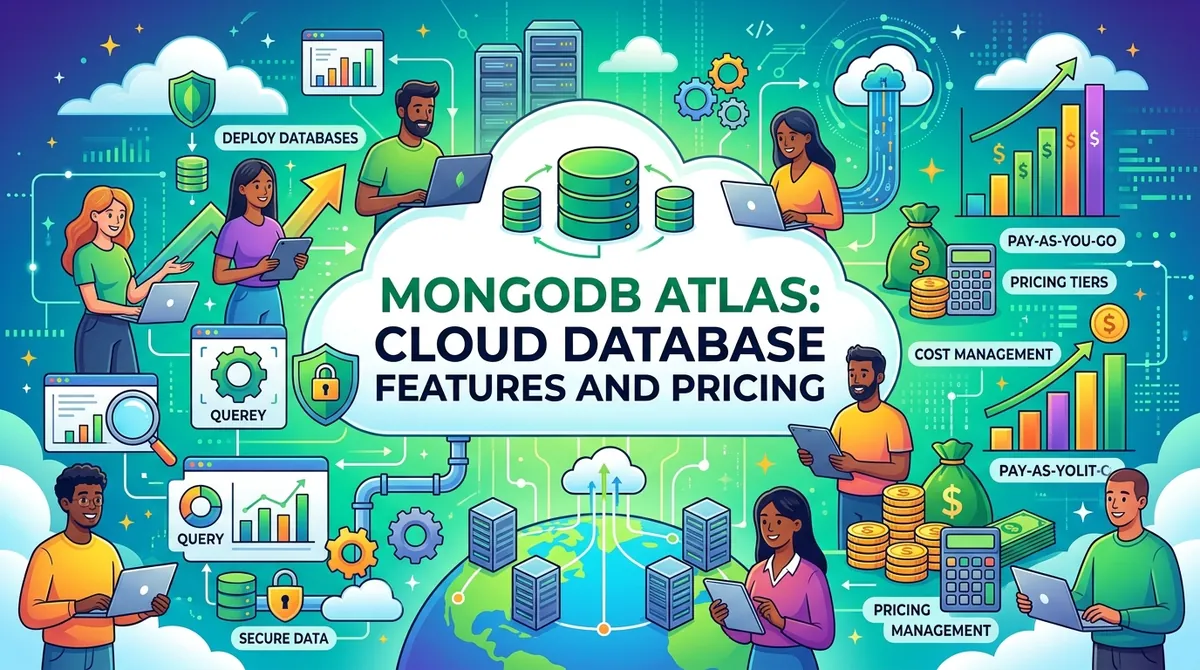
MongoDB Atlas is a fully managed, multi-cloud database service built around MongoDB's document-oriented database technology. It allows developers and organizations to deploy databases on Amazon Web Services, Microsoft Azure, or Google Cloud without managing the underlying database infrastructure themselves.
Atlas combines database deployment with monitoring, security, scaling, backups, search, vector search, data federation, and other application-development services. Organizations can start with a free cluster, use a usage-based Flex deployment for development and testing, or deploy dedicated infrastructure for production workloads.
The platform is designed to support applications ranging from prototypes to globally distributed production systems. Its pricing is primarily consumption-based, with costs depending on cluster resources, storage, data transfer, backups, region, and additional services.
What Is MongoDB Atlas?
MongoDB Atlas provides a managed environment for deploying and operating MongoDB databases in the cloud. MongoDB manages much of the underlying database infrastructure, allowing development teams to focus on application data and database configuration rather than maintaining database servers.
Atlas supports deployments across AWS, Azure, and Google Cloud, with more than 125 regions available according to MongoDB. Organizations can select a cloud provider and region that aligns with their application's architecture and geographic requirements.
The platform also supports multi-region and multi-cloud configurations for applications requiring geographic distribution or additional resilience.
Atlas Deployment Options
MongoDB Atlas currently provides three primary cluster categories: Free, Flex, and Dedicated.
Free Clusters
The Free tier provides a way to experiment with MongoDB Atlas without a paid subscription. It includes 512 MB of storage and is intended for learning, experimentation, and early development.
The free environment has resource limitations, so it is generally suited to small projects rather than production workloads.
Flex Clusters
Flex clusters are designed for application development, testing, prototypes, and workloads with relatively low or variable demand.
They use consumption-based pricing and can automatically scale within their supported limits. MongoDB currently lists Flex pricing from $0.011 per hour, with usage capable of reaching a maximum of $30 per month.
Flex replaced the older M2 and M5 cluster tiers and Atlas Serverless Instances, which were discontinued in January 2026.
Dedicated Clusters
Dedicated clusters provide more resources and capabilities for production applications.
MongoDB currently lists dedicated pricing beginning at $0.08 per hour, with the M10 tier starting around $56.94 per month. Dedicated configurations range from smaller M10 and M20 deployments to substantially larger configurations with up to 768 GB of RAM and 96 vCPUs in the published standard tiers.
Organizations can scale dedicated clusters vertically and horizontally depending on application requirements.
MongoDB Document Database
Atlas uses MongoDB's document model, where information is stored in flexible JSON-like documents rather than traditional rows and columns.
This structure can be useful for applications where data models change frequently or where related information can naturally be stored within a document.
Developers can interact with Atlas through MongoDB drivers, the MongoDB Shell, Compass, APIs, and integrations with common development environments.
MongoDB also supports indexing and query optimization tools that help developers analyze application performance.
Scaling and High Availability
Atlas provides automated infrastructure capabilities designed to support application growth.
Organizations can configure replica sets, sharding, multi-region deployments, and multi-cloud architectures depending on their cluster type and requirements. Atlas can automatically perform failovers and supports self-healing behavior for supported deployments.
Auto-scaling can adjust compute and storage resources according to workload requirements. MongoDB also provides monitoring and alerts that allow teams to track resource utilization and database performance.
Global Clusters and Multi-Region Deployments
Organizations serving users in multiple geographic locations can use Global Clusters and multi-region deployments.
Global deployments can distribute data and database operations across regions, allowing organizations to place data closer to users while addressing certain data-residency requirements.
MongoDB describes Global Clusters as supporting location-aware reads and writes, regional fault tolerance, and geographically distributed applications.
The available architecture depends on the selected cluster configuration and workload.
Security and Data Protection
Security features are integrated throughout Atlas.
Organizations can use encryption, authentication, IP access lists, private endpoints, network peering, and identity integrations to control access to databases.
Atlas supports authentication through options including SAML-based identity providers and supports MFA for Atlas users. MongoDB also provides encryption for data in transit and at rest, while Queryable Encryption allows supported queries to be performed against encrypted data.
Higher-level security capabilities can include LDAP integration, database auditing, and other enterprise controls.
MongoDB Search and Vector Search
Atlas extends beyond its core database through integrated search services.
MongoDB Search provides full-text and relevance-based search capabilities directly alongside application data. This allows developers to build search functionality without maintaining a completely separate search infrastructure.
MongoDB Vector Search supports semantic search and generative AI applications. Developers can store application data and vector representations within an integrated platform and use them for retrieval and AI-powered experiences.
These capabilities can be useful for applications involving recommendation systems, semantic search, retrieval-augmented generation, and other AI workloads.
Atlas Stream Processing and Data Federation
Atlas Stream Processing is designed for applications that need to process continuous streams of complex event data.
It can work alongside operational database data, allowing organizations to build applications that combine real-time event processing with persistent application information.
Atlas Data Federation allows organizations to query and work with data across Atlas and supported cloud object storage environments. This can provide a way to analyze or access data without moving everything into a single database cluster.
Monitoring, Backup, and Data Management
Atlas provides monitoring dashboards, alerts, performance information, and database-management tools.
Teams can review metrics related to database health and resource consumption, configure alerts, and use query and schema suggestions to identify potential optimization opportunities.
Backup capabilities vary according to deployment type. Dedicated clusters support configurable backups, snapshots, and point-in-time or automated restore capabilities, while backup services are not available on the Free tier.
Atlas also offers Online Archive, which can automatically move infrequently accessed data into managed cloud object storage while retaining query access.
MongoDB Atlas Pricing
MongoDB Atlas uses a consumption-based pricing model. Current reference prices include:
- Free: $0/hour, with 512 MB storage
- Flex: $0.011/hour, with usage capped at $30/month
- Dedicated: starting at $0.08/hour
- M10 Dedicated: approximately $56.94/month
- M30 Dedicated: approximately $0.54/hour at the published default configuration
Actual costs vary according to cloud provider, region, compute resources, storage, backups, data transfer, and additional services.
For example, MongoDB estimates that a default M30 deployment on AWS running continuously for 30 days costs approximately $388 per month, before additional configuration changes.
How Businesses Evaluate MongoDB Atlas
Organizations generally consider:
- Application workload and database size
- Required performance
- Cloud provider and geographic region
- High-availability requirements
- Multi-region or multi-cloud architecture
- Security and compliance requirements
- Backup and recovery needs
- Search and AI requirements
- Data-transfer costs
- Expected scaling patterns
- Additional Atlas services
The appropriate deployment depends on whether the database is being used for experimentation, development, or a production application with demanding availability and performance requirements.
Final Thoughts
MongoDB Atlas provides a managed cloud environment for MongoDB databases while adding capabilities for scaling, security, monitoring, search, AI applications, streaming data, and global deployments.
The Free tier can support learning and experimentation, Flex is designed around lower-cost development and testing workloads, and Dedicated clusters provide more resources and production-oriented capabilities. Organizations can also combine Atlas with MongoDB Search, Vector Search, Stream Processing, and Data Federation as application requirements expand.
Because Atlas pricing depends heavily on resource consumption and deployment architecture, businesses should evaluate expected workloads, regions, storage, backups, data transfer, and additional services when estimating total database costs.
About the Author
Daniel Brooks, 41, is a business technology consultant at a business advisory publication, specializing in data strategy, operational efficiency, and business intelligence. He helps organizations improve how they manage information and use data to support strategic and operational decisions.