


September 24, 2026 • Emily Carter
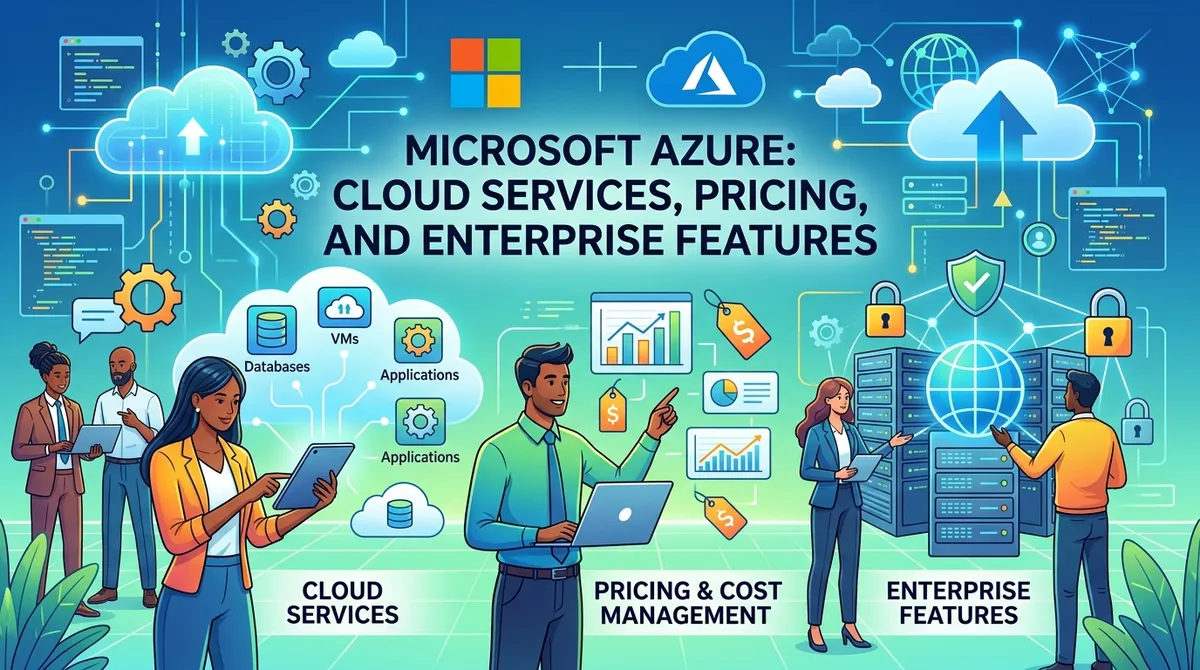
Microsoft Azure is a cloud computing platform that provides infrastructure, application development, databases, storage, analytics, artificial intelligence, networking, security, and other technology services. Organizations can use individual Azure services or combine them into larger cloud environments based on their technical and business requirements.
Azure supports workloads ranging from simple websites and development environments to enterprise applications, data platforms, AI systems, and hybrid cloud infrastructure. Microsoft's current product catalog includes services across compute, storage, databases, networking, identity, security, analytics, AI, management, and hybrid cloud.
Azure uses several purchasing and pricing models, including consumption-based pricing, reservations, and savings plans. This allows businesses to match cloud spending with workload requirements while providing options for reducing costs when usage is predictable.
What Is Microsoft Azure?
Microsoft Azure is Microsoft's cloud platform for building, deploying, and managing applications and IT infrastructure. Businesses can provision computing resources, databases, storage, networks, and managed services without maintaining all of the underlying physical infrastructure themselves.
Azure supports cloud, hybrid, and multicloud environments. Services such as Azure Arc extend Azure management capabilities to infrastructure running outside Azure, including on-premises and other cloud environments.
This makes Azure applicable to organizations at different stages of cloud adoption, from companies building new cloud-native applications to enterprises modernizing existing infrastructure.
Azure Compute Services
Azure provides several computing options for different application architectures.
Azure Virtual Machines provide configurable Windows and Linux virtual servers. Organizations can select virtual machine sizes according to processing, memory, storage, and networking requirements.
Azure App Service provides a managed environment for building and hosting web applications and APIs without requiring organizations to manage the underlying server infrastructure directly.
Azure Kubernetes Service (AKS) provides managed Kubernetes capabilities for containerized applications, while Azure Functions supports serverless, event-driven application development.
These options allow businesses to choose between infrastructure-level control and increasingly managed application environments.
Azure Storage and Databases
Azure provides several storage technologies for different data requirements.
Azure Blob Storage provides scalable object storage for documents, media, backups, application data, and large datasets. Azure also provides managed file, queue, and disk storage services.
For databases, Azure SQL Database provides a managed relational database service based on Microsoft SQL Server technology. Azure Cosmos DB provides a distributed database platform designed for applications requiring scalable performance and flexible data models.
Businesses can therefore select storage and database services according to application architecture, performance requirements, and data volume.
Data and Analytics
Azure includes services for data integration, data engineering, analytics, business intelligence, and machine learning.
Organizations can use services such as Azure Data Factory for data integration, Azure Synapse Analytics for analytics and data warehousing workloads, and Microsoft Fabric for integrated data and analytics scenarios.
Azure also connects with Power BI, allowing organizations to turn data into interactive reports and dashboards. Microsoft's current Azure catalog includes Fabric, Power BI, Azure Databricks, Synapse Analytics, Data Factory, and other analytics services.
These services can support data pipelines, enterprise reporting, business intelligence, and large-scale analytical workloads.
Azure AI and Microsoft Foundry
Artificial intelligence has become a major part of Azure's cloud offering. Microsoft Foundry provides a platform for developing and managing AI applications and agents, while Foundry Models provides access to a broad collection of foundation and specialized models.
Azure also provides services such as Azure Machine Learning, Azure AI Search, Document Intelligence, Speech, and other AI capabilities.
Organizations can use these services for applications such as document processing, search, conversational systems, predictive models, automation, and generative AI.
Networking and Hybrid Cloud
Azure provides networking services for connecting applications, users, offices, data centers, and cloud resources.
Services include virtual networking, VPN Gateway, ExpressRoute, Application Gateway, load balancing, DNS, and other networking capabilities.
For businesses maintaining infrastructure outside Azure, Azure Arc can provide a common management layer across on-premises, edge, and multicloud environments. Microsoft describes Arc as a way to extend Azure management and services to infrastructure running beyond Azure itself.
This hybrid approach can be important for organizations that cannot move every workload to a public cloud.
Azure Identity and Security
Azure provides identity and security services for protecting users, applications, infrastructure, and data.
Microsoft Entra ID, formerly Azure Active Directory, provides identity and access management capabilities, including single sign-on and integration with organizational directories.
Other Azure security services include Microsoft Defender for Cloud, Microsoft Sentinel, Azure Key Vault, Azure DDoS Protection, and security monitoring tools.
These services can be combined to manage identities, protect cloud workloads, detect threats, secure credentials, and monitor infrastructure.
Management and Governance
Azure includes tools for monitoring, managing, and governing cloud environments.
Azure Monitor provides observability across applications, infrastructure, and networks. Azure Advisor provides recommendations related to areas such as cost, security, reliability, performance, and operational efficiency.
Azure Policy can help organizations enforce governance requirements across cloud resources, while management groups and subscriptions provide structures for organizing larger Azure environments.
These capabilities become increasingly relevant as organizations operate multiple subscriptions, teams, applications, and cloud environments.
Enterprise Features
Azure includes features designed for organizations with complex infrastructure and governance requirements.
Enterprise users can use role-based access control, management groups, policies, private networking, hybrid connectivity, centralized monitoring, and security services to establish consistent cloud-management practices.
Azure's integration with Microsoft products such as Microsoft 365, Windows Server, SQL Server, Entra ID, Power Platform, and other Microsoft technologies can also simplify integration for organizations already operating within the Microsoft ecosystem.
Azure Arc extends management across hybrid and multicloud environments, while Microsoft Marketplace provides access to third-party software and services that can be purchased through Azure.
Azure Pricing
Azure generally uses consumption-based pricing, meaning businesses pay for the resources and services they use. Actual costs depend on the service, region, configuration, usage volume, and purchasing agreement.
Azure provides a Pricing Calculator for estimating the cost of planned architectures. Businesses can also use Azure Reservations and the Azure Savings Plan for Compute to reduce costs for qualifying workloads with predictable usage. Azure Hybrid Benefit can provide additional savings for eligible existing licenses.
New customers can currently receive a $200 Azure credit for use within 30 days when opening an Azure free account. The offer also includes specified free monthly amounts for selected services, subject to Microsoft's current terms.
Because Azure contains hundreds of individual services with different billing models, businesses should estimate costs based on the complete architecture rather than a single service price.
Azure for Different Business Needs
Software companies can use Azure for application hosting, databases, containers, DevOps, and AI development.
Enterprises can use Azure for infrastructure modernization, hybrid cloud management, analytics, identity, security, and business applications.
Data teams can combine storage, integration, analytics, machine learning, and business intelligence services.
AI teams can use Microsoft Foundry, model services, Azure Machine Learning, search, and other AI capabilities to build applications and agents.
IT departments can use Azure management, security, monitoring, identity, and hybrid-cloud services to operate distributed environments.
How Businesses Evaluate Azure
Businesses evaluating Azure should consider workload requirements, existing Microsoft investments, technical expertise, geographic needs, security requirements, integration requirements, and expected growth.
Cost should be assessed at the architecture level. Compute, storage, databases, networking, monitoring, security, data transfer, and third-party services can all contribute to the final bill.
Organizations should also determine whether they need purely cloud-based infrastructure or a hybrid model that incorporates existing data centers and other cloud environments.
Final Thoughts
Microsoft Azure provides a broad cloud platform covering compute, storage, databases, networking, analytics, AI, security, identity, application development, and hybrid infrastructure.
Its combination of managed services, enterprise governance, Microsoft ecosystem integration, and hybrid-cloud capabilities allows organizations to build different types of technology environments on the same platform.
For businesses evaluating Azure, the key considerations are workload architecture, security, integration requirements, technical resources, hybrid-cloud needs, and ongoing costs. Microsoft's consumption pricing and commitment-based options provide flexibility, but detailed cost planning remains important as cloud usage expands.
About the Author
Emily Carter, 34, is an investment consultant at [website name], specializing in emerging markets and risk management. She provides entrepreneurs with practical strategies to maximize returns, manage uncertainty, and protect long-term wealth.
References
- Microsoft Azure — Azure Products
- Microsoft Azure — Azure Pricing
- Microsoft Azure — Azure Purchase Options
- Microsoft Azure — Azure Free Account
- Microsoft Azure — Azure Arc
- Microsoft Azure — Azure Cloud Services
- Microsoft Azure — Microsoft Foundry and AI Services
- Microsoft Learn — Azure Identity and Security
- Microsoft Learn — Azure Architecture and Cloud Services