


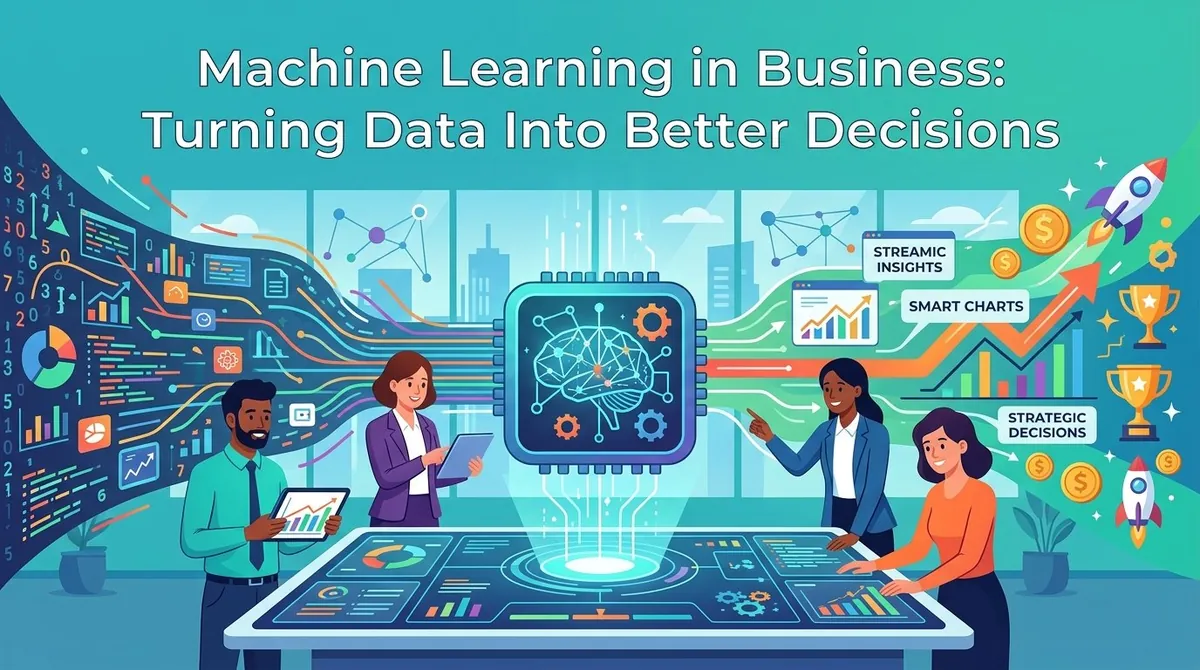
Businesses generate enormous amounts of information through transactions, customer interactions, digital platforms, operations, and connected systems. The challenge is no longer simply collecting this information but finding useful patterns within it and turning those patterns into better decisions.
Machine learning is one of the technologies helping organizations address this challenge. By identifying relationships and patterns in data, machine learning models can support forecasting, classification, recommendations, risk assessment, and other business activities.
The technology does not eliminate the need for human judgment. Instead, its practical value comes from helping organizations analyze information more efficiently and use evidence to support decisions.
Understanding Machine Learning in Business
Machine learning is a branch of artificial intelligence in which computer systems learn patterns from data and use those patterns to make predictions or classifications. Rather than programming every possible outcome manually, organizations provide models with relevant data and use the resulting patterns for specific tasks.
Business applications can include predicting customer behavior, detecting unusual transactions, forecasting demand, estimating risks, and recommending products or services.
Different machine learning approaches are appropriate for different problems. The right method depends on the available data, the objective, and how the resulting predictions will be used.
Turning Business Data Into Predictions
Traditional business reporting generally describes what has already happened. Machine learning can extend analysis by helping organizations estimate what may happen next.
For example, a retailer can analyze historical sales, seasonal patterns, and other relevant information to improve demand forecasts. A financial organization may analyze transaction patterns to identify potentially unusual activity.
These predictions are not guarantees. They represent estimates based on the information available to the model. Businesses therefore need to understand the limitations of their data and regularly evaluate whether models continue to perform as expected.
Improving Business Decision-Making
Machine learning can support decision-making by processing information at a scale that would be difficult to analyze manually. Instead of relying exclusively on a fixed set of rules, organizations can use models that identify patterns across multiple variables.
This can help managers identify trends that might otherwise be difficult to detect. For instance, a company could analyze customer behavior to determine which factors are associated with repeat purchases or cancellations.
The final decision can still remain with employees or managers. Machine learning provides an additional analytical input rather than automatically determining what the organization should do.
Applications Across Business Functions
Machine learning has applications across many areas of an organization.
- Marketing: Identify customer segments, predict engagement, and support personalized recommendations.
- Sales: Analyze customer behavior and estimate which opportunities may require additional attention.
- Finance: Support fraud detection, risk analysis, and financial forecasting.
- Operations: Improve demand planning, inventory management, and resource allocation.
- Customer service: Classify requests, identify recurring issues, and support customer-response systems.
The usefulness of each application depends on the quality of the underlying data and whether the prediction addresses a meaningful business problem.
Building a Machine Learning Strategy
Businesses should begin with a clearly defined objective rather than choosing a machine learning model first. A useful project starts by identifying a decision or process that could benefit from improved analysis.
A practical implementation process can include:
- 1Define the business objective: Establish what the organization wants to predict, classify, or improve.
- 2Assess available data: Determine whether sufficient, relevant, and reliable information exists.
- 3Prepare the data: Clean and organize information so that it can be used appropriately by the model.
- 4Test the model: Evaluate how accurately it performs against relevant historical or test data.
- 5Deploy with oversight: Integrate the model into the relevant business workflow while maintaining appropriate human review.
- 6Monitor performance: Track results over time and update the model when business conditions or data patterns change.
This process helps connect technical development with measurable business outcomes.
The Importance of Data Quality
Machine learning models depend heavily on the information used to train and evaluate them. Incomplete, outdated, inconsistent, or poorly structured data can reduce the usefulness of predictions.
Organizations should therefore establish processes for data collection, validation, storage, and governance. They also need to understand how data is sourced and whether it accurately represents the business situation the model is intended to address.
Data quality is particularly important when machine learning is used in decisions involving customers, finances, or other sensitive business processes.
Managing Machine Learning Risks
Machine learning introduces risks that organizations need to manage alongside its potential benefits. Models can produce incorrect predictions, and their performance can change when customer behavior, markets, or operating conditions change.
Bias in training data can also affect model outputs. Organizations should evaluate whether models produce appropriate results for their intended applications and establish procedures for reviewing unexpected outcomes.
Transparency can be another consideration. Decision-makers may need to understand why a model produced a particular result, especially when predictions influence important business decisions.
Measuring Business Impact
The success of a machine learning initiative should be measured according to the problem it was designed to solve. Model accuracy can be important, but it is not necessarily the only measure of business value.
Organizations can also examine changes in revenue, costs, processing times, customer retention, forecasting accuracy, operational efficiency, or other relevant indicators.
For example, a demand forecasting model should ultimately be evaluated not only by its statistical performance but also by whether it helps the organization manage inventory more effectively.
Common Challenges of Machine Learning Adoption
Businesses can face several challenges when introducing machine learning. Building reliable models requires suitable data, technical expertise, computing resources, and ongoing monitoring.
Integration can also be difficult. A model that performs well in testing may provide limited value if employees cannot easily access its predictions or if the result does not fit naturally into an existing workflow.
Organizations should therefore consider people and processes alongside technology. Employees need to understand how predictions are generated, when they should be used, and when human judgment should override an automated recommendation.
The Future of Machine Learning in Business
Machine learning is likely to become increasingly embedded in business applications as organizations improve their data infrastructure and analytical capabilities. Rather than operating as isolated projects, machine learning models can become part of forecasting, customer management, financial analysis, operations, and decision-support systems.
The growing availability of AI-enabled software may also make machine learning capabilities more accessible to businesses that do not have large specialist teams. However, accessibility does not remove the need for sound data management and governance.
Ultimately, the value of machine learning in business comes from connecting data with decisions. Organizations that combine reliable information, appropriate models, human expertise, and continuous measurement can use machine learning to improve how they understand their operations and respond to changing conditions.