


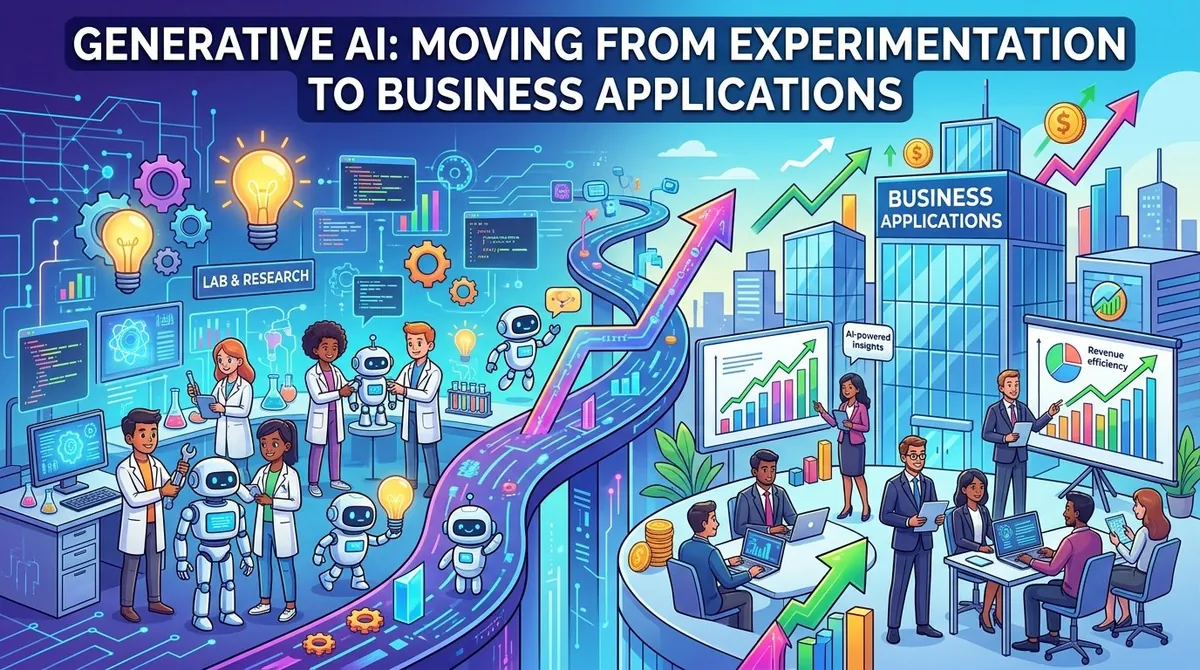
Generative artificial intelligence has quickly moved from an emerging technology discussed primarily by researchers and technology companies to a practical tool being tested across many business functions. Organizations are experimenting with systems that can generate text, images, code, summaries, presentations, and other forms of content.
The next stage of adoption is less about simply testing what generative AI can produce and more about determining where it can create measurable business value. Companies are increasingly considering how these tools can fit into established workflows, improve productivity, support employees, and create new ways of serving customers.
Understanding Generative AI in Business
Generative AI refers to artificial intelligence systems capable of producing new content based on patterns learned from large datasets. Unlike traditional software that follows predefined instructions, generative AI can respond to natural-language prompts and create outputs that vary depending on the information provided.
Businesses can use these capabilities across a wide range of activities. Marketing teams may use generative AI to develop initial content ideas, while software teams can use it to assist with coding and documentation. Customer service teams may also use AI to summarize conversations or help employees prepare responses.
The usefulness of these applications depends on the specific workflow and the quality of human oversight surrounding them.
From AI Experiments to Practical Use Cases
Many organizations begin their generative AI journey through experimentation. Employees may test chatbots, content-generation tools, or AI assistants to understand what the technology can and cannot do.
Experimentation is useful because it allows businesses to identify promising applications without immediately committing significant resources. However, individual experiments do not automatically translate into an effective business strategy.
The transition to practical adoption requires organizations to ask more specific questions: What problem is being solved? Who will use the system? How will success be measured? What information will the system access? And what level of human review is necessary?
Answering these questions can help businesses separate interesting demonstrations from use cases with genuine operational value.
Generative AI and Employee Productivity
One of the most common business applications of generative AI is assisting employees with repetitive or time-consuming tasks. AI tools can help summarize documents, organize information, generate drafts, create meeting notes, and support research.
These capabilities can reduce the time required for certain activities while allowing employees to focus on tasks requiring judgment and expertise. The objective is not necessarily to automate an entire role but to improve individual workflows.
For example, a financial professional might use an AI assistant to organize information before conducting a deeper analysis. The AI-generated material can provide a starting point, while the employee remains responsible for reviewing the information and making the final judgment.
Applying Generative AI Across Business Functions
Generative AI can be applied across different departments, but each use case presents different requirements.
- Marketing: Generate early drafts, campaign concepts, product descriptions, and content variations.
- Customer service: Summarize interactions, assist with response drafts, and organize frequently requested information.
- Human resources: Support job-description drafting, internal communications, and document organization.
- Software development: Assist with code generation, documentation, testing, and debugging.
- Finance and operations: Summarize reports, extract information from documents, and support routine analysis.
These examples demonstrate why a single company-wide AI strategy may need to include different approaches for different functions. The appropriate level of automation, oversight, and data access can vary substantially between use cases.
Building a Generative AI Strategy
Moving beyond experimentation requires a structured approach. Organizations should begin by identifying processes where generative AI could address a clearly defined problem rather than introducing the technology simply because it is becoming popular.
A practical implementation process can include:
- 1Identify suitable workflows: Look for repetitive, information-heavy, or time-consuming activities where AI assistance could provide measurable value.
- 2Assess the data involved: Determine what information the system will require and whether that information can be used safely.
- 3Run controlled pilots: Test selected applications with a limited group of users before expanding them across the organization.
- 4Establish review procedures: Define when employees must verify AI-generated information and who is responsible for final decisions.
- 5Measure business outcomes: Evaluate changes in productivity, processing time, quality, cost, or customer experience.
This approach allows businesses to learn from early deployments before making larger investments.
Managing Accuracy, Security, and Governance
Generative AI also introduces risks that businesses need to address. "AI systems can produce inaccurate or misleading information, sometimes presenting incorrect content in a convincing way." For this reason, organizations should establish appropriate review procedures for outputs used in important business processes.
Data security is another consideration. Employees may work with confidential customer information, financial records, intellectual property, or internal documents. Businesses need clear policies governing what information can be entered into AI systems and how generated outputs can be used.
Governance should therefore develop alongside adoption. Rather than treating risk management as a later stage, organizations can establish basic rules and responsibilities from the beginning.
Measuring the Business Value of Generative AI
The success of a generative AI initiative should ultimately be connected to business objectives. Usage statistics alone do not necessarily demonstrate that an AI deployment is delivering meaningful value.
Companies can track measures such as time saved per task, reduction in manual work, processing costs, output quality, employee adoption, or customer response times. The appropriate metrics depend on the original purpose of the implementation.
For example, if an organization introduces AI to accelerate document processing, the relevant measurement may be the time required to complete the process before and after implementation. Clear measurement makes it easier to determine whether an experiment should be expanded, modified, or discontinued.
Common Barriers to Adoption
Organizations can encounter several challenges when moving generative AI from experimentation into everyday operations. Employees may be uncertain about how AI will affect their responsibilities, while managers may struggle to determine which applications deserve investment.
Technical limitations can also create difficulties. AI systems may need to connect with existing software, databases, or internal knowledge sources. Poorly structured information can reduce the usefulness of an AI application even when the underlying model is capable.
Another challenge is avoiding unnecessary complexity. Not every business problem requires generative AI. In some cases, conventional automation, analytics, or process improvements may provide a simpler solution.
The Future of Generative AI in Business
As organizations gain more experience with generative AI, the focus is likely to shift from isolated experiments toward deeper integration with business processes. AI capabilities can increasingly become embedded within software employees already use rather than existing only as separate applications.
This shift could make AI assistance a normal part of everyday work. Employees may use AI to retrieve information, prepare drafts, analyze documents, or coordinate routine tasks without thinking of each activity as a separate technology project.
For businesses, the central challenge will be developing a practical balance between automation and human judgment. Companies that approach generative AI with clear objectives, reliable data, appropriate governance, and measurable outcomes can evaluate the technology based on its contribution to real business processes rather than experimentation alone.