


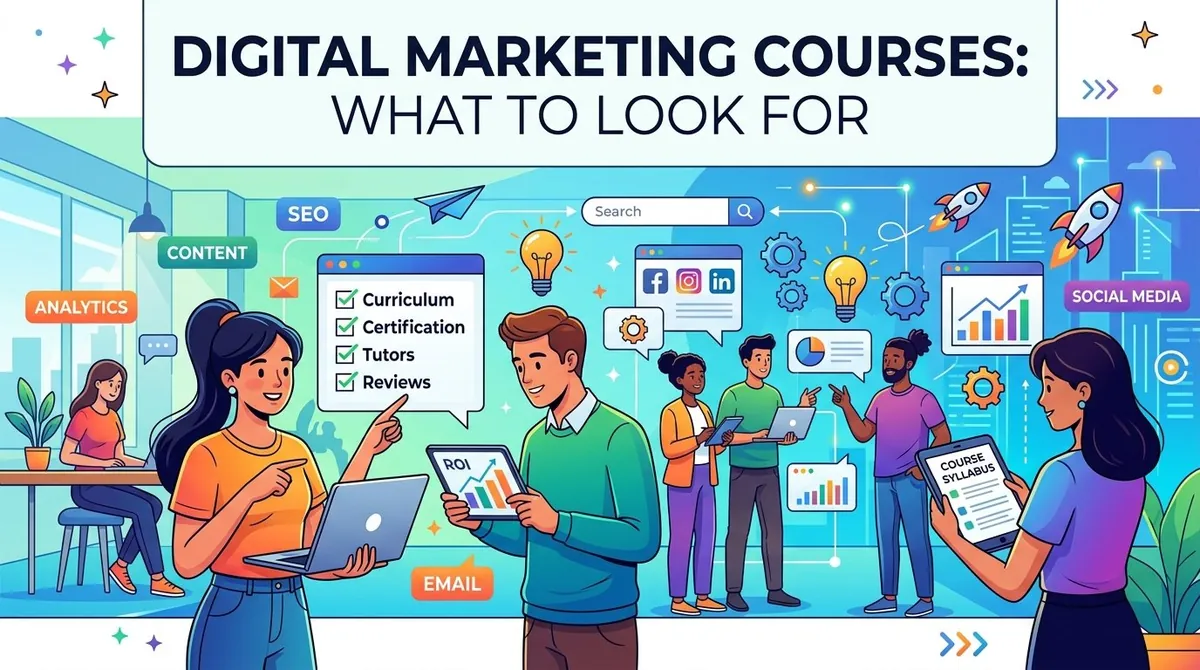
Digital marketing courses can help students, professionals, business owners, and career changers develop skills for reaching customers through online channels. Depending on the program, training may cover search engine optimization (SEO), paid advertising, social media, content marketing, email, analytics, e-commerce, and broader marketing strategy.
Because digital marketing includes many different disciplines, courses can vary considerably in their structure and depth. Some provide a broad introduction, while others focus on a specific platform or skill, such as Google Ads, social media advertising, SEO, or marketing analytics.
When comparing digital marketing courses, learners should consider the curriculum, practical training, instructors, tools covered, certification, learning format, and overall time and cost commitment. The right criteria depend on the learner's goals and existing experience.
What Do Digital Marketing Courses Cover?
A comprehensive digital marketing course typically introduces several online marketing channels and explains how they support broader business objectives.
Common subjects include:
- Digital marketing strategy
- Search engine optimization
- Paid search and social advertising
- Content marketing
- Social media marketing
- Email marketing
- Web and marketing analytics
- Conversion optimization
- E-commerce
- Audience and customer research
For example, Google's Digital Marketing & E-commerce Professional Certificate covers areas including search, email, social media, online advertising, analytics, e-commerce, and performance measurement.
A broad curriculum can be useful for beginners who want to understand how different marketing activities fit together before choosing a specialization.
Look for a Well-Structured Curriculum
The curriculum is one of the first things to review when comparing courses. A program should clearly explain what learners will study and how subjects progress from introductory concepts to more practical applications.
A strong foundation may include:
- Marketing objectives and strategy
- Customer and audience research
- Digital channels
- Campaign planning
- Content development
- Advertising
- Analytics and measurement
- Optimization
The curriculum should also match the learner's objective. Someone preparing for a general digital marketing role may need broad training, while someone pursuing paid media may benefit more from specialized advertising coursework.
Consider Practical Learning
Digital marketing requires practical skills, so learners should look for courses that provide opportunities to apply concepts rather than relying entirely on lectures.
Practical work can include:
- Creating campaign plans
- Conducting keyword research
- Developing content calendars
- Building advertising campaigns
- Analyzing marketing data
- Creating reports
- Testing different messages or audiences
Google's Skillshop, for example, provides product-focused training for Google Ads and describes courses that combine marketing strategy, product knowledge, and real-world scenarios.
Practical assignments can also give learners examples of their work that may be useful when applying for internships, jobs, or freelance projects.
Check SEO and Content Marketing Coverage
SEO and content are common components of digital marketing. A course should explain how businesses attract relevant audiences through search and useful content.
SEO training may include:
- Keyword research
- On-page optimization
- Technical SEO
- Search intent
- Link-related concepts
- SEO measurement
Content marketing courses may address audience research, content planning, creation, distribution, and performance measurement.
Semrush Academy, for example, offers training covering SEO, content marketing, social media, analytics, paid advertising, and other marketing subjects. Its courses include both foundational and specialized topics.
Evaluate Paid Advertising Training
Learners interested in performance marketing should pay particular attention to paid advertising coverage.
A useful course may explain:
- Campaign objectives
- Audience targeting
- Ad formats
- Budgeting
- Bidding
- Conversion tracking
- Creative testing
- Campaign optimization
Google Skillshop provides dedicated Google Ads training and certifications, while other programs may focus on social advertising or cover multiple advertising channels.
The important consideration is whether the course teaches transferable advertising principles in addition to the mechanics of a particular platform.
Look for Analytics and Measurement
Marketing skills increasingly depend on understanding performance data. Courses should therefore include at least some training in measurement and reporting.
Important topics can include:
- Key performance indicators
- Traffic and engagement metrics
- Conversion measurement
- Campaign reporting
- Attribution concepts
- Data interpretation
- Marketing optimization
Google's Analytics Academy on Skillshop provides courses covering Google Analytics setup, data collection, reporting, and measurement of online marketing effectiveness.
Analytics training can be particularly useful for learners who want to work in performance marketing, e-commerce, growth marketing, or marketing operations.
Consider the Tools and Platforms
Digital marketing courses often teach specific platforms and software. Depending on the program, these may include advertising platforms, analytics tools, SEO software, email marketing systems, content management systems, or customer relationship management platforms.
Platform knowledge can be valuable, but learners should also consider whether they are developing transferable marketing skills.
Software interfaces and features change frequently. Understanding campaign objectives, audience segmentation, measurement, testing, and optimization can remain useful even when a specific platform changes.
Review the Instructors
Instructor experience can provide useful context when evaluating a course.
Look for information about:
- Professional marketing experience
- Industry specialization
- Teaching experience
- Previous clients or projects
- Areas of expertise
Some programs combine instructors from companies, agencies, universities, and professional marketing organizations. Semrush Academy, for example, lists courses taught by marketing professionals with experience in SEO, content, social media, analytics, and other areas.
The instructor's background should also align with the subjects being taught.
Understand the Certification
Many digital marketing courses provide certificates after completion. However, not all certificates represent the same type of assessment or learning experience.
Before enrolling, check:
- Whether an exam is required
- Whether projects or assignments are included
- Who issues the certificate
- Whether the credential expires
- Whether it is relevant to the intended career or role
For example, Semrush Academy requires learners to complete course material and pass applicable assessments before receiving certificates, while Google offers product-specific certifications through Skillshop.
A certificate can document training, but practical skills and demonstrated experience can also be important when pursuing marketing work.
Choose the Right Learning Format
Digital marketing courses are available in self-paced, instructor-led, university-based, and professional certificate formats.
Self-paced courses can work well for learners with flexible schedules. Instructor-led programs may provide more interaction and feedback. Professional certificate programs can offer a more structured sequence of subjects.
For example, Google's Digital Marketing & E-commerce Professional Certificate is structured as an eight-course series with a flexible schedule, while Google Skillshop and Semrush Academy offer individual courses that learners can complete online.
Compare Cost and Time Commitment
Price should be considered alongside the amount of training provided. Some courses are free, while others use subscriptions, individual course fees, or longer certificate-program pricing.
Also consider the total time commitment. A short course may be useful for learning one specific skill, while a multi-course program may require several months of study.
Before enrolling, compare:
- Total cost
- Course duration
- Weekly workload
- Access period
- Practical projects
- Instructor support
- Assessments
- Certification
How to Choose a Digital Marketing Course
A simple evaluation process can make comparisons easier:
- 1Define the goal — Decide whether the objective is career development, a career change, business growth, or learning a specific skill.
- 2Review the curriculum — Check whether the subjects match that goal.
- 3Look for practical work — Prioritize exercises, projects, and real-world examples.
- 4Check platform coverage — Determine whether the tools taught are relevant to the intended role.
- 5Evaluate analytics training — Make sure the course explains how marketing performance is measured.
- 6Review certification requirements — Understand what is required to earn the credential.
- 7Compare time and cost — Consider the complete commitment rather than the advertised price alone.
Final Thoughts
Digital marketing courses can provide a structured way to develop skills across SEO, content, advertising, social media, analytics, and other areas of online marketing. Because programs differ substantially, learners should evaluate more than course titles or certificates.
A useful course should match the learner's objectives, provide relevant practical training, explain performance measurement, and offer a curriculum that reflects the skills needed for the intended area of digital marketing. Comparing these factors can help learners choose training that fits their experience, schedule, and professional goals.
References
- Google Skillshop — Digital Marketing and Google Product Training
- Google Analytics Academy — Analytics Training
- Google Digital Marketing & E-commerce Professional Certificate — Coursera
- Semrush Academy — Digital Marketing Courses and Certifications
- Meta Blueprint — Digital Marketing and Advertising Training