


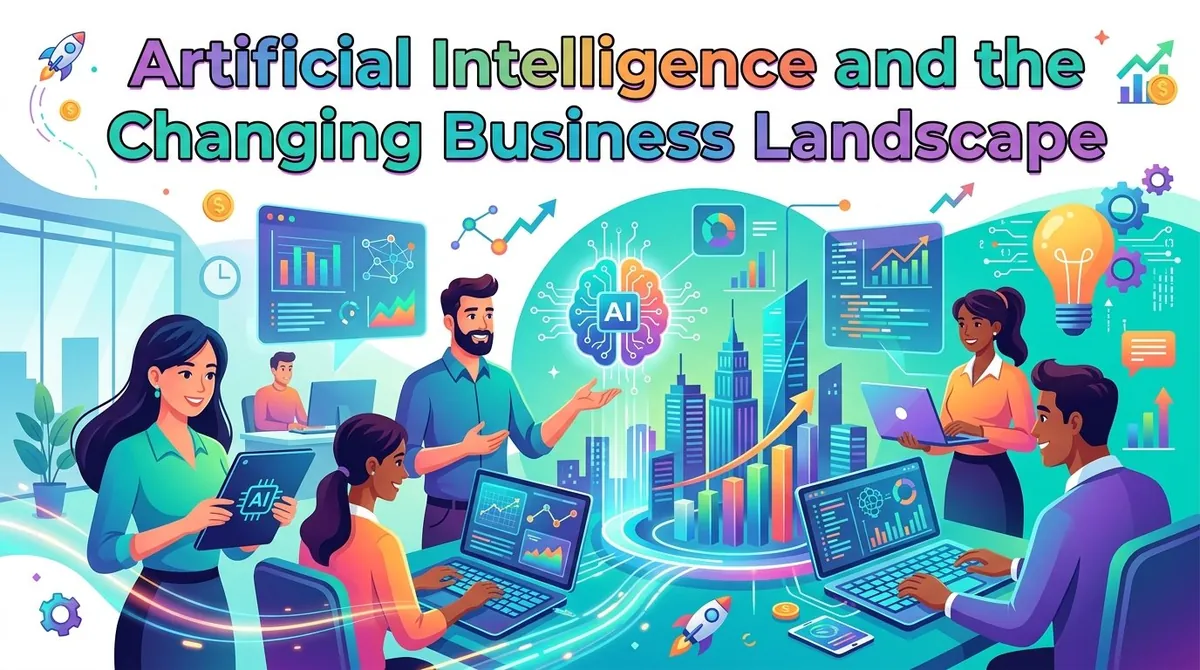
Artificial intelligence has moved from a specialized technology used by research teams to a practical business tool influencing how organizations operate, compete, and serve customers. Companies across industries are using AI to automate repetitive work, analyze information, improve decision-making, and develop new products and services.
The growing role of AI is changing more than individual processes. It is influencing business models, workforce requirements, customer expectations, and competitive strategy. Understanding these changes can help organizations approach artificial intelligence as part of a broader digital transformation rather than as a standalone technology investment.
Understanding the Role of Artificial Intelligence in Business
Artificial intelligence refers to technologies that enable computer systems to perform tasks that traditionally require human judgment or perception. These capabilities include analyzing large datasets, recognizing patterns, understanding language, generating content, and making predictions.
In business, AI can be applied to areas ranging from customer service and marketing to finance, operations, and supply chain management. The technology does not necessarily replace existing systems; in many cases, it works alongside employees and established processes to improve speed, consistency, or access to information.
The practical value of AI therefore depends not only on the technology itself but also on how well it addresses a specific business need.
How AI Is Changing Business Operations
One of the most visible effects of artificial intelligence is the automation of repetitive tasks. Organizations can use AI-powered systems to classify information, process documents, respond to routine customer questions, and assist with administrative workflows.
Automation can allow employees to spend more time on activities requiring judgment, communication, and problem-solving. At the same time, businesses need to review automated processes carefully to ensure that errors do not spread through connected systems.
AI is also changing how organizations work with information. Instead of relying exclusively on manually prepared reports, businesses can use analytical systems to identify patterns and generate insights from larger volumes of data.
AI and Business Decision-Making
Traditional business analysis often relies on historical reporting and manually assembled information. AI can expand these capabilities by identifying relationships within large datasets and helping organizations evaluate potential outcomes.
For example, companies may use predictive models to estimate demand, identify customers who may leave, detect unusual transactions, or improve inventory planning. These applications can support more timely decisions when managers have access to reliable data.
However, AI-generated recommendations should not automatically be treated as final decisions. Data quality, model limitations, changing market conditions, and inappropriate assumptions can all affect results. Human review remains an important part of responsible AI adoption.
Transforming Customer Experiences
Customer expectations are also influencing the adoption of artificial intelligence. Businesses increasingly use AI to personalize communications, provide automated assistance, and analyze customer interactions.
AI-powered customer service tools can help answer frequently asked questions and direct more complex requests to employees. Recommendation systems can also use customer behavior and preferences to present more relevant products or information.
The objective is not simply to introduce more automation. Effective customer-focused AI should make interactions easier while maintaining appropriate levels of transparency and human support.
AI, Employees, and the Future of Work
The impact of artificial intelligence on employment is one of the most discussed aspects of the changing business landscape. While some tasks can be automated, AI can also create demand for new skills and change the responsibilities associated with existing roles.
Employees may increasingly need to understand how to work with AI systems, evaluate their outputs, protect sensitive information, and incorporate automated tools into established workflows. Skills such as analytical thinking, communication, creativity, and technology literacy can become increasingly valuable alongside technical expertise.
Businesses introducing AI therefore need to consider workforce development as part of their technology strategy. Training employees can help organizations capture the benefits of new tools while reducing uncertainty around changing responsibilities.
Building an AI Strategy
Adopting artificial intelligence successfully requires more than purchasing a new platform. Organizations need to identify where AI can create measurable value and determine whether their data, systems, and processes are ready to support implementation.
A practical AI strategy can include:
- Identify business problems first: Start with specific operational or customer challenges rather than adopting AI simply because it is available.
- Evaluate data readiness: Review the quality, accessibility, security, and consistency of the information AI systems will use.
- Start with manageable applications: Pilot selected use cases before expanding AI across the organization.
- Measure outcomes: Track relevant changes in productivity, costs, customer experience, accuracy, or other business objectives.
- Establish governance: Define responsibilities for privacy, security, oversight, and the use of AI-generated outputs.
This approach allows businesses to evaluate artificial intelligence based on measurable business outcomes rather than technology adoption alone.
Common Challenges of AI Adoption
Despite its potential, artificial intelligence introduces practical challenges. Poor-quality data can produce unreliable outputs, while disconnected systems can make implementation more difficult. Organizations may also face concerns surrounding privacy, cybersecurity, intellectual property, and regulatory requirements.
Another challenge is managing expectations. AI is not equally effective for every task, and implementing a system without clearly defining its purpose can create additional complexity rather than solving an existing problem.
Successful adoption therefore requires coordination between technology teams, business leaders, employees, and other stakeholders. Clear policies and ongoing evaluation can help organizations manage the risks associated with increasingly automated processes.
Measuring the Business Impact of AI
The effectiveness of an AI initiative should be evaluated against clearly defined objectives. Metrics can vary depending on the application, but businesses may examine changes in processing time, operating costs, conversion rates, customer satisfaction, forecasting accuracy, or employee productivity.
Measurement is particularly important during the early stages of adoption. A pilot project that produces limited measurable value may indicate that the use case, implementation method, or underlying data needs to be reconsidered before further investment.
Over time, businesses can compare AI-supported processes with previous workflows and identify where the technology is producing meaningful improvements.
The Future of AI in Business
Artificial intelligence is likely to become increasingly integrated into everyday business systems rather than remaining a separate technology category. AI capabilities may become embedded in analytics platforms, customer relationship systems, productivity tools, financial software, and operational applications.
As adoption expands, competitive differences may depend less on whether a company uses AI and more on how effectively it integrates the technology into its business model. Organizations that combine reliable data, appropriate technology, skilled employees, and clear governance can build a stronger foundation for long-term digital transformation.
The changing business landscape will therefore require companies to view AI as an evolving capability. Rather than treating artificial intelligence as a one-time technology project, businesses can approach it as an ongoing process of experimentation, measurement, learning, and improvement.