


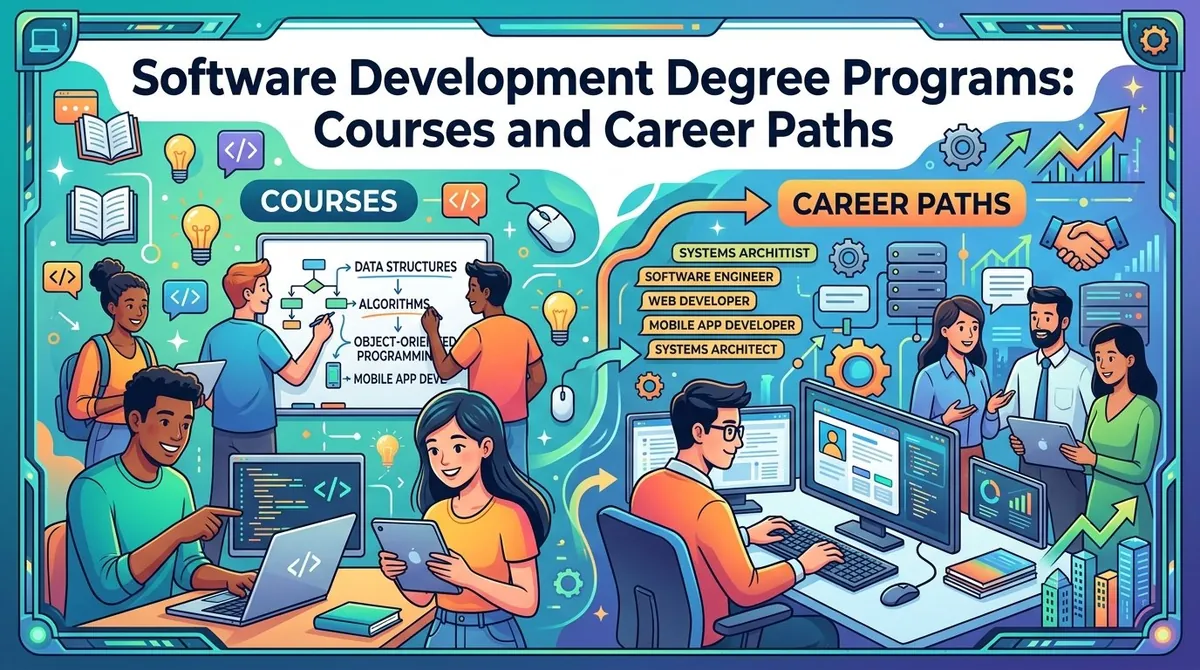
Software development degree programs prepare students to design, build, test, maintain, and improve software applications. Programs can provide foundations in programming and computer science while also introducing software engineering practices, databases, operating systems, security, and application development.
Students can choose from different educational pathways, including associate degrees, bachelor's degrees, master's programs, and related degrees in computer science, software engineering, information technology, or computer information systems. The curriculum and technical depth can vary considerably between institutions.
Understanding common courses and potential career paths can help prospective students compare programs and determine which type of education aligns with their interests, previous experience, and professional objectives.
What Is a Software Development Degree?
A software development degree is an academic program focused on the knowledge and skills used to create and maintain software. Depending on the institution, the degree may be specifically titled software development, software engineering, computer science, or a related field.
The ACM, IEEE Computer Society, and AAAI's CS2023 curriculum guidelines identify areas including software development fundamentals, software engineering, algorithms, programming languages, data management, operating systems, networking, security, and artificial intelligence as components of modern computer science education.
Programs may therefore combine programming instruction with broader computer science and engineering concepts.
Types of Software Development Degree Programs
Associate Degrees
Associate programs generally provide introductory technical training over a shorter period than bachelor's programs. Students may study programming fundamentals, databases, web development, software testing, and basic computer systems.
Graduates may pursue entry-level technical positions or continue their education through a bachelor's degree, depending on transfer opportunities.
Bachelor's Degrees
A bachelor's degree is a common pathway for students seeking professional software development careers. Programs typically provide several years of coursework covering programming, algorithms, software engineering, databases, computer architecture, operating systems, and related subjects.
The U.S. Bureau of Labor Statistics lists a bachelor's degree as the typical entry-level education for software developers, quality assurance analysts, and testers.
Master's Degrees
Master's programs generally provide advanced study after a bachelor's degree. Depending on the program, students may specialize in areas such as software engineering, artificial intelligence, cybersecurity, distributed systems, cloud computing, or advanced application development.
Some programs are designed for working professionals and can be completed online or part time.
Common Software Development Courses
Course requirements vary, but students can expect many programs to include subjects such as:
- Programming fundamentals
- Object-oriented programming
- Data structures and algorithms
- Software engineering
- Database systems
- Web development
- Operating systems
- Computer networks
- Software testing
- Systems analysis and design
- Cybersecurity
- Cloud or distributed computing
The CS2023 curriculum specifically identifies programming concepts, data structures, algorithms, software development practices, software design, software construction, verification and validation, refactoring, and software reliability among software-related knowledge areas.
Students should compare actual course descriptions because programs with similar names may emphasize different technologies and development approaches.
Programming and Software Development Fundamentals
Programming is a core component of most software development education. Students learn how to write, read, debug, and maintain code using one or more programming languages.
Early coursework may cover:
- Variables and data types
- Control structures
- Functions and methods
- Object-oriented programming
- Data structures
- Algorithms
- Error handling
- Testing and debugging
The CS2023 guidelines describe software development fundamentals as including programming concepts, data structures, algorithms, and software development practices.
Learning multiple programming concepts is generally more transferable than focusing exclusively on one language because development environments and technologies change over time.
Software Engineering
Software engineering courses introduce methods for developing software systematically, particularly when projects become too complex for individual coding exercises.
Students may learn about:
- Requirements gathering
- Software architecture
- System design
- Version control
- Development methodologies
- Testing
- Code review
- Documentation
- Maintenance
- Refactoring
Software engineering also introduces collaboration. Professional development projects commonly involve multiple developers, product teams, designers, testers, and other stakeholders.
Databases and Data Management
Many applications depend on storing and retrieving information, making database knowledge useful for software developers.
Students may learn relational database concepts, SQL, data modeling, transactions, normalization, and database management. More advanced programs may also introduce NoSQL databases, distributed databases, or cloud-based data services.
Database coursework can help students understand how application code interacts with persistent data and how software systems manage information at scale.
Web, Mobile, and Application Development
Some programs offer specialized courses in web or mobile development. Web development can include front-end technologies, back-end programming, APIs, authentication, and application architecture.
Mobile development may introduce application development for smartphones and tablets, while other programs may offer electives covering desktop applications, game development, embedded systems, or specialized platforms.
CS2023 includes specialized platform development as a knowledge area and identifies web and mobile platforms among possible areas of study.
Students interested in a particular development environment should examine whether the program offers relevant electives or project opportunities.
Software Testing and Quality Assurance
Testing is an important part of professional software development. Courses may introduce unit testing, integration testing, system testing, automated testing, debugging, and quality assurance processes.
Students can also learn how to identify defects, reproduce problems, verify fixes, and evaluate whether software meets specified requirements.
The CS2023 software engineering guidelines include software verification and validation, reliability, and code evolution among relevant areas of study.
Career Paths for Graduates
Software development education can support several technology careers.
Software Developer
Software developers design, build, modify, and maintain applications and software systems. They may specialize in areas such as web applications, mobile applications, enterprise software, or backend systems.
Software Engineer
Software engineers apply software development and engineering principles to larger or more complex systems. Their work can involve architecture, scalability, reliability, testing, and system design.
Web Developer
Web developers create and maintain websites and web applications. Depending on their specialization, they may focus on front-end interfaces, back-end systems, or both.
Application Developer
Application developers create software for specific platforms or business requirements. They may work on desktop, mobile, enterprise, or specialized applications.
QA Analyst or Tester
Quality assurance analysts and testers evaluate applications to identify defects and verify that software functions as expected. Their work can involve manual testing, automated testing, test planning, and defect reporting.
Systems Analyst
Systems analysts examine organizational technology requirements and help design or improve information systems. This role can combine technical knowledge with business and communication skills.
The BLS reports that software developers, quality assurance analysts, and testers are among computer and information technology occupations for which a bachelor's degree is typically the entry-level education. It also projects 10% employment growth for the combined occupation group from 2025 to 2035.
How to Choose a Software Development Degree
Prospective students should compare several factors before selecting a program.
**Curriculum:** Review programming, algorithms, databases, software engineering, testing, and systems courses.
**Technical depth:** Determine whether the program provides enough programming and computer science fundamentals for the intended career.
**Specializations:** Check for electives in web development, mobile applications, cloud computing, AI, cybersecurity, or other areas of interest.
**Practical experience:** Look for projects, internships, capstone courses, and opportunities to build software.
**Program format:** Compare campus, online, and hybrid options and determine how much interaction and scheduled attendance are required.
**Career support:** Review internships, career counseling, employer connections, and alumni resources.
**Cost:** Consider tuition, fees, technology expenses, textbooks, and other costs associated with completing the degree.
Building Experience Alongside a Degree
Academic coursework provides a foundation, but students can strengthen their preparation through independent and practical projects.
A portfolio might include websites, mobile applications, APIs, data-driven applications, or other software projects. Students can also contribute to open-source projects, participate in coding competitions, complete internships, or collaborate on team-based projects.
These activities can help demonstrate practical development skills and provide experience working with version control, documentation, testing, and collaborative development practices.
Final Thoughts
Software development degree programs can provide structured preparation in programming, software engineering, databases, testing, systems, and application development. Students can choose among different degree levels and related fields depending on their educational background and career objectives.
When comparing programs, prospective students should look beyond the degree title and examine the actual curriculum, technical depth, practical opportunities, specialization options, program format, and career support.
A program that combines strong programming fundamentals with software engineering practices and hands-on development can provide a useful foundation for pursuing software development and related technology careers.
References
- ACM/IEEE-CS/AAAI — Computer Science Curricula 2023
- ACM/IEEE-CS/AAAI — Software Development Fundamentals
- ACM/IEEE-CS/AAAI — Software Engineering Curriculum
- U.S. Bureau of Labor Statistics — Software Developers, Quality Assurance Analysts, and Testers
- U.S. Bureau of Labor Statistics — Computer and Information Technology Occupations