


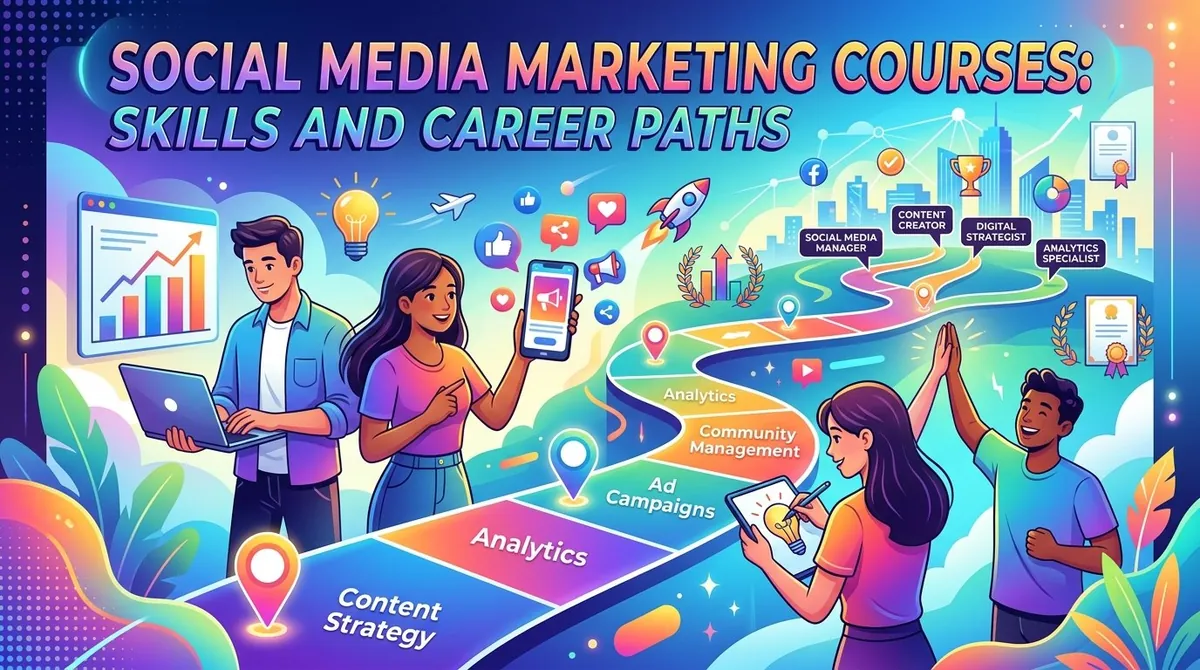
Social media marketing courses can help students, marketers, business owners, and career changers develop skills for using social platforms to reach audiences, build communities, promote products, and measure marketing performance. Training can range from introductory courses covering social media fundamentals to advanced programs focused on strategy, advertising, analytics, and platform management.
Social media marketing has expanded beyond simply creating and publishing posts. Professionals may be responsible for developing strategies, researching audiences, producing content, managing paid campaigns, responding to customers, monitoring performance, and communicating results to stakeholders.
Because courses differ in subject coverage, learning format, practical assignments, and certification requirements, students should examine the curriculum and intended career outcomes before enrolling. Understanding the skills taught and the roles they can support can make it easier to choose an appropriate program.
What Do Social Media Marketing Courses Cover?
Social media marketing courses generally teach how businesses and organizations use social platforms as part of broader marketing strategies.
Common subjects include:
- Social media strategy
- Content planning and creation
- Audience research
- Community management
- Social media advertising
- Analytics and reporting
- Influencer marketing
- Social listening
- Brand management
- Campaign optimization
Hootsuite Academy's Social Media Marketing Certification, for example, covers social media strategy, community building, content marketing, and social advertising.
A broad introductory course can help learners understand how these activities connect, while specialized courses can provide deeper training in particular areas.
Social Media Strategy
Strategy is one of the most important subjects to look for in a social media marketing course. Rather than focusing only on individual posts, strategy training should explain how social activity supports specific business and marketing objectives.
Students may learn how to:
- Define social media objectives
- Identify target audiences
- Select appropriate platforms
- Develop content strategies
- Establish publishing schedules
- Define key performance indicators
- Evaluate campaign results
The choice of platform can depend on the target audience, content format, business objectives, and available resources. A course should therefore explain strategic decision-making rather than assuming that every business should use the same platforms.
Content Creation and Planning
Content is a central part of social media marketing. Courses may teach learners how to develop posts, short-form video, images, stories, and other formats appropriate for different platforms.
Content-related skills can include:
**Content planning:** Developing calendars and organizing campaigns around business objectives, events, launches, or recurring themes.
**Copywriting:** Creating concise messages that communicate value and encourage appropriate actions.
**Visual content:** Understanding basic principles for images, video, graphics, and platform-specific formats.
**Content adaptation:** Adjusting a message for different audiences and social networks instead of publishing identical content everywhere.
Google's digital marketing training also incorporates online customer engagement and the use of digital tools and platforms, illustrating how social media can form part of broader digital marketing education.
Community Management
Social media marketing courses may also cover the ongoing management of relationships with followers and customers.
Community management can involve responding to questions, monitoring comments, identifying recurring customer concerns, and maintaining consistent brand communication.
Students should learn that social media is not solely a publishing channel. It can also function as a customer-service, communication, and relationship-building channel.
Hootsuite's training resources include areas such as publishing, monitoring, engagement, and social media strategy, reflecting the operational skills involved in managing social accounts.
Social Media Advertising
Paid social advertising is another important area for learners interested in performance marketing.
Courses may cover:
- Campaign objectives
- Audience targeting
- Ad formats
- Budgeting
- Bidding
- Creative testing
- Retargeting
- Conversion tracking
- Campaign optimization
Meta Blueprint provides training resources and certification preparation for digital marketing professionals, including advertising on Meta technologies. Its Digital Marketing Associate certification is designed for entry-level marketers, students, and people changing careers.
Paid advertising training is particularly relevant for learners interested in roles involving campaign management, performance marketing, or paid social media.
Analytics and Measurement
Social media professionals need to understand whether campaigns are achieving their objectives. Analytics training can help learners interpret metrics and communicate results.
Common topics include:
- Reach and impressions
- Engagement
- Click-through rates
- Audience growth
- Video performance
- Conversions
- Cost per result
- Return on advertising spend
- Campaign reporting
Hootsuite's platform training includes social metrics and analytics reporting, while its broader training resources cover measuring social activity and campaign performance.
Students should look for courses that explain what metrics mean and how to use them to make decisions rather than simply teaching how to generate reports.
Social Listening and Research
Social listening involves monitoring conversations, mentions, trends, and other signals across social platforms. It can help organizations understand customer opinions, identify emerging topics, and monitor brand discussions.
Courses covering social listening may introduce:
- Brand monitoring
- Competitor research
- Audience sentiment
- Trend identification
- Customer feedback
- Conversation analysis
These skills can complement traditional market research and help social media professionals understand what audiences are discussing.
Skills Developed Through Social Media Marketing Courses
A well-rounded course can develop a combination of technical, creative, analytical, and communication skills.
Communication skills help professionals write content, respond to audiences, and explain campaign results.
Creative skills support the development of compelling visual and written content.
Analytical skills help marketers evaluate campaign performance and identify opportunities for improvement.
Strategic thinking allows professionals to connect social media activities with broader business objectives.
Platform skills help marketers use publishing, advertising, analytics, and management tools.
The U.S. Bureau of Labor Statistics identifies analytical, communication, creativity, decision-making, interpersonal, and organizational skills as important qualities for advertising, promotions, and marketing managers.
Career Paths in Social Media Marketing
Social media marketing training can support several career directions.
Social Media Specialist
Social media specialists may manage day-to-day publishing, content calendars, community engagement, and basic reporting.
Social Media Manager
Social media managers generally take broader responsibility for strategy, campaigns, content, platforms, and team coordination.
Paid Social Specialist
Paid social specialists focus on advertising campaigns, audience targeting, creative testing, budgets, tracking, and optimization.
Content Strategist
Content strategists develop content plans and determine how messaging supports marketing and business objectives.
Community Manager
Community managers focus on audience engagement, customer interactions, conversations, and relationship building.
Digital Marketing Specialist
Digital marketing specialists may combine social media with SEO, email, paid search, content marketing, analytics, and other online channels.
Career progression can eventually lead to broader marketing or management responsibilities. The U.S. Bureau of Labor Statistics reports that marketing managers typically need a bachelor's degree and related work experience, while projected employment for marketing managers is expected to grow 7% from 2025 to 2035.
Certification and Practical Experience
Some social media marketing courses offer certificates or professional certifications. These credentials can document completed training, but students should examine what the credential actually represents.
Meta provides certification pathways through Meta Blueprint, while Hootsuite Academy offers Social Media Marketing Certification covering strategy, community building, content marketing, and social advertising.
Practical experience can complement certification. Learners can build sample content calendars, analyze social campaigns, create advertising exercises, or manage social accounts for projects. A portfolio can provide additional evidence of skills when applying for internships, freelance projects, or full-time positions.
How to Choose a Social Media Marketing Course
Before enrolling, consider:
- 1**Course level** — Choose a program appropriate for your existing experience.
- 2**Curriculum** — Check for strategy, content, advertising, analytics, and community management.
- 3**Practical work** — Look for projects, exercises, case studies, or portfolio assignments.
- 4**Platform coverage** — Determine whether the course covers platforms relevant to your goals.
- 5**Analytics training** — Make sure performance measurement is included.
- 6**Instructor experience** — Review the professional background of instructors.
- 7**Certification** — Understand the assessment and requirements for earning the credential.
- 8**Cost and time** — Compare fees, course length, access period, and workload.
Final Thoughts
Social media marketing courses can provide structured training in strategy, content, advertising, community management, analytics, and other skills used by modern marketing teams. The career opportunities can range from social media and content roles to paid advertising, digital marketing, and broader management positions.
When comparing programs, learners should look beyond the course title and certificate. A curriculum that combines strategic knowledge, practical application, platform skills, and analytics can provide a stronger foundation for continued professional development.
The most appropriate course depends on the learner's current experience and intended career path. Reviewing the curriculum, practical requirements, certification, platform coverage, and overall commitment can help students select training that matches their objectives.
References
- U.S. Bureau of Labor Statistics — Advertising, Promotions, and Marketing Managers
- U.S. Bureau of Labor Statistics — Top Skills by Detailed Occupation
- Meta Blueprint — Digital Marketing Associate Certification
- Hootsuite Academy — Social Media Marketing Certification
- Hootsuite — Social Media Training and Platform Education
- Google — Digital Marketing & E-commerce Career Certificate