


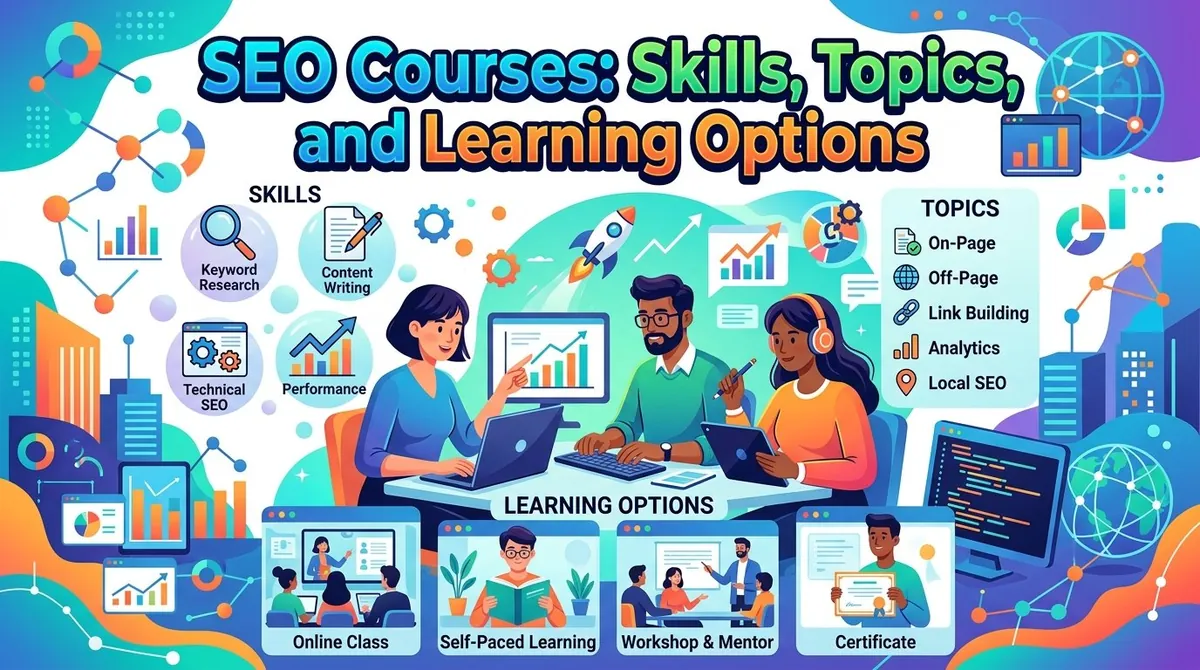
SEO courses can help students, marketers, business owners, content professionals, and career changers develop skills for improving the visibility of websites in search engines. Search engine optimization involves more than selecting keywords. It can include content strategy, technical website improvements, search intent, internal linking, performance analysis, and understanding how search engines discover and interpret web pages.
SEO training is available in many formats, from short introductory courses to specialized programs covering technical SEO, local SEO, content optimization, link building, or SEO tools. Some programs are designed for complete beginners, while others assume previous marketing or website experience.
Because courses differ in depth, curriculum, practical training, and certification, prospective learners should compare what each program actually teaches. The right option depends on whether the goal is to understand SEO fundamentals, manage a website, develop professional SEO skills, or specialize in a particular area.
What Do SEO Courses Cover?
SEO courses generally explain how search engines discover, crawl, index, and present web pages, along with methods for improving a site's search visibility.
Google's SEO Starter Guide describes SEO as helping search engines understand content and helping users discover websites through search. It covers areas including crawling, indexing, content, links, images, and Search Console.
Common SEO course topics include:
- Keyword research
- Search intent
- On-page SEO
- Technical SEO
- Content optimization
- Internal linking
- Link building
- Local SEO
- SEO analytics
- Search performance measurement
A broad introductory course can establish the fundamentals before learners move into more specialized training.
Keyword Research and Search Intent
Keyword research is a common component of SEO education. Courses may teach students how to identify search terms, evaluate their relevance, understand search intent, and organize keywords into content opportunities.
Good training should also explain that keyword research is not simply about finding terms with high search volume. Learners need to understand what users are trying to accomplish when they search and whether a page can realistically satisfy that intent.
Ahrefs' beginner SEO course, for example, includes keyword research, searcher intent, and ranking difficulty as part of its curriculum.
On-Page SEO
On-page SEO focuses on elements that can be managed directly on a webpage.
Courses may cover:
- Page titles
- Headings
- Meta descriptions
- Content structure
- Internal links
- Image optimization
- URL structure
- Content relevance
Google recommends creating useful, well-organized, original, and up-to-date content rather than relying on practices such as keyword stuffing. Its current SEO guidance also emphasizes writing naturally for users and using relevant search terms where appropriate.
Learners should therefore look for courses that teach optimization as part of a broader content and user-experience strategy.
Technical SEO
Technical SEO addresses aspects of websites that affect how search engines access, crawl, understand, and index content.
Courses may introduce:
- Crawling and indexing
- XML sitemaps
- Robots.txt
- Canonicalization
- Redirects
- Site architecture
- Mobile accessibility
- JavaScript SEO
- Structured data
- Page performance
Google's developer documentation recommends making sites accessible to crawlers, using crawlable links, providing appropriate sitemaps, and checking how Google sees individual pages through Search Console.
Technical SEO can become increasingly specialized, so beginners may want to start with fundamental concepts before moving into advanced implementation.
Content and SEO
Modern SEO training should also explain the relationship between content and search visibility. Search engines need to understand what a page is about, while users need content that answers their questions or helps them accomplish a task.
Google's guidance recommends creating content that is helpful, reliable, people-first, readable, organized, unique, and maintained over time.
A course may therefore cover:
- Content planning
- Topic research
- Search intent
- Content structure
- Updating existing pages
- Internal linking
- Content quality
- Measuring content performance
This area can be particularly useful for writers, publishers, and content marketers.
Link Building
Links can play an important role in SEO education. Courses may explain internal linking as well as external links and backlink acquisition.
However, learners should be cautious about programs that promise guaranteed rankings through particular link-building techniques. Google's documentation explains that links can help users and search engines understand related content, while its guidance on third-party SEO services warns against providers that guarantee ranking improvements.
Ahrefs' beginner course includes link-building fundamentals and techniques for evaluating backlinks.
SEO Analytics and Measurement
SEO professionals need to understand whether optimization work is producing useful results. Courses may introduce Google Search Console, analytics platforms, rank tracking, traffic analysis, and reporting.
Google describes Search Console as a tool that helps website owners and SEO professionals understand how their sites perform in Google Search.
Learners should look for courses that explain metrics in context rather than simply teaching how to produce reports. Useful topics can include organic traffic, impressions, clicks, click-through rate, indexing, search queries, rankings, and conversions.
SEO Tools and Platforms
Many courses use SEO software to demonstrate practical workflows. Common tools can support keyword research, technical audits, rank tracking, backlink analysis, competitor research, and reporting.
Semrush Academy currently offers courses covering keyword research, technical SEO, content optimization, backlink opportunities, site audits, and ranking analysis.
Ahrefs Academy also offers beginner SEO training and courses focused on using its tools for keyword research, technical SEO, competitor analysis, and backlink research.
Tool-specific training can be useful, but students should also develop transferable SEO concepts that apply across different platforms.
Types of SEO Courses
Different learners may need different types of training.
Beginner SEO courses introduce fundamental concepts and terminology for people with limited experience.
Technical SEO courses focus more heavily on crawling, indexing, site architecture, JavaScript, structured data, and website implementation.
Content SEO courses emphasize keyword research, search intent, content planning, optimization, and internal linking.
Local SEO courses focus on improving visibility for geographically relevant searches and may cover business profiles, local keywords, citations, and location-based optimization.
Tool-specific courses teach learners how to use platforms for research, auditing, reporting, and ongoing SEO management.
Certification and Course Completion
Some SEO courses provide certificates after learners complete coursework and pass an assessment. Others provide training without a formal credential.
Semrush Academy, for example, offers free courses and certifications, with certification exams available after completing applicable course material.
A certificate can document completed training, but learners should also consider practical experience. SEO is an applied field, and working with websites, datasets, content, or technical audits can provide evidence of skills beyond a course credential.
How to Choose an SEO Course
Before enrolling, consider several factors:
- 1Learning objective — Decide whether the goal is general knowledge, career development, website management, or specialization.
- 2Curriculum — Check whether the course covers the SEO subjects relevant to that goal.
- 3Skill level — Make sure the program matches existing knowledge.
- 4Practical work — Look for exercises, website examples, audits, or projects.
- 5Tools — Determine which SEO platforms are included and whether the skills transfer to other tools.
- 6Instructor experience — Review the instructor's professional and teaching background.
- 7Certification — Understand whether an exam or assessment is required.
- 8Time and cost — Compare course length, access period, fees, and other requirements.
Final Thoughts
SEO courses can provide a structured way to learn search optimization, from keyword research and content development to technical SEO, link building, analytics, and reporting. The range of available programs means learners can choose broad introductory training or specialize in a particular area.
When comparing courses, students should focus on the curriculum, practical application, instructor experience, tools, assessment, and learning format. Training that combines fundamental SEO principles with hands-on work can provide a useful foundation for managing websites, supporting marketing teams, or pursuing professional SEO roles.