


September 25, 2026 • James Mitchell
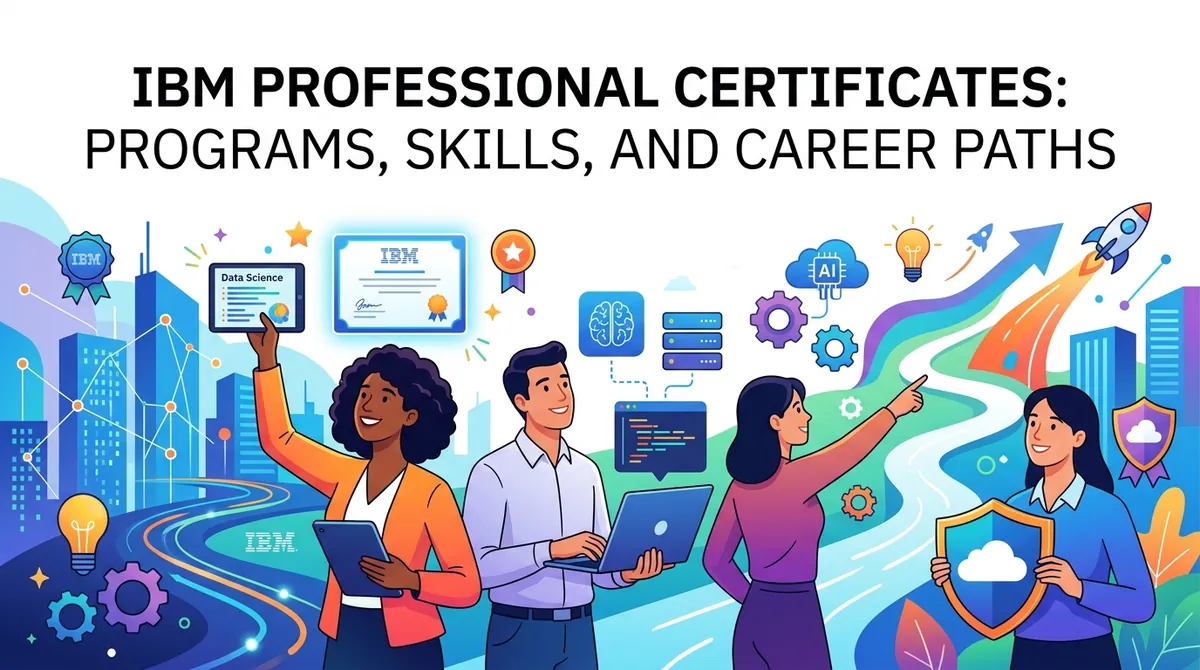
IBM Professional Certificates are online, career-focused programs designed to help learners develop practical skills in technology, data, cybersecurity, software development, business analysis, project management, and other professional fields. Many of the programs are delivered through Coursera and combine structured coursework with hands-on labs, projects, and career preparation.
The programs are generally designed for beginners or early-career professionals and can be completed without a traditional computer science or technology degree. IBM has developed certificates around specific occupational skills, allowing learners to choose a program based on the type of work they want to pursue.
IBM also operates its own broader IBM Training platform, which provides thousands of courses, learning paths, certifications, and digital credentials across technologies including AI, cloud, cybersecurity, data, automation, and mainframes.
What Are IBM Professional Certificates?
IBM Professional Certificates are multi-course online programs built around particular career paths. Rather than focusing on a single software product or isolated technical concept, the programs generally combine multiple skills needed for a specific role.
IBM says its Professional Certificates are designed to take learners from foundational knowledge toward job-ready capabilities. The programs include hands-on labs and projects, while several of IBM's major certificates have also added career guidance, resume advice, interview preparation, and generative AI content.
Programs are delivered at the learner's own pace through Coursera, allowing students to study around existing work or education commitments.
IBM Data Science Professional Certificate
The IBM Data Science Professional Certificate is designed for learners interested in data science and analytical work.
Coursework covers areas such as Python, SQL, data analysis, visualization, machine learning, and practical data science workflows. Projects give learners opportunities to apply these skills rather than relying exclusively on theoretical instruction.
This pathway can support foundational preparation for roles involving data analysis, data science, machine learning, and business analytics.
IBM Data Analyst Professional Certificate
The IBM Data Analyst Professional Certificate focuses more specifically on data analysis.
Learners can develop skills involving spreadsheets, SQL, Python, data visualization, dashboards, and analytical methods. The program is designed to help beginners develop a portfolio of practical work that demonstrates their ability to work with data.
Potential career directions include junior data analyst, reporting analyst, business data analyst, and related entry-level analytical roles.
IBM Data Engineering Professional Certificate
The IBM Data Engineering Professional Certificate focuses on the infrastructure and processes used to collect, transform, store, and manage data.
Topics can include Python, SQL, databases, ETL processes, data pipelines, big-data technologies, and cloud-oriented data engineering concepts.
This path is more technically oriented than a traditional data analyst program and can be relevant to learners interested in building and maintaining data systems.
IBM Full Stack Software Developer Professional Certificate
The IBM Full Stack Software Developer Professional Certificate is designed for people interested in web and application development.
The current program contains 15 courses and is presented as a beginner-level program requiring no prior experience. Coursera currently estimates approximately six months at 10 hours per week.
The curriculum covers technologies including HTML, CSS, JavaScript, React, Bootstrap, back-end development, databases, APIs, and other software-development concepts. The program also incorporates current AI skills.
Projects can provide portfolio material that learners can use when demonstrating development capabilities to prospective employers.
IBM Cybersecurity Analyst Professional Certificate
Cybersecurity is another major IBM Professional Certificate pathway.
The IBM Cybersecurity Analyst Professional Certificate introduces learners to security concepts, network security, Linux, incident response, vulnerability assessment, and other foundational cybersecurity skills.
IBM has specifically identified cybersecurity among its major Professional Certificate programs and has incorporated career guidance and generative AI content into the updated program structure.
Potential career directions include entry-level cybersecurity analyst, security operations, and related IT security roles.
IBM DevOps and Software Engineering
The IBM DevOps and Software Engineering Professional Certificate focuses on modern software delivery practices.
The program can cover software engineering, application development, containers, Kubernetes, CI/CD, DevOps practices, and cloud-native development.
This pathway can be relevant to learners who want to understand both software development and the operational processes involved in building, testing, deploying, and maintaining applications.
IBM Business and Program Management Certificates
IBM's certificate portfolio has expanded beyond traditional technical careers.
Current offerings include IBM Business Analyst, IBM Project Manager, IBM IT Project Manager, IBM IT Scrum Master, and IBM Program Manager Professional Certificates. IBM describes these programs as ways to develop skills for project, program, Agile, and business-analysis roles.
For example, the IBM Program Manager Professional Certificate is currently structured as a seven-course series and is estimated at approximately two months at 10 hours per week. It covers program management, Agile methodologies, stakeholder management, resource allocation, change management, and related skills.
Design, Marketing, and Other Career Paths
IBM also offers Professional Certificates outside traditional data and software roles.
Current programs include IBM UI/UX Designer, IBM Digital Marketing and Growth Hacking, and IBM Front-End Developer certificates. IBM describes these programs as combining practical skills, hands-on experience, projects, and portfolio development.
This broader selection allows learners to use IBM certificates for career paths involving design, marketing, front-end development, and digital business functions.
Hands-On Labs and Projects
Practical experience is an important component of IBM's certificate model.
Courses can include interactive exercises, hands-on labs, assessments, and projects. The goal is to give learners opportunities to apply concepts in realistic scenarios and create work samples that can potentially be included in a portfolio.
For technical programs, this may involve writing code, querying databases, building applications, analyzing datasets, or working with security technologies.
For business-oriented programs, projects may involve planning, analysis, stakeholder communication, or process design.
Career Preparation and AI Skills
IBM has added explicit career-development components to several of its major Professional Certificates.
The enhanced programs include career guidance covering job research, resume development, portfolio creation, networking, and interview preparation. IBM has also added courses explaining how generative AI can be applied within specific professional roles.
This means the programs increasingly combine technical instruction with career-oriented preparation rather than treating the certificate as an academic credential alone.
IBM Professional Certificate Cost
IBM Professional Certificates on Coursera are generally accessed through Coursera's subscription model rather than a separate one-time IBM examination fee.
Coursera currently advertises Professional Certificate programs starting at $49 per month, with a seven-day free trial for eligible programs. The actual cost depends on how long a learner takes to complete the program and the applicable Coursera subscription terms.
Some programs can be completed within a few months, while longer technical programs may take substantially longer. IBM's Full Stack Software Developer certificate, for example, is currently estimated at six months at 10 hours per week.
Pricing and promotional offers can change, so learners should verify the current enrollment terms before starting.
IBM Professional Certificates and Career Development
A Professional Certificate can demonstrate that a learner completed structured training and practical projects, but it does not guarantee employment.
Career outcomes can depend on practical experience, portfolio quality, technical interviews, geographic market, employer requirements, and additional qualifications.
IBM also operates entry-level career programs, apprenticeships, and other workforce-development initiatives. Its careers site highlights opportunities for students, career changers, and people developing technology skills.
Some IBM Professional Certificates have also received ACE credit recommendations, meaning eligible certificate completions can potentially translate into college credit at participating institutions. The applicable programs and institutions should be checked individually.
How to Choose an IBM Professional Certificate
The appropriate program depends on the learner's target career.
Someone interested in analytical work may consider Data Analyst or Data Science. A learner interested in infrastructure and data systems may choose Data Engineering, while an aspiring developer could consider Full Stack Software Development.
Cybersecurity provides a security-focused pathway, while Business Analyst, Project Manager, and Program Manager programs address business and management-oriented roles.
Learners should also consider the amount of hands-on work included, expected completion time, portfolio opportunities, and whether the skills taught match current job descriptions in their target market.
Final Thoughts
IBM Professional Certificates provide structured online pathways into technology, data, cybersecurity, software development, business analysis, project management, marketing, and other professional fields. Many programs combine coursework with hands-on labs, practical projects, career preparation, and increasingly AI-related skills.
The certificates are generally accessible to beginners and can be completed at an individual pace through Coursera. Costs depend primarily on the subscription period and the specific program.
For learners changing careers or building a technology-focused skill set, an IBM Professional Certificate can provide a structured starting point. Combining the certificate with portfolio projects, practical experience, and skills aligned with specific job requirements can create a broader foundation for professional development.
About the Author
James Mitchell is a 36-year-old financial specialist at [website name], focused on navigating volatile markets and developing resilient investment strategies. He helps professionals build diversified portfolios designed to withstand market fluctuations and support sustainable growth.
References
- IBM — Professional Certificate Programs
- IBM — Professional Certificates and Career Preparation
- IBM — IBM Training and Certification
- Coursera — IBM Professional Certificates
- Coursera — IBM Data Science Professional Certificate
- Coursera — IBM Data Analyst Professional Certificate
- Coursera — IBM Full Stack Software Developer Professional Certificate
- Coursera — IBM Program Manager Professional Certificate
- IBM — IBM Business Analyst Professional Certificate
- IBM — IBM Professional Certificates and ACE Credit