


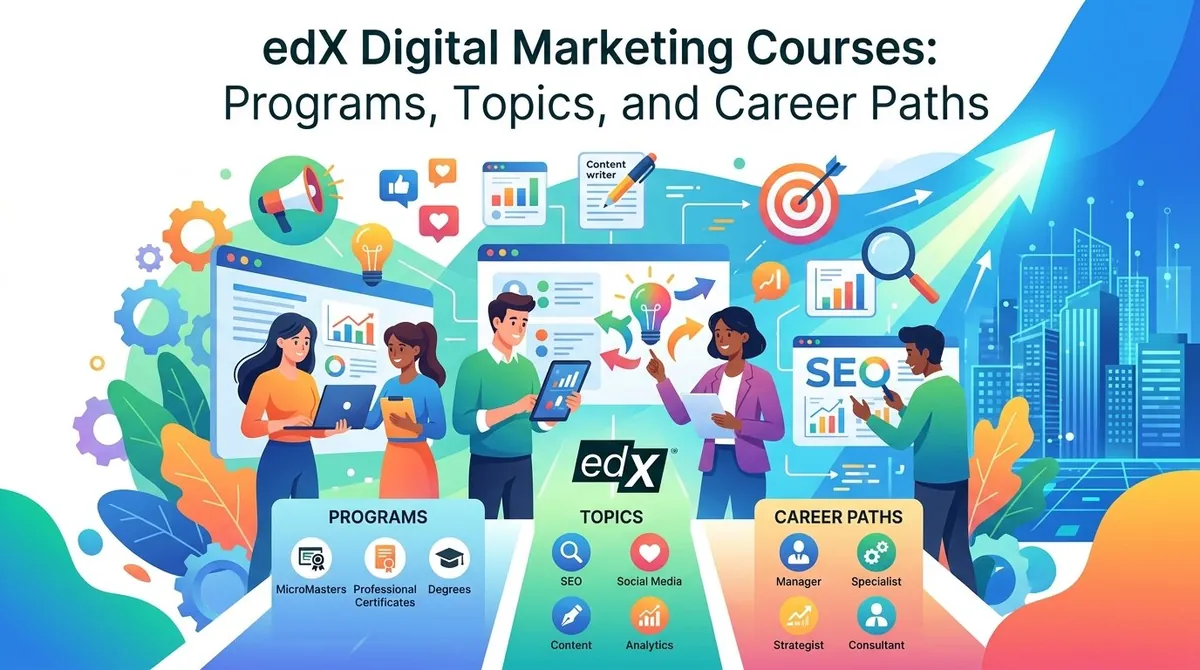
Digital marketing combines marketing strategy with online channels, data, and technology. Businesses use search engines, social media, email, websites, online advertising, and other digital channels to reach audiences and support customer relationships. As these activities become more specialized, professionals often use online education to develop relevant skills.
edX digital marketing courses provide learning options ranging from individual courses and Professional Certificates to executive education and degree programs. The platform offers programs from universities and other institutions, allowing learners to study subjects such as SEO, digital advertising, social media, analytics, content marketing, and digital strategy.
The appropriate program depends on the learner's current knowledge, career objectives, available time, and preferred level of education. Understanding the different program types and the skills they cover can help learners choose an option that fits their professional development plans.
What Are edX Digital Marketing Courses?
edX is an online learning platform offering courses and programs from universities and educational institutions. Its digital marketing catalog includes individual courses, Professional Certificates, executive education programs, and degree-level options.
Courses can cover individual marketing disciplines or combine several areas into a broader curriculum. Current edX offerings include subjects such as:
- Digital marketing strategy
- Search engine optimization
- Pay-per-click advertising
- Social media marketing
- Content marketing
- Marketing analytics
- E-commerce
- Customer analytics
- Artificial intelligence in marketing
Some courses are designed for beginners, while more advanced programs focus on specialized skills or strategic decision-making.
Types of Digital Marketing Programs on edX
Individual Courses
Individual courses provide a focused way to study a specific topic. "edX states that beginner digital marketing courses can typically take around two to six weeks, although the actual duration depends on the course and learning pace."
This format can work well for learners who want to explore digital marketing before committing to a larger program or professionals who want to strengthen one particular skill.
Professional Certificates
Professional Certificates combine multiple courses into a more structured learning path. "According to edX, digital marketing Professional Certificates can typically take around two to three months, depending on the program."
For example, the University of Maryland's Professional Certificate in Digital Marketing includes topics such as omnichannel marketing, marketing analytics, social media strategy, online advertising, and customer value analysis.
Executive Education
Executive education programs are intended for professionals who want more advanced or strategic training. "edX describes digital marketing executive education as covering areas such as SEO, SEM, social media, email marketing, paid advertising, analytics, and marketing strategy."
These programs can be relevant to managers and experienced marketers who want to develop strategic or leadership capabilities.
Degree Programs
edX also provides access to online bachelor's and master's programs. Degree programs generally require a substantially greater time commitment than individual courses or certificates.
For learners seeking a formal academic qualification, a degree can provide broader education in marketing and related business disciplines.
Topics Covered in edX Digital Marketing Courses
Digital Marketing Strategy
Strategy courses examine how businesses use digital channels to achieve marketing objectives. Learners may study customer journeys, marketing funnels, channel selection, positioning, and campaign planning.
The goal is to understand how individual marketing activities fit within a broader business strategy.
Search Engine Optimization and Advertising
SEO courses introduce methods for improving organic visibility in search engines. Topics can include keyword research, content optimization, search intent, and technical considerations.
Digital advertising courses may cover paid search, online advertising ecosystems, campaign planning, and performance measurement. Some edX programs combine SEO and PPC within a broader digital marketing curriculum.
Social Media Marketing
Social media courses explore how organizations use social platforms to reach and engage audiences. Topics can include content planning, audience research, social advertising, community engagement, and measurement.
These skills can apply to social media specialists as well as broader digital marketing roles.
Content Marketing
Content marketing focuses on creating and distributing information that supports marketing objectives. Courses may cover content strategy, audience needs, storytelling, search optimization, and content performance.
Content skills are useful across SEO, social media, email, and broader digital campaigns.
Marketing Analytics
Analytics courses focus on using data to evaluate marketing activities. Learners can study measurement, customer behavior, campaign performance, key performance indicators, and data-driven decision-making.
edX's digital marketing catalog includes programs specifically covering digital customer analytics and marketing analytics.
E-Commerce and Emerging Technology
Some digital marketing programs address e-commerce, user experience, web design, and emerging technologies such as artificial intelligence.
The University of Edinburgh's Digital Marketing Fundamentals Professional Certificate, for example, includes content marketing, e-commerce, user experience, social media, SEO, and PPC.
Career Skills Developed
Digital marketing courses can develop a combination of technical, analytical, and strategic skills.
Marketing strategy involves setting objectives, identifying audiences, selecting channels, and planning campaigns.
Analytics skills help professionals interpret campaign data and evaluate performance.
Content skills include developing marketing messages and planning content for different digital channels.
Advertising skills can involve paid search, social advertising, campaign management, and optimization.
Customer research helps marketers understand audience needs, behavior, and preferences.
These capabilities can overlap across multiple digital marketing roles rather than being limited to one position.
Career Paths in Digital Marketing
Digital marketing education can support several career directions.
**Digital Marketing Specialist** — Supports campaigns across channels such as search, social media, email, and content.
**SEO Specialist** — Focuses on organic search visibility, keyword research, content optimization, and technical SEO.
**Paid Media Specialist** — Manages paid advertising campaigns and analyzes their performance.
**Social Media Specialist** — Develops social content, manages communities, and evaluates social campaigns.
**Content Marketing Specialist** — Plans and develops content designed to attract and engage audiences.
**Marketing Analyst** — Uses data to evaluate marketing performance and identify trends.
**Digital Marketing Manager** — Coordinates digital marketing strategy and may oversee multiple channels, campaigns, and team members.
Responsibilities vary by employer, industry, and level of experience.
How to Choose an edX Digital Marketing Program
Consider Your Career Goal
Start by identifying the role or skill you want to develop. Beginners may benefit from introductory courses, while experienced professionals may prefer specialized or executive education.
Review the Curriculum
Look at the actual course topics and learning outcomes. A program focused on SEO will have different requirements and outcomes from one focused on analytics or digital strategy.
Check the Program Format
Compare individual courses, Professional Certificates, executive education, and degree programs based on time commitment and educational depth.
Consider Practical Learning
Projects, assignments, case studies, and strategy exercises can provide opportunities to apply concepts rather than simply study them.
Review the Credential
Check whether the program provides a certificate and understand what completion requirements apply. The value of a credential also depends on how relevant it is to the role you are pursuing.
Building Experience Alongside Online Learning
Coursework can provide foundational knowledge, but practical experience can help develop applied skills.
Learners can create projects such as SEO audits, content strategies, advertising plans, social media calendars, customer research reports, and marketing dashboards.
These examples can form part of a portfolio and demonstrate the ability to apply marketing concepts to practical problems.
Internships, freelance projects, volunteer marketing work, and workplace assignments can also provide opportunities to develop experience alongside formal education.
Final Thoughts
edX digital marketing courses provide flexible learning options across digital strategy, SEO, advertising, social media, content marketing, analytics, and e-commerce. Learners can choose from individual courses, Professional Certificates, executive education, and degree programs depending on their goals and experience.
When comparing programs, consider the curriculum, provider, learning format, time commitment, credential, practical components, and career relevance. A short course may be appropriate for developing one skill, while a Professional Certificate or degree can provide broader education.
Combining online coursework with practical projects and professional experience can help learners develop both the technical and strategic skills used across modern digital marketing roles.
References
- edX — Digital Marketing Courses and Programs
- edX — Online Marketing Courses and Programs
- edX — Digital Marketing Professional Certificate
- edX — Digital Marketing Executive Education Programs
- edX — Digital Marketing Career Guide
- U.S. Bureau of Labor Statistics — Advertising, Promotions, and Marketing Managers