


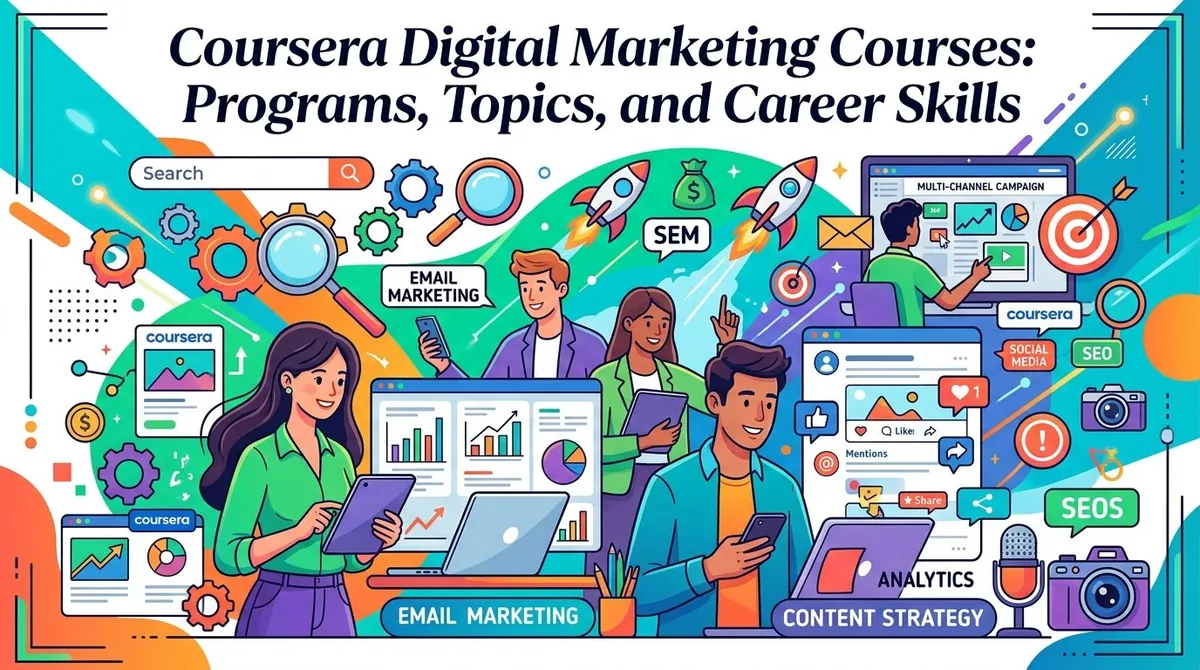
Digital marketing covers a broad range of activities, from search engine optimization and paid advertising to social media, email, content, and analytics. As businesses increasingly use digital channels to reach customers, professionals often look for structured ways to develop practical marketing skills.
Coursera digital marketing courses provide access to courses, professional certificates, and degree programs from universities and companies. The platform includes introductory courses for beginners as well as more structured programs designed to develop skills across several areas of digital marketing.
The right program depends on a learner's experience, career objectives, preferred learning format, and the specific skills they want to develop. Understanding the types of Coursera programs and their subject areas can help learners evaluate available options.
What Are Coursera Digital Marketing Courses?
Coursera is an online learning platform that hosts courses and programs from universities, colleges, and companies. Its digital marketing catalog includes individual courses, Specializations, Professional Certificates, and other learning programs.
Digital marketing courses can cover topics such as:
- Digital marketing strategy
- Search engine optimization
- Social media marketing
- Email marketing
- Content marketing
- Paid advertising
- Marketing analytics
- E-commerce
Course length and structure vary. Some individual courses can be completed relatively quickly, while larger programs combine multiple courses into a longer learning path.
Coursera Digital Marketing Programs
Individual Courses
Individual courses generally focus on a specific topic or skill. Examples can include social media strategy, SEO, content marketing, marketing analytics, or digital advertising.
This format can be useful for professionals who want to develop one particular capability without enrolling in a comprehensive program.
Specializations
Coursera Specializations typically combine several related courses into a structured sequence. A specialization can provide broader coverage than an individual course while remaining focused on a particular subject.
For example, a learner interested in digital marketing analytics could choose a sequence that covers measurement, data interpretation, and marketing applications.
Professional Certificates
Professional Certificates are designed around career-oriented skills. Programs can combine multiple courses and practical activities to help learners build knowledge for a particular job area.
Coursera hosts Professional Certificates from companies and educational institutions, including programs related to digital marketing and e-commerce.
Degree Programs
Coursera also provides access to online degree programs from universities. These programs generally require a significantly greater time and financial commitment than individual courses or certificates.
For learners seeking formal academic credentials, an online degree can provide broader education alongside specialized marketing knowledge.
Topics Covered in Digital Marketing Courses
Digital Marketing Strategy
Strategy courses introduce the role of digital channels within broader marketing plans. Learners may study customer journeys, target audiences, marketing objectives, channel selection, and campaign planning.
Understanding strategy helps connect individual activities such as SEO or social advertising with larger business objectives.
Search Engine Optimization
SEO courses cover methods used to improve a website's visibility in organic search results. Common subjects include keyword research, search intent, on-page optimization, technical considerations, content, and SEO measurement.
SEO education can also introduce tools used to research search performance and analyze competitors.
Social Media Marketing
Social media courses examine how businesses use platforms to reach audiences, publish content, build communities, and measure performance.
Depending on the program, learners may study social media strategy, content calendars, audience research, paid social advertising, and social analytics.
Email Marketing
Email marketing courses focus on using email to communicate with customers and prospects. Topics can include list management, segmentation, campaign planning, automation, personalization, and performance measurement.
Email remains a useful area of study for professionals working with customer retention and lifecycle marketing.
Content Marketing
Content marketing courses teach how organizations plan and distribute useful content to attract and engage audiences.
Learners may study content strategy, audience research, editorial planning, storytelling, search optimization, and content performance.
Marketing Analytics
Analytics courses focus on measuring marketing activity and interpreting results. Topics can include key performance indicators, conversion measurement, reporting, attribution concepts, and data analysis.
Analytical skills are increasingly relevant because marketers need to understand whether campaigns are contributing to business objectives.
Career Skills Developed Through Coursera Courses
Digital marketing education can help learners develop a combination of technical and strategic skills.
Research skills can include keyword research, audience analysis, competitor research, and market research.
Campaign skills may include planning digital campaigns, selecting channels, developing content, managing advertising activities, and coordinating marketing initiatives.
Analytical skills involve interpreting reports, tracking conversions, measuring campaign performance, and identifying areas for improvement.
Communication skills can include writing marketing copy, presenting campaign findings, preparing reports, and communicating strategies to stakeholders.
These skills can apply across different marketing roles rather than being limited to one platform or channel.
Career Paths in Digital Marketing
Digital marketing courses can support preparation for a variety of roles.
**Digital Marketing Specialist** — Works across multiple online marketing channels and may support campaign planning, content, advertising, and analytics.
**SEO Specialist** — Focuses on organic search visibility, keyword research, technical optimization, and content performance.
**Social Media Specialist** — Develops social media content, manages communities, and evaluates social performance.
**Paid Media Specialist** — Manages paid advertising campaigns across search, social, display, or other digital channels.
**Content Marketing Specialist** — Plans and develops content designed to attract, educate, and engage target audiences.
**Marketing Analyst** — Uses marketing data and reporting tools to evaluate campaigns and identify performance trends.
Actual responsibilities vary between employers, and some positions combine several of these functions.
How to Choose a Coursera Digital Marketing Program
Start With Your Career Goal
Identify the role or skill you are targeting before selecting a course. A beginner may benefit from broad digital marketing training, while an experienced professional may prefer specialized education in analytics, SEO, or paid advertising.
Review the Curriculum
Look at the individual courses and learning objectives. A program should cover the subjects most relevant to your intended career path.
Consider the Provider
Coursera programs are offered by different universities and companies. Review who created the course, what credentials are provided, and whether the curriculum matches your objectives.
Check the Format
Many Coursera courses are designed for flexible online learning. Review whether the program is self-paced or includes scheduled activities, projects, assessments, or deadlines.
Look for Practical Projects
Projects and assignments can provide opportunities to apply concepts. Practical work can also become part of a portfolio that demonstrates marketing skills.
Building a Marketing Portfolio
Completing a course is only one way to demonstrate digital marketing knowledge. Learners can strengthen their professional profile by creating practical examples of their work.
A portfolio could include:
- SEO keyword research
- Content strategies
- Social media calendars
- Paid advertising campaign plans
- Email marketing sequences
- Marketing analytics reports
- E-commerce marketing plans
Projects can demonstrate how a learner approaches a marketing problem, develops a solution, and evaluates results.
Certifications and Career Development
A Coursera certificate can document completion of a course or program, depending on the specific offering. Some Professional Certificates are designed to demonstrate career-oriented training in a particular field.
However, certificates are only one component of professional development. Employers may also evaluate previous work experience, communication abilities, analytical skills, portfolios, and demonstrated results.
For career development, learners can combine online coursework with practical projects, internships, freelance work, or professional marketing experience.
Final Thoughts
Coursera digital marketing courses provide flexible learning options across SEO, social media, content marketing, email, advertising, analytics, and digital strategy. The platform offers individual courses as well as broader Specializations, Professional Certificates, and degree programs.
When comparing programs, consider the curriculum, provider, learning format, practical projects, credential, and connection to your career objectives.
For professionals building a career in digital marketing, structured coursework can provide foundational knowledge, while practical projects and real-world experience can help turn that knowledge into applicable skills. A combination of education, hands-on work, and continuous learning can support development as digital marketing channels and tools continue to evolve.
References
- Coursera — Digital Marketing Courses
- Coursera — Digital Marketing Specializations and Certificates
- Google — Digital Marketing & E-commerce Certificate
- U.S. Bureau of Labor Statistics — Advertising, Promotions, and Marketing Managers
- U.S. Bureau of Labor Statistics — Market Research Analysts
- Meta Blueprint — Digital Marketing Training