


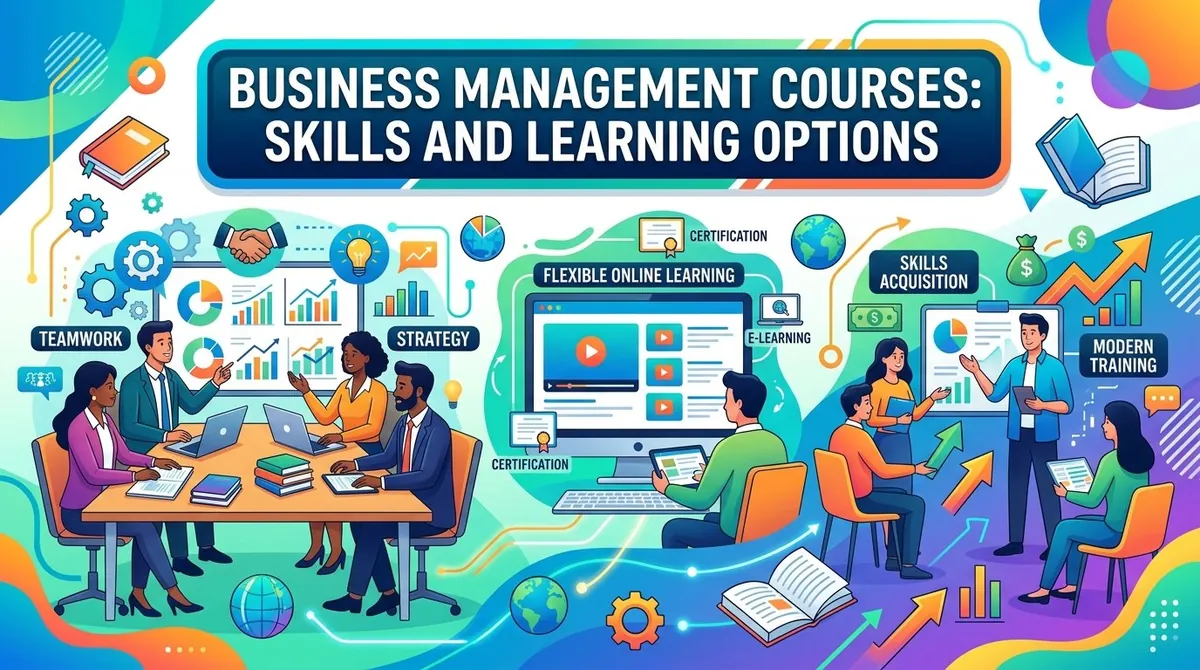
Business management encompasses abilities organizations apply to "plan operations, manage people, allocate resources, and make decisions." As competitive pressures intensify, professionals increasingly pursue formal education to deepen their grasp of management fundamentals and real-world business practices.
Educational pathways include university degrees, professional certificates, online platforms, and specialized workshops. Some programs offer comprehensive introductions to management, while others concentrate on particular domains like leadership, finance, marketing, operations, or project management.
Selecting an appropriate course requires considering your background, career ambitions, learning preferences, and desired competencies. Familiarity with primary subject areas facilitates comparing available options.
What Are Business Management Courses?
These programs teach principles and abilities needed to "manage organizations, departments, teams, and business activities." They range from foundational offerings for newcomers to sophisticated training for seasoned executives.
Typical topics encompass:
- Business strategy
- Leadership and management
- Accounting and finance
- Marketing
- Operations management
- Human resources
- Project management
- Business analytics
- Entrepreneurship
Program depth varies significantly. Brief online modules may cover introductory concepts, whereas university curricula integrate multiple subjects with coursework, projects, and examinations.
Core Skills Developed in Business Management Courses
**Leadership and Team Management**
Management programs typically address how leaders "set objectives, communicate expectations, delegate responsibilities, and support team performance." Instruction explores various leadership philosophies and demonstrates adapting communication approaches to organizational contexts.
**Business Strategy**
Strategy coursework investigates organizational goal-setting and determinations regarding markets, offerings, resources, and competitive positioning. Students examine strategic planning, competitive examination, market evaluation, and results tracking—connecting immediate operational choices with future organizational aims.
**Financial Management**
Although managers may not specialize in accounting, grasping financial data enhances decision-making capabilities. Programs introduce "budgeting, financial statements, costs, revenue, profitability, and financial planning," enabling managers to assess financial ramifications of operational decisions.
**Marketing**
Marketing instruction addresses "customer research, segmentation, positioning, branding, digital marketing, and campaign measurement." Understanding customer identification and value communication across channels benefits managers.
**Operations Management**
Operations studies examine how organizations "produce goods or deliver services efficiently." Material covers process enhancement, supply chain management, quality assurance, capacity determination, and resource distribution—particularly valuable for those overseeing operational enhancement.
**Business Analytics**
Contemporary management demands data interpretation abilities. Analytics programs introduce "methods for using information to identify patterns, measure performance, and support decisions," potentially encompassing spreadsheets, dashboards, visualization, statistical methods, or intelligence instruments.
Types of Business Management Courses
**Introductory Online Courses**
Brief online offerings deliver accessible management introductions. They typically enable self-directed learning and emphasize single areas such as leadership, finance, marketing, or operations. These suit professionals developing particular competencies without extended academic commitment.
**Professional Certificate Programs**
Certificate initiatives offer systematic training surpassing individual courses. They frequently combine multiple subjects alongside assessments or hands-on assignments. Such programs benefit individuals seeking documented credentials while acquiring specific management abilities.
**University Business Courses**
Academic institutions present undergraduate and postgraduate management education, offering "broader academic coverage and may include specialized concentrations." Bachelor's degrees introduce core business subjects; master's and MBA curricula typically deliver sophisticated management and strategic material.
**Executive Education**
Programs targeting working professionals and managers emphasize leadership, strategy, innovation, finance, or organizational change. Duration extends from brief sessions to extensive multi-month experiences.
Online vs. In-Person Learning
Online business courses offer adaptability for those juggling education alongside employment. Delivery incorporates recorded content, synchronous sessions, forum discussions, assignments, and evaluations. In-person settings enable closer instructor-student connection and networking chances. Hybrid arrangements combine digital coursework with physical gatherings.
The optimal approach depends on scheduling needs, learning inclinations, geographic factors, and interaction preferences.
Business Management Courses for Different Career Goals
Management requirements vary by aspiration. Operations managers benefit from operations, supply chain, process enhancement, and analytics training. Marketing management pursuit emphasizes marketing strategy, consumer insights, digital channels, and analytics. HR management candidates study organizational dynamics, employment regulations, talent strategies, and leadership. Entrepreneurship-focused learners prioritize business planning, finance, marketing, operations, and venture progression. Current organizational managers may select courses addressing particular duties like strategic direction, team oversight, or financial decision-making.
How to Choose a Business Management Course
Multiple considerations help when evaluating options.
**Define the Learning Objective**
Identify which capability or understanding gap the program should bridge. Foundational management instruction suits those establishing a base; seasoned managers typically need concentrated specialization.
**Review the Curriculum**
Scrutinize course summaries and educational aims. Prioritize subjects matching your intended professional direction.
**Consider the Provider**
Educational institutions, professional associations, technology enterprises, and learning platforms deliver business courses. Evaluate reputation, instructors, subject matter, and certification approaches.
**Check the Learning Format**
Confirm whether delivery is self-directed, instructor-facilitated, synchronous online, face-to-face, or combined. Note anticipated weekly effort and completion period.
**Look at Practical Components**
Projects, case examination, simulations, and tasks permit applying management principles versus theoretical study solely.
**Review Cost and Requirements**
Compare fees, materials, testing expenses, prerequisites, and duration before committing.
Building Practical Management Skills
Although courses offer structured instruction, workplace application develops competencies. Professionals advance learning by implementing theories in work projects, examining business scenarios, directing team efforts, or engaging cross-departmental initiatives. Strengthening interpersonal, analytical, problem-resolution, and judgment capabilities enhances educational study.
Documenting accomplished projects and quantifiable achievements aids development. While portfolios aren't universally required, demonstrating applied management concepts helps establish competency.
Certifications and Career Development
Certain programs award certificates or professional designations. Their importance depends on issuer, content area, evaluation rigor, and professional relevance. Credentials document systematic learning completion, though employers simultaneously consider education, background, managerial capability, and achieved business outcomes.
Professionals reasonably view certifications as continuing development components rather than experience replacements.
Final Thoughts
Business management programs offer training in "leadership, strategy, finance, marketing, operations, analytics, and entrepreneurship." Alternatives span brief digital offerings, professional credentials, university curricula, and executive workshops.
Course selection requires considering educational aims, subject material, institutional source, delivery methodology, hands-on elements, investment, and professional alignment. Targeted programs address distinct competency shortages; comprehensive offerings establish multidisciplinary foundations.
Merging systematic instruction with practical workplace application enables professionals transforming management concepts into applicable abilities for operations, problem-solving, team direction, and organizational advancement.